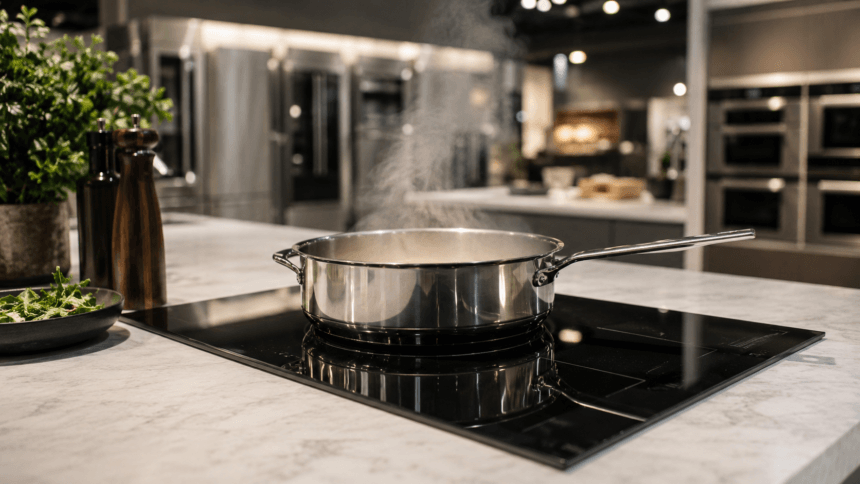
Induction cooking is moving from policy debate to product strategy. The category now has a stronger business case, a clearer indoor-air-quality tailwind and new rebate support in some state programs. What it still does not have is an easy sales-floor conversation.
The promise is straightforward: induction can heat quickly, avoid open combustion in the kitchen and appeal to consumers who want cleaner, more precise cooking. The challenge is just as practical: electrical capacity, cookware compatibility, higher upfront cost and a customer base that often still thinks “electric cooking” means old coil burners.
That tension is why 2026 is shaping up as an important year for induction. The market momentum is real, but it will not convert into mass adoption unless manufacturers, retailers, builders and installers solve the practical barriers that still appear before checkout.
The business case is building
Induction’s business story is no longer limited to policy incentives or climate marketing. Premium kitchen brands, commercial foodservice buyers and specialty startups are treating the category as a growth platform.
Induction Hardware, a founder-owned startup, launched its 48-inch professional induction range at KBIS 2026 and won a Best of KBIS sustainability award. Entrepreneur reported in June that the company was seeing 150% month-over-month growth after its launch. That figure is company-reported and early-stage, but it shows the level of interest around premium induction when the product is positioned as performance hardware rather than a compromise. Entrepreneur Induction Hardware
Commercial cooking is also moving. Technavio has projected the commercial induction cooktop market will grow by $6.09 billion at a 7.73% compound annual growth rate from 2023 to 2028. More recent market estimates vary, but they point in the same direction: induction is gaining share as foodservice operators weigh energy efficiency, ventilation costs, speed, kitchen heat and worker comfort. Technavio
More Read
The household market is also drawing bullish projections. Coherent Market Insights estimated the household induction cooktops market at $29.86 billion in 2026 and projected it would reach $61.99 billion by 2033, a compound annual growth rate of 11%. Those forecasts should be read as market estimates, not guaranteed demand, but they explain why manufacturers are putting more attention on induction ranges, cooktops and hybrid kitchen packages. Coherent Market Insights
The health data is a tailwind
The clearest nonbusiness tailwind is indoor air quality. Stanford researchers found that gas and propane stove combustion can emit benzene, while induction cooktops emitted no detectable benzene in the study. The Stanford report said benzene emitted from gas and propane combustion could move through homes and, in some cases, raise bedroom concentrations above health benchmarks for hours after the stove was turned off. Stanford
The peer-reviewed study reported detectable and repeatable benzene emissions from natural gas and propane stoves and found no detectable benzene from induction cooktops tested. It also found that benzene from stove combustion could migrate beyond the kitchen. Environmental Science & Technology
Appliance News previously reported on the benzene study and its implications for ventilation design. This induction story is different. It asks what happens when the health-data conversation becomes a product-selling point for electric cooking.
The answer is not that every customer will buy induction for health reasons. Many will not. But the safety and indoor-air-quality case gives retailers a new way to explain the category beyond speed and sleek surfaces. It also gives builders, remodelers and property owners another reason to evaluate induction where ventilation, combustion concerns or electrification plans are already part of the project.
Rebates help, but do not solve the sale
Federal home energy rebates can help lower the upfront price for income-qualified households in states where programs are active. DOE’s consumer home-upgrades page says an ENERGY STAR-certified induction cooktop, electric stove, cooktop, range or oven may be eligible for a Home Electrification and Appliance Rebate of up to $840, or for Home Owner Managing Energy Savings rebates tied to larger energy-saving projects. DOE
That support matters, especially as induction products still carry higher upfront prices in many retail comparisons. But the rebate conversation is narrower than many shoppers expect. Rebates are state-administered, income-based and subject to program rules. They may require approval before purchase, qualified products, participating contractors or proof of existing equipment.
Appliance News recently drafted a sales-floor guide to DOE rebate guidance, including the importance of checking state status and avoiding blanket promises. That caution applies directly to induction. A salesperson should not say, “You get $840 off,” until the state program, income eligibility, product eligibility and timing rules are verified.
Rebates can move a customer who is already leaning toward induction. They are less effective when the customer also needs new wiring, a panel upgrade or cookware replacement. That is where the sale becomes a project, not a product.
- Business momentum: Premium launches, startup activity and commercial forecasts are giving induction more visibility.
- Safety tailwind: Induction avoids combustion in the kitchen and emitted no detectable benzene in the Stanford study.
- Rebate support: Some income-qualified households may qualify for up to $840 through state-administered programs.
- Sales barrier: Electrical capacity, cookware compatibility and upfront price still slow adoption.
The electrical capacity problem
The first sales-floor barrier is power. A customer replacing an electric smooth-top range with an induction range may already have an appropriate circuit, though specifications still need to be checked. A customer replacing a gas range may not.
That difference can change the sale immediately. A gas-to-induction project may require a dedicated 240-volt circuit, wiring work, panel capacity review, permit requirements and coordination with an electrician. In older homes, the cost of electrical work can rival or exceed the product price difference between gas and induction.
Retailers should screen for that before quoting a final installed price. The question is not only, “Do you want induction?” It is, “What is currently installed, what electrical service is available, and who will verify the circuit before delivery?”
Portable induction burners can help some renters or cautious buyers try the technology without a full kitchen conversion. They do not replace the full-range conversation, but they can reduce fear of the cooking experience and create a lower-cost entry point.
Cookware is still a real objection
Induction also requires compatible cookware. Many stainless steel and cast iron pans work, but aluminum, copper, glass and some older stainless cookware may not unless they have a magnetic base. The magnet test remains the simplest sales-floor demonstration: if a magnet sticks firmly to the bottom, the cookware is likely compatible.
That objection is more than a talking point. A customer who has to replace a favorite cookware set may see induction as a hidden-cost purchase. Retailers can reduce that friction by bundling a starter pan set, showing compatible cookware options and explaining the test before the customer gets home.
Manufacturers also have a role. Product pages should clearly explain cookware requirements, electrical requirements and installation conditions. Too many induction listings still emphasize speed and control while leaving compatibility and power questions buried in manuals.
The best sales experience is tactile. A live demo lets customers boil water quickly, simmer without flame cycling and see the cooktop surface cool faster than they expect. Without a demo, induction can sound like an efficiency lecture. With a demo, it becomes a performance product.
Upfront cost still decides the sale
Induction’s biggest commercial challenge is still price. Entry-level induction has become more available, but many full-size induction ranges and premium cooktops remain more expensive than conventional electric or gas alternatives. When electrical work is required, the installed cost gap widens.
That is why the business case cannot rely only on long-term benefits. Retailers need to translate induction into near-term customer value: faster cooking, easier cleanup, less kitchen heat, no combustion at the burner and, where eligible, rebate support. For builders, the value may include modern kitchen positioning, code or incentive alignment, reduced combustion concerns and simplified ventilation strategies in some designs.
For manufacturers, the path to volume depends on bringing induction into midmarket packages without making the product feel stripped down. The premium buyer may pay for a 48-inch pro-style induction range. The mass-market buyer needs a credible 30-inch range that works with existing kitchen layouts, has clear controls and does not require a confusing installation process.
The category will also need better post-sale support. Induction service requires familiarity with power electronics, sensors, controls and sometimes more complex diagnostic workflows than conventional cooking appliances. If adoption rises faster than technician training, early reliability complaints could slow momentum.
What retailers should say now
The sales-floor message should avoid extremes. Induction is not just a political appliance, and it is not a universal drop-in replacement. It is a high-performance cooking platform that can reduce combustion-related indoor pollutants, but it requires the right electrical setup, cookware and budget.
A better script is: “Induction gives you the speed and control many people like about gas without an open flame. Before we quote it, we need to check your electrical setup, your cookware and whether your state has any rebate support.”
That answer keeps the sale honest. It frames induction as performance, not sacrifice. It also prevents the two failures that create customer frustration: selling a product the home cannot easily support, or promising a rebate the customer cannot use.
Retailers should also train staff to segment buyers. Health-conscious families may respond to the indoor-air-quality case. Serious cooks may respond to control and speed. Remodelers may respond to clean design and no open flame. Budget buyers may respond only if rebates, promotions or lower installed cost close the gap.
Why 2026 is different
Induction has had years of advocacy, but 2026 is different because several forces are arriving at once. Product design is improving. Premium brands are building around induction instead of treating it as a niche option. Commercial kitchens are evaluating it for operating reasons. Health data has given the category a sharper contrast with gas. Rebates can help some buyers cross the cost barrier.
The remaining obstacle is execution. The category will not break through simply because studies, startups and rebate pages say it should. It will break through when a customer can understand the product, verify the home can support it, afford the installed price and trust that service will be available if something fails.
That makes induction a test of the appliance industry’s ability to sell a new technology honestly. The business momentum is there. The health-data tailwind is there. The policy support is there in some states. The sales-floor challenge is now the difference between curiosity and conversion.