For most of the refrigerator’s history, ice was a utility: frozen water in roughly square pieces, dumped into a glass. LG now talks about it as a “solution,” which sounds like marketing until you look at how much engineering the appliance industry has begun devoting to the shape, texture, speed and location of frozen water.
LG’s current refrigerator strategy spans conventional cubes, crushed ice, large round Craft Ice and other formats aimed at different drinks and household habits. The company is using the variety to turn the ice maker from a checkbox on a refrigerator specification sheet into a feature buyers might choose a model around.
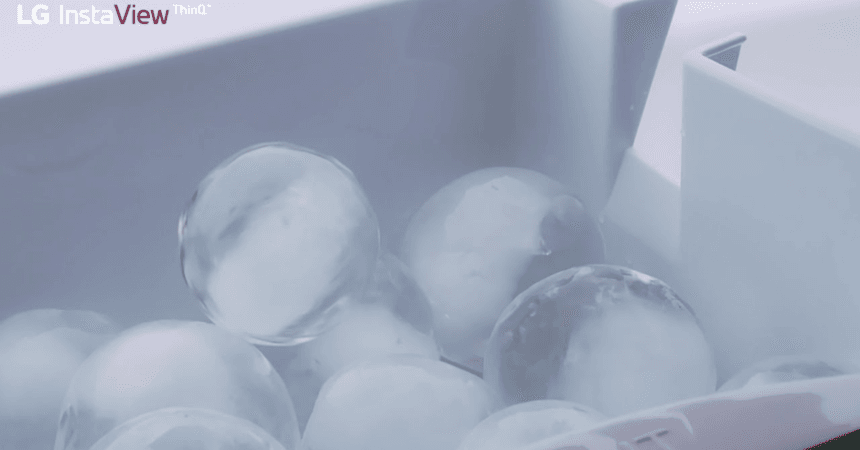
The idea is not new. What is notable is how far it has traveled since 2019, when LG introduced refrigerators that automatically produced two-inch spherical Craft Ice. A novelty once attached to a few premium InstaView models expanded into dozens of refrigerators and helped normalize a broader appliance-industry competition over ice itself.
In 2019, Round Ice Was the Headline
LG’s August 2019 launch announcement described four InstaView refrigerators that could automatically make two-inch round ice in the freezer while also dispensing conventional cubed and crushed ice through the door. LG called it an industry first.
The pitch was borrowed from bars and restaurants, where a large piece of ice has an obvious visual appeal and a practical one: less surface area relative to volume can slow dilution compared with many small pieces of ice under similar conditions.
What made LG’s approach appliance-worthy was automation. A silicone mold can make a round piece of ice cheaply. A refrigerator that repeatedly freezes, releases and stores spheres without the owner filling molds is a mechanical system that has to work unattended for years.
More Read
LG quickly widened the bet. In 2020 it announced Craft Ice on 15 additional models; by 2021 the company said more than 30 premium refrigerators would offer cubed, crushed and round ice. Today, LG still markets a dedicated Craft Ice refrigerator lineup.
Why Ice Became a Refrigerator Feature Worth Competing Over
Refrigerators have a mature core job: keep food cold. That makes visible differentiation difficult. Compressors can become more efficient and temperature control can improve, but those advances are not always obvious to a shopper standing in a store.
Ice is different. A customer can see it, touch it and immediately understand the distinction between a standard crescent, a large sphere and a soft chewable piece. It also connects a major appliance to beverage trends that consumers encounter at coffee shops, convenience stores and cocktail bars.
That helps explain why LG executives now describe an “ice solution” built around hygiene, suitability and convenience rather than merely an ice maker. The company’s recent promotional material points to different shapes for different uses: slower-melting ice for drinks meant to be sipped, crushed ice for rapid cooling and smaller or chewable forms for café-style beverages and everyday hydration.
The language is promotional, but the underlying consumer behavior is easy to recognize. A household that buys bags of nugget ice or keeps specialty molds in the freezer is already assigning value to ice beyond temperature.
Every New Ice Shape Adds Engineering
There is a less glamorous side to the refrigerator ice race: each added ice format introduces hardware, water handling and control logic into one of the appliance’s most failure-prone subsystems.
A conventional automatic ice maker already needs a water valve, fill path, mold, temperature sensing and a mechanism to release ice. Door dispensers add chutes, motors, switches and seals. Specialty ice can add different molds, release cycles, storage arrangements and software settings.
LG’s own current product pages illustrate the tradeoff. One Craft Ice model automatically makes batches of three spheres per day and offers a faster Craft Ice+ setting through the ThinQ app; LG cautions that ice shape and clarity can vary with settings, household use and water supply.
For service technicians, that means a complaint as simple as “the ice is wrong” can involve water pressure, freezer temperature, sensors, valves, software, a mechanical ice maker or the household’s expectations about what the finished ice should look like.
A Premium Feature Can Become a Mainstream Expectation
The trajectory of Craft Ice follows a familiar appliance pattern. A feature begins on expensive showcase models, gives salespeople an easy demonstration, then migrates down or across the lineup if buyers respond.
LG has already shown that a conspicuous refrigerator feature can endure. Appliance News reported this month that LG’s InstaView refrigerator platform surpassed 5.3 million global sales after a decade. The knock-to-see glass panel began as an attention-grabbing premium idea and became a recognizable part of the company’s refrigerator identity.
Ice is following a similar path, but with an important difference: unlike a window in a door, an ice system has to make something repeatedly. The more central it becomes to why a customer chose the refrigerator, the more consequential a slow, noisy or failed ice maker becomes to the ownership experience.
What Buyers Should Ask Before Choosing a Refrigerator for Its Ice
Consumers comparing specialty-ice refrigerators should look past the shape shown in the showroom. Production rate matters. So does bin capacity, because a beautiful ice type that takes hours to replenish can disappoint a household entertaining a crowd.
- How much specialty ice does the refrigerator make in 24 hours?
- Where is the ice maker located, and how much freezer or fresh-food space does it consume?
- Does faster production change the appearance or clarity of the ice?
- Can the ice maker be serviced or replaced without major sealed-system work?
- What does the warranty cover if the specialty-ice system stops working?
Those questions are less photogenic than a glass filled with perfectly round ice. They are also more likely to determine whether the feature remains delightful after the first summer.
Ice Is Becoming Part of Refrigerator Design Language
The refrigerator business is increasingly crowded with features that have little to do with basic refrigeration: cameras, screens, transparent doors, convertible drawers and multiple ice makers. Manufacturers use them because the basic rectangular cold box is difficult to differentiate at a glance.
LG’s ice strategy shows how small that differentiating feature can be. The company did not invent frozen water or the spherical ice mold. Its contribution was to automate a specialty form and make it part of the refrigerator’s daily behavior.
Seven years after the first Craft Ice launch, the more revealing change is not that a refrigerator can make a round piece of ice. It is that appliance companies now expect shoppers to care which piece of ice comes out.