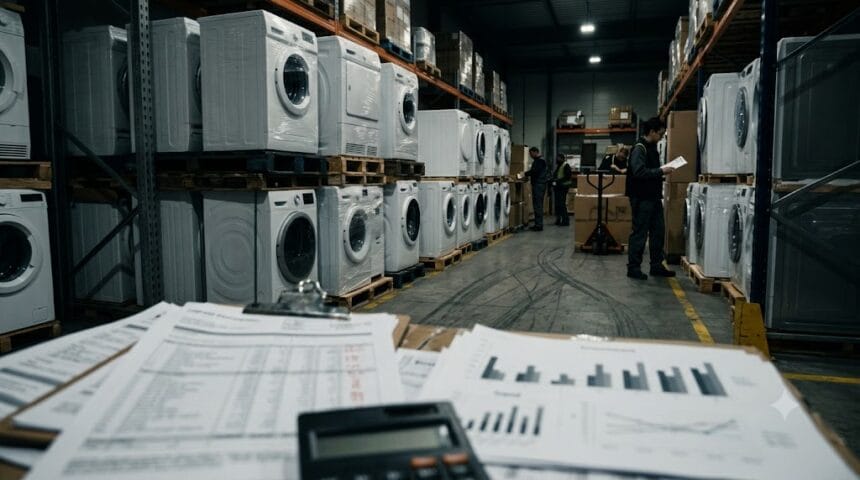
Whirlpool Corp. spent much of the past year arguing that a stronger tariff wall around imported appliances would reward its U.S. manufacturing footprint. Instead, the company is now facing the opposite kind of reckoning: a suspended dividend, sharply reduced profit guidance, expensive refinancing and a stock price sitting near levels last associated with the post-financial-crisis period.
The collapse did not come from one shock. It came from three pressures arriving together. Tariffs raised Whirlpool’s strategic hopes and some of its costs. Consumers delayed discretionary appliance purchases as inflation fears, weak housing activity and the Iran war weighed on confidence. Debt maturities then forced the company to refinance older, cheaper obligations with longer-dated secured borrowing.
For appliance retailers, servicers, distributors and suppliers, Whirlpool’s current position is more than a stock-market story. It is a warning about how quickly a manufacturer’s public strategy can break down when pricing power, consumer demand, factory utilization and balance-sheet flexibility all weaken at once.
The ‘net winner’ thesis met the cash-flow test
Whirlpool’s tariff argument was simple. The company produces a larger share of the major appliances it sells in the United States domestically than many competitors, giving it a potential advantage if import costs rise.
In its 2025 annual report, Whirlpool said, “We will be a net winner in the new tariff environment,” pointing to its U.S. production base and its claim that 80% of the major appliances it sells in the U.S. are produced domestically. Whirlpool 2025 annual report
That message was still alive in 2026. In May, Chairman and CEO Marc Bitzer said Whirlpool was “structurally positioned to win” with its American-made products as Section 232 changes moved in favor of domestic manufacturers. Whirlpool first-quarter results
More Read
But the cash-flow test is harder than the policy argument. A tariff advantage only matters if the company can preserve margin, keep enough demand, avoid losing share to lower-priced rivals and prevent higher input costs from overwhelming the benefit of domestic production. Whirlpool has not yet shown that it can do all four at the same time.
Whirlpool itself acknowledged the tension in 2025. During the third-quarter earnings call, management said tariffs had been a headwind to the business so far that year and had affected margins by about $100 million, even as the company continued to argue that it would be a long-term winner from trade policy. Whirlpool third-quarter 2025 transcript
The guidance cut was the turning point
The most visible break came with Whirlpool’s first-quarter 2026 results. The company reported net sales of $3.27 billion, down 9.6% from a year earlier, and a net loss available to common shareholders of $85 million. Ongoing EBIT fell to $44 million from $214 million a year earlier, and ongoing EBIT margin dropped to 1.3% from 5.9%.
Whirlpool cut its full-year 2026 ongoing earnings guidance to $3 to $3.50 per diluted share. Earlier 2026 guidance had called for ongoing earnings of about $7 per diluted share and GAAP earnings of about $6.25. That was not a small revision. It was an admission that the company’s margin-recovery plan had run into a demand shock and a cost problem at the same time.
The company also lowered its full-year net sales outlook to about $15 billion, down from a previous range of $15.3 billion to $15.6 billion. It now expects North American industry demand to decline about 5% for the year.
The stock market response reflected that reset. Reuters reported that Whirlpool shares hit a 14-year low after the company cut targets and suspended the dividend. Whirlpool’s own stock page showed a June 23 close of $36.19 and a June 30 close of $39.42; the stock was around $40 on July 1. A historical data service showed Whirlpool’s highest 2025 close at $123.66 on Jan. 27, meaning the share price had fallen roughly two-thirds from that early-2025 peak. Whirlpool stock information
The dividend was the accountability moment
The dividend suspension cut through the strategy language. Whirlpool said it was suspending its common stock dividend and would prioritize more than $900 million of debt reduction in 2026. For income investors, that ended the central reason many had continued to hold the stock despite years of operating pressure.
The Wall Street Journal described the decision as the end of a roughly 70-year dividend streak. Whirlpool had already reduced the payout in 2025, when Reuters reported that the company cut its annual dividend to $3.60 per share from $7 while lowering its 2025 profit forecast. Reuters
That sequence matters. The first dividend cut told investors Whirlpool needed more room. The suspension told them the room was gone. For a company that had positioned itself as a beneficiary of industrial policy, the move was an unusually clear sign that tariffs had not translated into enough operating cash to protect shareholders from a balance-sheet reset.
The decision may be financially rational. Reducing debt can improve flexibility, especially as refinancing costs rise. But it also raises a harder question: If the domestic manufacturing advantage was supposed to create a durable margin moat, why did the company have to choose debt reduction over a dividend that had survived far worse macroeconomic cycles?
Consumers are repairing, not upgrading
The demand problem is the second part of the trap. Tariffs can raise the price umbrella for domestic production, but they cannot force consumers to replace a working dishwasher, refrigerator or laundry pair.
Whirlpool said U.S. appliance industry demand declined 7.4% during the first quarter and 10% in March. On its earnings call, executives said discretionary demand fell about 15%, while replacement purchases tied to broken appliances remained comparatively stable. The company tied the deterioration to weak housing demand, severe winter weather, tariff uncertainty and consumer worries about inflation and the Iran war.
That mix is particularly damaging for an appliance maker. Replacement demand keeps service calls and lower-end purchases moving, but discretionary replacement is where consumers trade up, builders package kitchens and retailers sell premium suites. If consumers decide to wait, tariffs and price increases can reinforce the delay.
Whirlpool said spare-parts and repair operations were among its strongest businesses during the quarter. That is useful for parts revenue, but it is also a warning sign for new-product demand. When households repair instead of replace, appliance manufacturers lose the volume and mix benefits they need to cover factory costs, fund new platforms and support premium brand positioning.
- Retailers face a tougher sell when shoppers are price-sensitive and willing to keep older appliances running.
- Servicers may benefit from repair demand, but profitability still depends on parts availability, labor rates and warranty authorization.
- Distributors must plan around slower turns, uncertain promotions and potential model transitions tied to cost cuts.
- Suppliers may see lower volumes even as manufacturers demand price relief and faster productivity gains.
Debt turned pressure into constraint
The third thread is refinancing. Whirlpool recently moved to buy back near-term euro-denominated notes due in 2026 and 2027 after receiving tenders for about €912 million of the €1.1 billion outstanding. At the same time, it prepared $2 billion of longer-dated senior secured second-lien notes due in 2031 and 2034. Whirlpool tender results
That move buys time. It does not remove the strategic problem. The older notes carried rates of 1.25% and 1.10%. The new secured notes carry stated rates of 7.5% and 7.875%. The instruments differ in currency, maturity, security and market conditions, so the rates are not a perfect comparison. But the direction is clear: Whirlpool is extending maturities in a more expensive capital environment.
Higher financing costs matter because the company is trying to do several expensive things at once. It is pushing cost reductions, investing in U.S. manufacturing, refreshing products, responding to tariff changes, supporting parts and service infrastructure, and defending retail relevance in a weak market. The debt load narrows the margin for error.
That is why the dividend suspension and refinancing belong in the same story. The dividend was not suspended in isolation. It was sacrificed so Whirlpool could preserve cash and reduce debt while trying to rebuild margins in a shrinking appliance market.
U.S. manufacturing is an asset, but not a shield
Whirlpool still has one of the most significant domestic manufacturing footprints in the appliance industry. That matters. U.S. production can reduce dependence on finished-goods imports, support faster regional response and give the company a stronger policy argument than rivals that rely more heavily on overseas plants.
But domestic production is not a shield against lower demand, underused factories or imported components. Whirlpool says 80% of the major appliances it sells in the U.S. are produced domestically, but it also acknowledges that products assembled in the U.S. use domestic and imported components. Tariffs can therefore support the selling price of imported finished goods while still increasing the cost of some inputs.
Recent reporting has also complicated the political story. Reuters reported that Whirlpool’s Amana, Iowa, refrigerator plant has lost more than half of its roughly 2,000-person workforce within a year and that another 288 jobs are set to be eliminated, even as the company invests in Ohio and describes tariff policy as supportive of domestic manufacturing. Reuters
That does not prove tariffs caused the job cuts. Whirlpool has cited modernization, technology upgrades and future investment needs. But the optics are difficult: a company that argued tariffs would reward its U.S. manufacturing base is cutting jobs at a flagship Iowa facility while investors absorb a lost dividend and a sharply lower stock price.
The accountability question
Whirlpool’s challenge is not that management failed to identify the right strategic pressure points. The company has been talking about tariffs, domestic manufacturing, cost actions, product refreshes, debt reduction and replacement demand for months. The problem is that those pieces have not added up to a resilient strategy.
A “net winner” from tariffs should have visible pricing power. Whirlpool is raising prices, but the demand environment is weak enough that higher prices may push more households toward repair or delay. A domestic manufacturer should benefit from policy favoring U.S. production. Whirlpool may still benefit over time, but it is also absorbing tariff-related costs, lower volume and job-cut scrutiny. A dividend stalwart should be able to carry shareholders through a downturn. Whirlpool instead suspended the dividend to prioritize debt reduction.
The company now has to prove that the tariff thesis was delayed rather than broken. That proof will not come from slogans about American-made appliances. It will come from margin recovery, market-share stability, successful price realization, manageable financing costs, clearer parts and service support, and evidence that consumers are again willing to buy rather than simply repair.
For the appliance industry, Whirlpool’s tariff trap is a larger lesson. Industrial policy can change the playing field, but it cannot by itself create consumer demand, erase debt costs or make a high-fixed-cost manufacturing network efficient when volumes fall. Whirlpool may still be a long-term beneficiary of domestic production. Right now, however, the market is treating it less like a protected winner and more like a manufacturer caught between its policy bet and the economics of the appliance aisle.