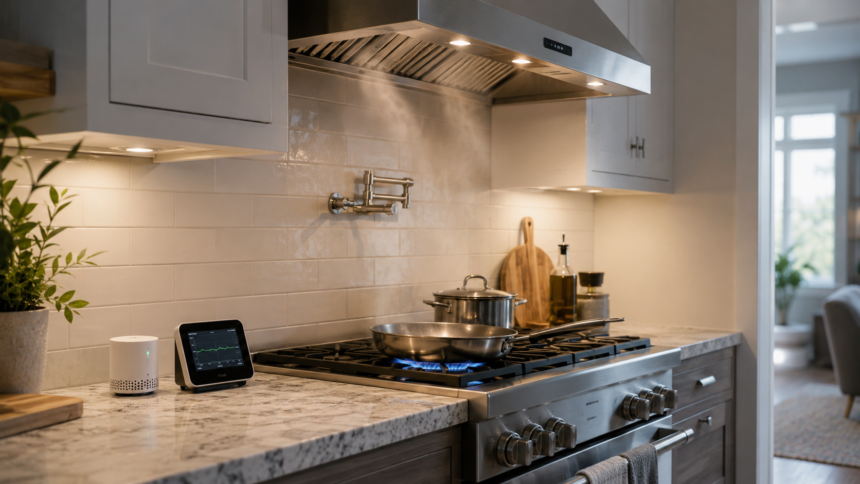
A peer-reviewed study of 87 stoves found that burning natural gas or propane can produce benzene inside homes, adding a consequential new finding to the appliance industry’s debate over cooking fuels, ventilation and indoor air quality. The research does not establish that every gas stove creates the same exposure or calculate the health risk for a typical household, but it does identify the flame itself as a potentially significant source of a known carcinogen.
Published June 15, 2023, in the American Chemical Society journal Environmental Science & Technology, the study examined natural gas, propane, electric coil, radiant and induction cooking appliances in homes across California and Colorado.
The researchers reported that gas and propane burners and ovens produced substantially more benzene than the electric alternatives tested. Benzene generated in kitchens also moved into other rooms, with elevated concentrations persisting in some bedrooms for hours after an oven had been turned off.
Combustion is the new ventilation question
The findings broaden the indoor-air discussion surrounding cooking appliances. Previous research has documented nitrogen dioxide, carbon monoxide, formaldehyde and particulate pollution associated with cooking and gas combustion. This study focused on benzene formed while gas and propane were burning.
Benzene is classified as a human carcinogen. That hazard classification does not, by itself, quantify the cancer risk created by cooking a meal. Actual exposure depends on factors including the appliance’s emission rate, cooking duration, room volume, building ventilation and whether pollutants are effectively exhausted outdoors.
The industry implication is not that every gas appliance produces an identical exposure. It is that combustion can create benzene indoors, and the amount that remains in a home can vary substantially with appliance operation, home size and ventilation.
More Read
That distinction matters for manufacturers, retailers and service companies. Consumers may increasingly ask not only whether an appliance cooks effectively, but also how its fuel, burner design and ventilation system affect the air elsewhere in the home.
What the researchers measured
The research team sampled 87 stoves in 14 California and Colorado counties during 2022. The appliances were installed in private homes, apartments and several short-term rentals.
Researchers measured emissions from 54 natural gas burners operating on high, 43 gas burners on low and 47 gas ovens set to 350 degrees. The study also included propane appliances, electric coils, radiant cooking elements, electric ovens and induction cooktops.
Mean benzene emissions were 2.78 micrograms per minute from gas burners on high and 5.82 micrograms per minute from gas ovens set to 350 degrees. Propane burners on high averaged 5.48 micrograms per minute, while propane ovens averaged 6.46 micrograms per minute.
By comparison, electric coils and radiant elements operating on high averaged 0.28 micrograms per minute. Electric ovens averaged 0.23 micrograms per minute. Emissions from induction elements were statistically indistinguishable from zero under the study conditions.
Overall, the mean emissions from gas and propane burners on high and ovens at 350 degrees were approximately 10 to 25 times those of the comparable electric resistance appliances.
The study points to combustion, not food
To separate fuel-related emissions from cooking emissions, the researchers prepared bacon and pan-fried fish on induction cooktops that had not produced detectable benzene. Neither food produced a statistically detectable amount of benzene in those tests.
The food experiment was limited to two meals, so it cannot establish that no food or cooking method ever produces benzene. It does, however, support the researchers’ conclusion that the elevated emissions measured during gas and propane cooking came primarily from fuel combustion rather than from the food.
The study also found a correlation between benzene and carbon monoxide emissions. The authors said that relationship was consistent with both pollutants forming under conditions of incomplete combustion, although the paper did not identify a visual flame characteristic or simple field test that technicians could use to estimate benzene output.
Pollution did not stay in the kitchen
In a subset of 17 homes, the researchers conducted 33 tests using a single gas or propane burner on high or an oven at 350 degrees for 45 minutes. Benzene concentrations increased above the starting level in every kitchen tested.
In nine of those 33 tests, the resulting kitchen concentration exceeded 0.78 parts per billion, a value the paper used for comparison with the upper estimate associated with secondhand tobacco smoke and with typical indoor concentrations reported in an earlier international literature review. That comparison value is not the same as a finding that occupants experienced a specific health effect.
The researchers also conducted longer tests in six homes. In those experiments, a gas or propane oven was operated at 475 degrees for 90 minutes with the hood off. The team then continued measuring benzene in the bedroom farthest from the kitchen for another 6.5 hours.
Peak bedroom concentrations rose to between five and 70 times the baseline measurement. Three of the six homes experienced bedroom concentrations above California’s 8-hour reference exposure level for extended periods. In the highest-emitting home, the bedroom concentration briefly exceeded the state’s acute reference level and remained above the lower reference value for more than five hours.
Those tests demonstrate that stove-generated pollution can travel through a home. They do not represent every cooking pattern: The scenario used a relatively hot oven for 90 minutes, involved only six homes and was performed with the ventilation hood turned off.
What manufacturers and servicers should watch
For appliance manufacturers, the findings create a case for more product-level testing. Emissions varied widely among the stoves, and the study found no statistically significant relationship with appliance brand or age. That suggests broad fuel categories tell only part of the story.
- Manufacturers: Burner geometry, fuel-air mixing, oven cycling and combustion controls could become important areas for additional emissions research.
- Ventilation brands: Capture efficiency, installation quality, airflow and outdoor ducting need to be evaluated under realistic burner and oven conditions.
- Retailers: Sales guidance may need to address fuel choice and ventilation without presenting either gas or electric cooking as pollution-free.
- Servicers: The research reinforces the importance of addressing combustion abnormalities and ventilation problems, but it does not provide a field procedure for measuring or eliminating benzene.
- Warranty companies and property managers: Complaints involving odors, air quality or poorly vented cooking appliances may require coordination among appliance, ventilation and building professionals.
The paper included a limited comparison of two externally vented range hoods. In one home, operating the hood on high did not keep the kitchen below California’s 8-hour benzene reference level during the test. With only two hoods evaluated, the results cannot be used to rank ventilation products or conclude that hoods are generally ineffective.
Instead, the small hood sample highlights a familiar appliance-industry problem: Performance depends on the complete installation. Hood airflow, capture area, duct configuration, replacement air and the location of the active burner can all influence how much cooking pollution reaches the exhaust.
What the study did not establish
The research measured appliance emissions and indoor concentrations; it did not track illnesses among residents or calculate the lifetime cancer risk associated with typical stove use. The participating homes were recruited through online sign-ups and community organizations rather than selected as a nationally representative sample.
Some kitchens were temporarily partitioned with plastic when researchers calculated appliance emission rates. The authors said those partitions were not used for the reported room-concentration measurements, which were conducted in unsealed or open kitchens.
The six bedroom experiments were useful for observing pollutant movement but were too small to establish how frequently similar concentrations occur across the housing stock. The study also did not evaluate every hood design, cooking behavior, fuel composition or building ventilation system.
The authors declared no competing financial interest. Primary research support came from the High Tide Foundation. Researchers were affiliated with Stanford University, PSE Healthy Energy, the University of California, Berkeley, and Lawrence Berkeley National Laboratory.
The next testing frontier
The study gives appliance and ventilation companies a measurable issue to investigate rather than a generalized debate over cooking preferences. Future work could compare emissions across burner designs, power levels, fuel compositions, oven cycles and maintenance conditions while evaluating the full cooking-and-ventilation system.
Independent testing could also clarify which hood configurations reliably capture combustion pollutants and whether emerging controls, sensors or automatic ventilation features materially reduce exposure.
For consumers replacing a range, the findings add indoor air quality to the tradeoffs among purchase price, electrical capacity, cooking performance, operating cost and fuel availability. For households retaining gas or propane appliances, the study supports greater attention to effective outdoor-venting systems and manufacturer instructions.
The broader message for the appliance industry is straightforward: Cooking performance can no longer be considered separately from the air surrounding the appliance. The next competitive frontier may be not only how quickly a range heats a pan, but also how effectively the complete kitchen system manages what cooking releases into the home.