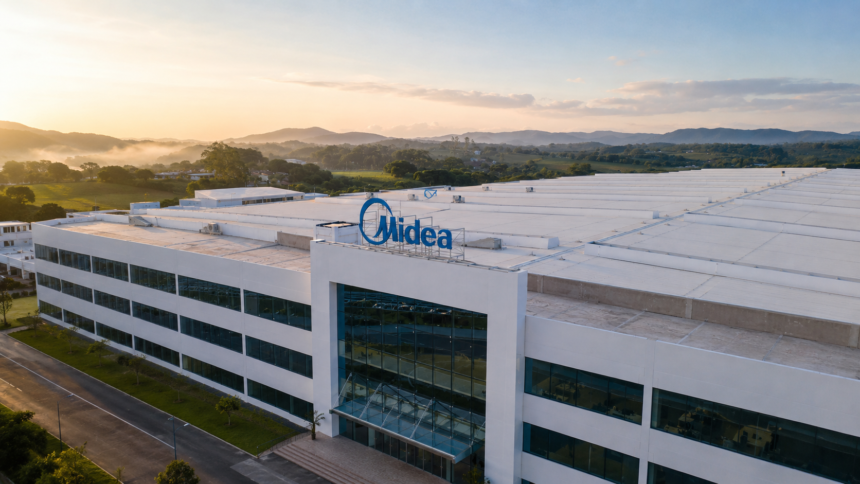
Midea Group has raised about $2.2 billion through a convertible bond sale, giving one of China’s largest appliance manufacturers fresh capital to accelerate its global expansion. For U.S. appliance dealers, the financing is another sign that Chinese appliance brands are not simply exporting products into overseas markets — they are funding a longer campaign for distribution, brand presence and market share.
The transaction, completed in May, totaled about HK$17.2 billion through a dual-tranche, zero-coupon convertible bond issuance, according to Reuters and transaction details reported by law firms advising on the deal. Freshfields said the offering was completed May 13 and that roughly 60% of net proceeds are earmarked for international expansion and offshore liquidity.
Midea is already a global force in air conditioning, refrigeration, laundry, cooking and small appliances. The bond raise gives the company more financial flexibility at a time when the U.S. appliance market is marked by cautious consumers, high financing costs, price pressure and intensifying competition across value and midmarket categories.
Midea’s financing move matters because it gives a major global appliance maker more room to invest abroad while many competitors are focused on cost control and demand softness.
Appliance News analysis
Why this matters
For U.S. dealers, Midea’s capital raise should be viewed as part of a broader competitive shift. Chinese manufacturers have moved well beyond low-cost production roles, and several are now competing more directly for brand recognition, channel access and consumer trust in North America.
That matters because the appliance market is already crowded. Whirlpool, GE Appliances, LG, Samsung, Bosch, Electrolux, Hisense, Haier and other brands are competing for floor space, online visibility, builder relationships, service support and promotional dollars.
A better-capitalized Midea could sharpen that competition, particularly in categories where the company has global scale, including air treatment, room air conditioners, refrigeration, dishwashers, cooking products and compact appliances.
More Read

What changed
Midea’s convertible bond sale was structured in two equal tranches, with maturities in 2027 and 2033, according to transaction summaries. The bonds were issued through a wholly owned offshore subsidiary and guaranteed by Midea Group.
Freshfields described the deal as the largest convertible bond offering in Greater China so far in 2026. Fangda Partners, another adviser on the transaction, said the issuance totaled HK$17.248 billion and was completed in the international market.
The key appliance-industry detail is not only the size of the raise, but how the proceeds are expected to be used. Freshfields said about 60% of net proceeds are intended to support international growth and offshore liquidity, while the rest is expected to support broader corporate needs.
The North America angle
Midea already sells home appliances and smart home products in the U.S., including room air conditioners, portable air conditioners, dehumidifiers, fans, heaters, water heaters, microwaves and other small appliances through its U.S. consumer channels. Its brand has also gained attention in the U.S. room air category, including inverter window air conditioners and compact cooling products.
The question for dealers is whether Midea’s next phase abroad will mean deeper investments in brand marketing, more channel partnerships, expanded service infrastructure, more aggressive pricing, broader product assortments or additional North American partnerships.
Morningstar and Reuters both framed the financing as tied to global expansion. For U.S. appliance retailers, that puts Midea in the same strategic conversation as other Asian appliance makers that have used scale, supply chain control and category specialization to build stronger North American positions.
The industry impact
Midea’s move comes as several appliance manufacturers are managing demand weakness and margin pressure. U.S. housing turnover remains low, mortgage rates remain elevated and replacement purchases are carrying more of the market than discretionary remodeling demand.
That creates an opening for companies with access to capital and global manufacturing scale. If Midea uses part of the proceeds to build distribution, marketing, fulfillment or service capacity abroad, it could create new pressure on incumbents that are defending share in a slower market.
For dealers, the impact will depend on execution. A lower-priced appliance line may win attention, but long-term channel acceptance depends on parts availability, warranty handling, installation support, service documentation, delivery reliability and confidence that a brand will support products after the sale.
- Dealers should watch whether Midea expands product availability, sales programs or support resources in North America.
- Servicers should monitor parts access, technical documentation and warranty processes as Chinese brands grow share.
- Manufacturers may face more price and promotional pressure if Midea uses scale to pursue share abroad.
- Distributors could see new opportunities if Midea looks for broader regional reach or category-specific channel partners.
What comes next
The bond raise does not automatically translate into a larger North American footprint. But it gives Midea more financial capacity to pursue that goal at a time when international growth is a stated use of proceeds.
U.S. dealers should watch for practical signals: more product categories, expanded retail placement, new builder or Pro programs, better service infrastructure, increased marketing and deeper partnerships with established North American appliance players.
The competitive takeaway is clear. In a slower appliance cycle, the companies with capital to invest through the downturn may be better positioned when demand improves. Midea’s $2.2 billion raise suggests it intends to be one of them.