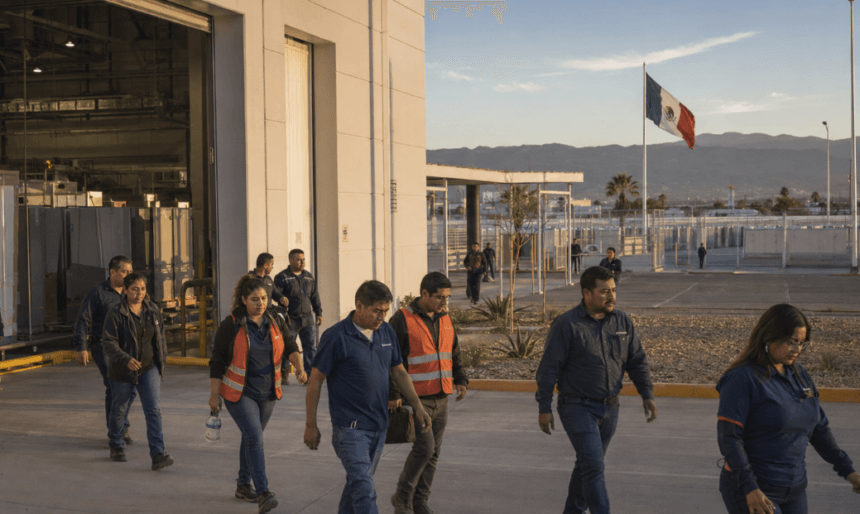
Whirlpool Corporation will close its Supsa manufacturing facility in Apodaca, Mexico, by the second quarter of 2027, moving production to another Mexican plant and other parts of its manufacturing and supply chain network as it reshapes its refrigeration footprint.
The plan was disclosed in a July 1 Form 8-K filed with the U.S. Securities and Exchange Commission. Whirlpool said the action is part of factory-footprint changes previously discussed during its first-quarter 2026 earnings call and is intended to improve operational efficiency and the cost structure of its refrigeration product category.
What Is Closing in Apodaca
The filing identifies the closing site as Whirlpool’s Supsa manufacturing facility in Apodaca, Mexico. It does not provide a headcount, list specific refrigerator models, describe the plant’s annual capacity or say whether the property will be sold, idled or repurposed after production ends.
Whirlpool’s timeline is gradual rather than immediate. The company said it expects to phase out the Supsa facility by the second quarter of 2027 and substantially complete the broader restructuring actions during 2027.
For workers and local suppliers, that leaves a yearlong transition window but not much public detail. The filing gives cost categories tied to the closure, including employee-related costs, yet it does not spell out severance arrangements, redeployment opportunities, supplier-transition schedules or whether any portion of the current workforce could move with the work.
Where Production Is Moving
Whirlpool said production will be transferred to its manufacturing facility in Ramos Arizpe, Mexico, and “across its manufacturing and supply chain network.” That wording points to consolidation inside Mexico but also leaves room for selected work, components or logistics steps to be redistributed beyond a single replacement plant.
More Read
The Ramos Arizpe reference matters because it suggests Whirlpool is not exiting Mexican appliance production. Instead, the company is concentrating at least some refrigeration-related activity at another Mexican manufacturing site while using the wider network to absorb the rest of the transition.
What the filing does not say is just as important for the trade. It does not identify which product platforms move to Ramos Arizpe, which lines move elsewhere, how production will be staged during the phaseout or whether dealers should expect any change in lead times, allocation or model availability.
The Restructuring Bill
Whirlpool estimated up to approximately $165 million in total restructuring costs connected with the Supsa actions. The largest portion is up to about $95 million in asset impairment costs, followed by about $30 million in employee-related costs and about $40 million in other associated costs.
Roughly $70 million of the estimated total is expected to become future cash expenditures. Whirlpool expects about $100 million of the total restructuring costs to be incurred in 2026, while about $15 million of the anticipated cash spending is expected to occur in 2026.
- Estimated total restructuring costs: up to approximately $165 million.
- Asset impairment costs: up to approximately $95 million.
- Employee-related costs: approximately $30 million.
- Other associated costs: approximately $40 million.
- Future cash expenditures: approximately $70 million, including about $15 million expected in 2026.
Why the Footprint Shift Matters
For appliance manufacturers, plant closures rarely affect only the four walls of a factory. They can change supplier lanes, component flows, warehousing needs, service-parts planning, labor requirements and the timing of model transitions.
Whirlpool’s latest annual report shows how large that footprint already is. As of Dec. 31, 2025, the company reported 20 principal manufacturing locations in four countries, including 10 in its MDA North America segment and eight in MDA Latin America. The Supsa disclosure therefore lands inside a manufacturing network that is already spread across regional business lines rather than centered in one country or one plant.
The trade issue is not simply whether a refrigerator comes from Apodaca or Ramos Arizpe. It is whether the production transfer changes cost, capacity, mix, delivery reliability or parts continuity for Whirlpool-branded and related appliance programs that depend on the company’s refrigeration network.
What Remains Unclear
The SEC filing gives investors the expected timing and cost framework, but it does not answer several operational questions that matter to workers, suppliers, retailers and servicers.
For workers, the open questions include the number of affected jobs, whether Whirlpool will offer transfers, and how the phaseout will be sequenced through 2027. For suppliers, the open questions include which purchase orders, component categories and logistics lanes shift to Ramos Arizpe or elsewhere in the network.
For appliance production, the biggest unknowns are capacity and product mix. Whirlpool has disclosed the destination framework, but not the exact production map. Until more detail is available, the Supsa closure should be read as a confirmed plant exit with a still-developing operational handoff.