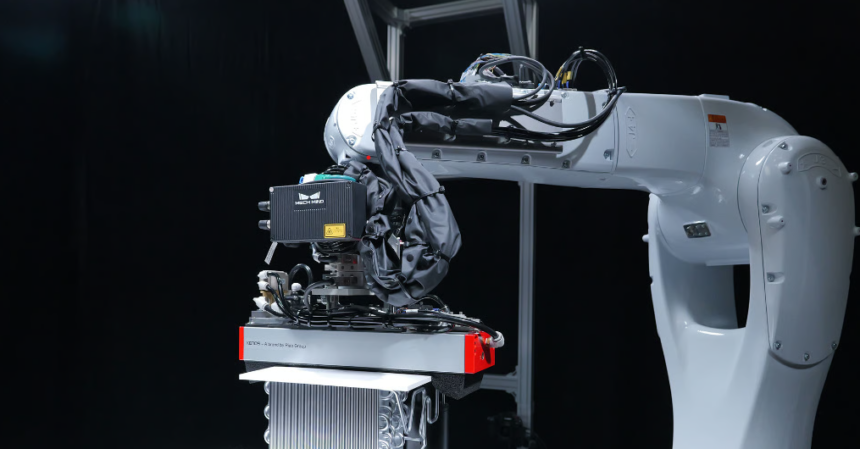
Panasonic is turning one of the appliance industry’s least glamorous problems into a test case for robotics, artificial intelligence and circular design: taking old machines apart. The company is using AI-enabled robots and a “Disassembly CPS,” or cyber-physical system, to help separate appliance materials more precisely and feed those lessons back into future product design.
The shift matters because appliance recycling is no longer just a back-end waste issue. For manufacturers, servicers, retailers and warranty companies, disassembly is becoming part of the product lifecycle — touching design, repair access, parts recovery, labor needs and the economics of recycled materials.
“By incorporating design principles that enhance maintainability, the Group aims to achieve both longer product lifespans and resource recovery.”
Panasonic Holdings Corporation
Why disassembly is becoming design work
Appliances are heavy, mixed-material products with metals, plastics, wiring, motors, compressors, electronics and, in some categories, refrigerants and oils that must be handled properly. Traditional recycling often depends on manual dismantling, shredding and sorting — useful, but imperfect when the goal is high-purity material recovery or component reuse.
U.S. Environmental Protection Agency data show the scale of the challenge. In 2018, the U.S. generated about 5.25 million tons of major appliances in municipal solid waste; about 3.14 million tons were recycled, while about 2.11 million tons were landfilled. Small appliances performed far worse, with the EPA estimating that only about 5.6% of 2.16 million tons generated in 2018 was recycled and 75.9% was landfilled. EPA
That is why Panasonic’s work is notable for the appliance sector. The company is not just looking at how to recycle more material after a product is crushed. It is testing how AI, machine vision and robotic workcells can remove parts in a more controlled sequence — and how those findings can influence future appliance architecture.
How Panasonic’s system works
Panasonic said its Disassembly CPS visualizes how easy a product is to take apart, simulates disassembly motions and time using 3D CAD, and uses that data to inform both new product design and automated disassembly robots. The company has targeted practical implementation in fiscal 2028.
More Read
The current work builds on Panasonic’s earlier dismantling automation for air conditioner outdoor units. In 2023, Panasonic Holdings said it had developed equipment that uses AI-based recognition to find screws even when outdoor units are dirty or rusted, then positions a robotic arm with a screwdriver to remove fasteners and lift the cover.
Assembly Magazine reported that Panasonic engineers are programming six-axis robots to work on air conditioners, microwave ovens and washing machines, using magnetic grippers, screwdrivers and other end effectors to remove covers, fasteners, wiring and components. The publication also reported that Panasonic cited a washing machine heat pump redesign that moved the component from the bottom to the top of the machine, improving maintainability and cutting repair time by 50%. Assembly Magazine
The repair connection
For appliance manufacturers, the most important development may be the feedback loop. A robot that struggles to remove a part can expose a design problem: poor tool access, too much adhesive, hard-to-reach screws or assemblies that are efficient to build but costly to repair or recycle.
That could push more product teams toward design-for-disassembly principles: mechanical fasteners instead of permanent bonds, clearer access paths to high-value components and layouts that allow machines to be serviced, harvested or recycled with fewer destructive steps.
For servicers, the implications are practical. The same design changes that help robots remove components can also help technicians reach them. If circular-design work carries over into production models, it could reduce repair time, improve parts access and make some machines less likely to be replaced after a single major failure.
- Manufacturers may face new pressure to design products for disassembly, not just assembly.
- Servicers could benefit from easier access to components if circular-design changes reach production appliances.
- Retailers and distributors may see recycling and takeback programs become more important to brand value and compliance strategy.
- Warranty companies should watch whether easier repairs reduce labor time, replacement rates and parts-related friction.
Automation does not solve everything
Old appliances arrive with dents, corrosion, missing parts, regional design differences and uncertain service histories. Refrigerated products add compliance requirements because refrigerants, oils and other materials must be recovered or handled before disposal. The EPA says appliance recycling typically includes refrigerant recovery and hazardous-component removal before evacuated appliances are shredded. EPA
Robotics can help with repetitive or risky tasks, but the business case depends on throughput, model coverage, recovered-material value and whether manufacturers can standardize enough design elements to make automated disassembly repeatable. The robot is only part of the system. The product design, data layer, recycling plant layout and parts market all matter.
Panasonic’s fiscal 2028 implementation target gives the appliance industry a timeline to watch. If the approach scales, the payoff could be bigger than cleaner scrap streams: more repair-friendly products, better recovered materials and a stronger link between design, service and end-of-life planning.
The industry has spent decades optimizing how appliances are assembled. Panasonic’s experiment points to the next question: whether the business can make taking appliances apart just as deliberate.