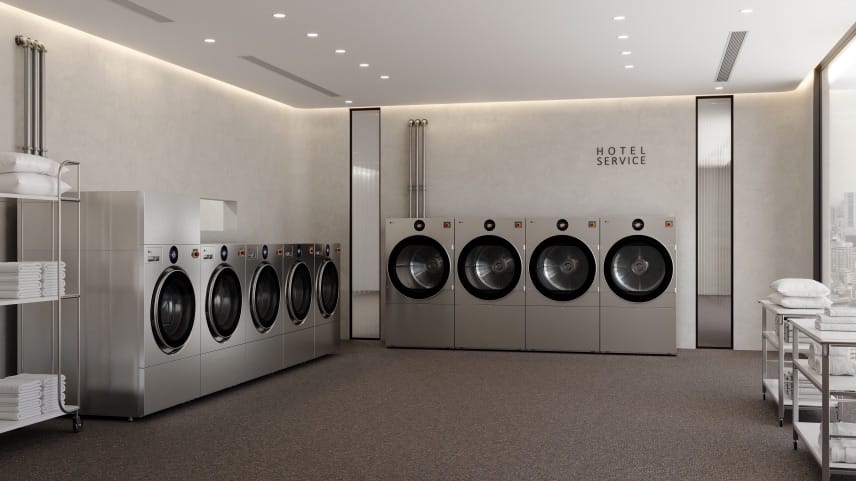
LG Electronics is taking its large-capacity Professional Laundry lineup global, expanding beyond residential appliances with commercial washers, dryers and all-in-one units aimed at laundromats, hotels, health care facilities and industrial operators.
- A commercial lineup built around throughput
- The service-ready claim will be tested in the field
- New components mean new training needs
- Self-cleaning features do not remove maintenance
- Remote management could change the service call
- North American groundwork is already underway
- What repair managers should watch
The lineup launches in Europe in July, with Asia and North America to follow. LG did not provide North American launch dates, model numbers, pricing, warranty terms or service-network details in its announcement. LG Electronics
For appliance repair companies, the launch is more than a product story. It points to a possible new service market built around heat-pump drying, inverter-driven systems, connected diagnostics, high-speed extraction and commercial preventive maintenance. It also raises questions about technician training, parts access and who will control the operational data generated by the machines.
A commercial lineup built around throughput
LG says the Professional Laundry range includes large-capacity washers and dryers designed for high-volume commercial workloads. The company is targeting retail and industrial laundry businesses as well as hospitality and health care operators.
The centerpiece is a ductless WasherDryer that LG says can complete a full wash-and-dry cycle in about one hour using an International Electrotechnical Commission standard seven-kilogram load. LG notes that results can vary by operating environment and load conditions.
The all-in-one unit uses AI Weight Detection to adjust water and energy use according to load size. A Dual Inverter HeatPump system provides low-temperature drying without conventional exhaust ductwork.
More Read
That ductless design could reduce installation constraints in buildings where adding or maintaining dryer vents is difficult. It does not eliminate maintenance. Heat-pump systems add refrigerant circuits, heat exchangers, pumps, sensors and airflow paths that require different diagnostic skills than conventional electric or gas dryers.
The service-ready claim will be tested in the field
LG is promoting a Front Service Ready design that gives technicians access to key components from the front of the machine. The company says the layout is intended to shorten service time and reduce downtime.
Front access matters in commercial laundry rooms where machines may be installed side by side, stacked or placed against walls with limited rear clearance. A technician who must move a heavy machine or dismantle surrounding equipment before reaching a failed part can turn a routine repair into hours of lost operation.
LG made similar serviceability claims when it announced a North American distribution agreement with CSC ServiceWorks in 2025. The company said its commercial units were designed so most servicing could be performed from the front without extensive disassembly. LG and CSC ServiceWorks
The real test will be parts placement, diagnostic access and repair documentation. A front panel is useful only if common failure points can be reached without removing the drum, cabinet or adjacent machines. LG has not yet released North American service manuals, parts diagrams or labor-time guidance for the new lineup.
“By combining our AI-powered washing and drying technologies with our advanced core tech and comprehensive support services, we are providing our B2B partners with solutions that support business growth.”
Baek Seung-tae, president of LG Home Appliance Solution Company
New components mean new training needs
The Professional Laundry platform combines technologies that residential appliance technicians may recognize with commercial operating demands that can be less forgiving.
LG’s Dynamic Ball-Core System uses a gyro sensor to detect drum imbalance and a ball balancer to stabilize the load. The company says the system supports spin speeds of up to 1,100 rpm, improving water extraction while reducing vibration and drying time.
For technicians, that adds another mechanical and sensor-based system to the diagnostic path. An imbalance complaint could involve installation, load distribution, suspension components, the gyro sensor, control software or the ball-balancing mechanism rather than a single conventional failure point.
The dryers and WasherDryer also use moisture sensing and model-specific algorithms to limit over-drying. Wet Cleaning with MotionCare combines low-temperature drying with controlled drum movements for delicate fabrics.
Those systems could create opportunities for service companies able to troubleshoot inverter controls, heat-pump circuits, sensors and software-driven cycle behavior. They could also produce longer callbacks if technicians lack access to fault histories, test modes or component-level documentation.
- Heat-pump system: Refrigerant, compressor, heat-exchanger, condensate and airflow diagnostics.
- Dynamic Ball-Core System: Gyro sensing, load balancing, high-speed spin and vibration complaints.
- Connected controls: Software updates, remote settings, network problems and data access.
- Commercial operating environment: Higher cycle counts, faster response expectations and downtime costs.
Self-cleaning features do not remove maintenance
LG says Heat Exchanger Cleaning Assist automatically rinses the heat exchanger after every cycle. That feature is designed to address a known maintenance pressure point in heat-pump dryers, where lint and residue can reduce airflow and heat-transfer performance.
Automatic rinsing may reduce manual cleaning frequency, but it does not guarantee that the heat exchanger, drain path, pump or filters will remain clear under every commercial load. Towels, bedding, uniforms and health care textiles can produce different lint, detergent and contamination patterns.
The lineup also includes a Tub Clean cycle. LG says an Intertek test conducted in May 2025 found that the cycle reduced tested bacteria in the washer drum by 99.9999% under specified conditions. The company cautions that real-world performance may vary by operating environment.
Operators should not treat that laboratory result as a replacement for facility sanitation procedures, chemical controls or preventive maintenance. Health care and hospitality customers may have their own requirements for infection control, documentation and machine cleaning.
Remote management could change the service call
LG’s LaundryCrew app allows operators to monitor equipment status, operating data and machine settings. It also supports software updates and system management.
In theory, connected monitoring can help identify recurring faults, abnormal cycle times or machines that require attention before a complete shutdown. For repair companies, that could improve triage and allow technicians to arrive with a better diagnosis and the correct parts.
The unresolved question is whether independent service providers will have access to that information. LG’s announcement describes tools for owners and managers but does not explain technician permissions, diagnostic-data retention, remote fault-code access or integration with third-party dispatch systems.
LG also offers an Open API for integration with existing business systems. The API is not standard with purchase. LG says customers must initiate a separate system-development process after buying the equipment.
That limitation matters for operators comparing connected platforms. An API can be valuable, but development cost, licensing, cybersecurity, data ownership and long-term software support can determine whether integration is practical for a regional laundry operator or only for larger chains.
North American groundwork is already underway
LG is not entering North American commercial laundry from a standing start. It has distribution relationships with major service providers including CSC ServiceWorks and WASH, and it displayed Professional Laundry equipment at Clean Show 2025.
At that event, LG said the Professional lineup was not yet distributed in the United States. The July 2026 launch moves the program forward, but North America is still listed as a future market rather than an immediate rollout. LG at Clean Show 2025
LG also showed commercial laundry products at the HITEC hospitality technology conference in June. That display focused on conventional washer-dryer pairs for hotels and guest laundry, indicating that the company is building multiple commercial channels rather than relying on a single large-capacity platform. LG at HITEC 2026
For independent repair companies, the channel structure will matter. If the Professional lineup is sold primarily through large managed-laundry providers, much of the warranty and maintenance work may remain inside contracted networks. If hotels, health care facilities and laundromats can buy directly through distributors, regional service companies may have a larger role.
What repair managers should watch
The commercial opportunity is real, but managers should not assume residential LG experience automatically qualifies a company to support the new machines. Commercial accounts expect shorter response times, documented preventive maintenance and faster access to parts because every hour of downtime can affect revenue or facility operations.
Before committing to the platform, service companies should ask whether LG will offer factory training, diagnostic software, technical manuals, warranty authorization and local parts stocking. They should also determine whether refrigerant certification or specialized heat-pump tools will be required for the WasherDryer.
LG has not yet disclosed North American capacities, electrical requirements, installation specifications or service policies for the Professional lineup. Those details will determine whether the machines fit existing laundromats and utility rooms—and whether independent technicians can service them profitably.
The launch shows where commercial laundry is heading: more heat-pump drying, more sensor-driven operation and more remote management. Repair companies that prepare for that shift may gain access to higher-value B2B accounts. Those that wait for the first breakdown may discover that the technical and contractual barriers are higher than they are in residential service.