Bosch’s new $225 million CHIPS Act funding agreement is easy to read as an automotive story. The appliance angle is in the power electronics: the same silicon carbide technology that helps manage high-voltage electricity in vehicles also matters to advanced appliance controls, inverter-driven motors, heat-pump systems and the broader supply chain behind efficient home equipment.
The Department of Commerce’s CHIPS Program Office announced July 13 that it signed a direct funding agreement with Robert Bosch Semiconductor LLC for up to $225 million in incentives under the CHIPS and Science Act. The award supports Bosch’s $2 billion investment to transform its Roseville, California, site into a silicon carbide, or SiC, semiconductor production facility.
Commerce described SiC semiconductors as essential components not only for automotive applications, but also for industrial, energy and consumer appliance industries. That one sentence is what makes the deal relevant beyond electric vehicles.
What Bosch Is Building in Roseville
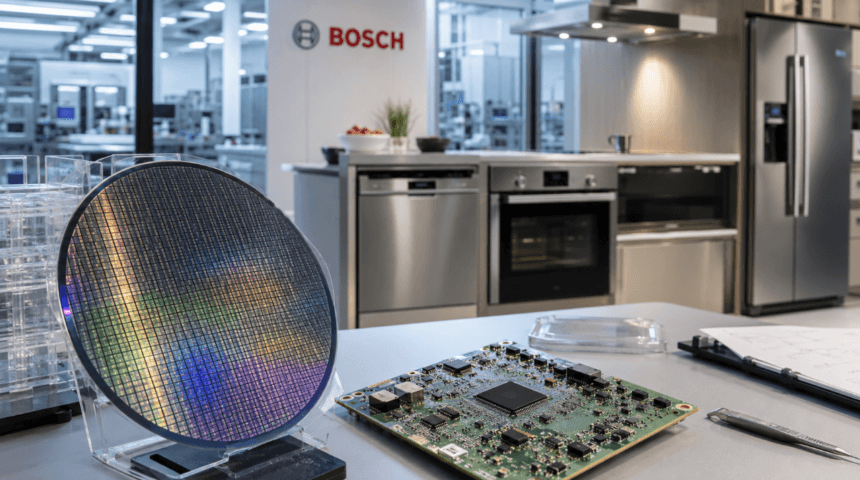
The Roseville project is designed to modernize and expand what Commerce calls Bosch’s largest SiC facility globally. Bosch has developed new cleanroom space and an advanced manufacturing line for SiC semiconductors at the site, with sample production already underway and commercial production expected to begin in 2026.
The facility is Bosch’s first semiconductor production site in the United States. Commerce said the funding will accelerate new cleanroom development and production capacity, while Bosch said the site has more than 40 years of semiconductor-manufacturing experience and currently employs more than 300 associates.
The federal award follows an earlier preliminary agreement, but the July announcement is the definitive funding step. Commerce said Robert Bosch Semiconductor LLC is a subsidiary of Robert Bosch GmbH and described Bosch as a critical supplier across automotive, industrial and energy markets. Bosch said it has produced and delivered more than 60 million SiC chips worldwide since its first generation went into production in 2021.
More Read

Why Silicon Carbide Matters to Appliances
Silicon carbide is not a “smart appliance” feature in the way consumers think about apps, cameras or voice controls. It is a power-management technology. Commerce describes SiC as a wide-bandgap semiconductor that can handle high voltages, high temperatures and fast switching with smaller components.
That is the same design problem many modern appliances are trying to solve. Refrigerators, washers, dryers, dishwashers, HVAC equipment and heat-pump systems increasingly rely on electronic controls, variable-speed motors, inverter drives, compressors, pumps, fans and power-conversion hardware. The more an appliance moves from simple on-off operation to modulated operation, the more important its power electronics become.
For the appliance trade, the promise is not that every dishwasher or refrigerator suddenly needs an SiC chip. Lower-cost silicon electronics will still be used where they are good enough. The point is that higher-performance power semiconductors can help engineers reduce switching losses, manage heat, shrink electronics packages and improve the efficiency of systems that run motors or convert power.
The Department of Energy has made a similar point about wide-bandgap semiconductors generally, saying the technology can make electronic components smaller, faster and more efficient and could increase efficiency in applications ranging from industrial motors to household appliances. In appliances, that matters most where energy standards, heat management, quiet operation and precise motor control all collide.
The Control Board and Inverter Connection
Appliance servicers already see the practical side of this transition. More models use electronic boards, inverter modules and sensors to manage wash action, compressor speed, fan speed, drying behavior or heat-pump operation. When those systems work well, they can reduce energy use, smooth performance and support quieter operation. When they fail, repairs can be expensive and diagnosis can be more complex than replacing a mechanical timer or relay.
SiC does not remove that repair reality. In some products, more advanced power electronics could improve durability by running cooler or switching more efficiently. In others, the economics may still push manufacturers toward integrated boards or modules that are replaced rather than repaired in the field. The technology can improve efficiency while still raising questions about serviceability, parts pricing and technician access to diagnostics.
Retailers and distributors should watch this from the other end of the channel. Efficiency gains often show up in product claims, ENERGY STAR positioning, utility-rebate conversations and premium-product differentiation before consumers understand the components behind them. A chip plant in Roseville will not change showroom training overnight, but it is part of the upstream technology stack behind the next wave of efficient appliances.
Supply-Chain Resilience Is the Policy Story
Commerce framed the Bosch award as an effort to onshore critical SiC technology and strengthen domestic supply-chain resilience. That matters because appliance manufacturers are still dealing with the long tail of pandemic-era electronics shortages, higher logistics risk and uneven availability of components that can stop production even when cabinets, tubs or compressors are ready.
Power semiconductors are small parts with outsized leverage. A shortage of a specialized chip, module or control component can force a factory to slow production, redesign a board, qualify a substitute or delay a model transition. Domestic SiC production does not make the appliance supply chain immune to shortages, but it can add regional capacity for a class of components that is becoming more important in electrified equipment.
There is also a parent-company strategy here. Bosch is not only a component supplier; through BSH Hausgeräte GmbH, it is connected to one of the world’s major home appliance groups. BSH, a Bosch Group company, sells Bosch, Thermador and Gaggenau appliances in North America and describes its portfolio as spanning cooking, dishwashing, laundry, refrigeration and small appliances. Bosch’s semiconductor investment does not mean BSH appliance lines will automatically receive Roseville chips, but it does show how the parent company is investing in technologies that sit upstream from multiple businesses.
- Manufacturers: Watch whether domestic SiC capacity changes cost, lead times or sourcing options for inverter systems, power modules and high-efficiency platforms.
- Retailers: Watch how efficiency, quiet operation, heat-pump performance and premium controls are explained without overpromising what a component can do.
- Servicers: Watch whether more advanced electronics improve reliability or create more expensive board-level replacement decisions.
- Consumers: Watch total ownership cost, including energy savings, repair cost and parts availability, not just the efficiency label.
What Remains Unclear for Appliances
The Commerce announcement confirms the funding agreement, the Roseville investment and the broad industry relevance of SiC. It does not say how much Roseville capacity will serve consumer appliances, whether any output is reserved for Bosch-affiliated appliance operations, or which appliance categories are most likely to use Bosch SiC parts.
It also does not settle the cost question. SiC can support more efficient and compact power electronics, but those benefits have to be weighed against component cost, product price, repairability and the manufacturer’s ability to design reliable systems around the technology.
That is why the appliance angle is hidden but real. The Roseville deal is about semiconductor capacity, not a new appliance launch. But as appliances become more electrified, inverter-driven and efficiency-constrained, the supply of advanced power electronics becomes part of the appliance business itself.