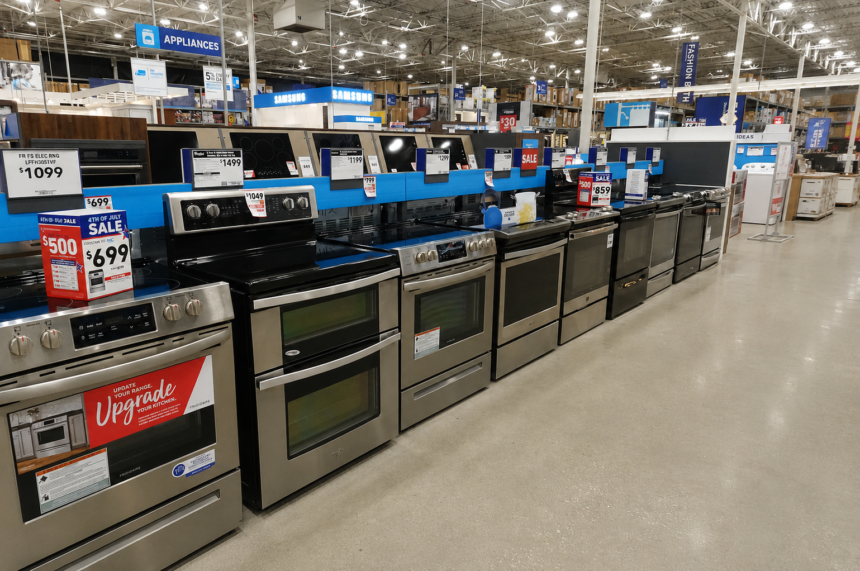
Lowe’s is seeing a familiar split in the home improvement market: shoppers are still spending on repairs, replacements and some appliance purchases, but many are pulling back from larger discretionary projects. The shift is important for appliance retailers and manufacturers because it suggests the replacement cycle remains active even as the broader remodeling market stays under pressure.
The retailer reported first-quarter 2026 comparable sales growth of 0.6%, with total sales of $23.1 billion, according to Lowe’s May 20 earnings release. The company said the comparable-sales gain was driven by strong spring execution, 15.5% online sales growth and continued strength in appliances, home services and Pro sales.
That modest sales lift came against a difficult housing backdrop. High mortgage rates, low housing turnover and cautious consumer spending have continued to weigh on the kinds of big-ticket DIY projects that often drive appliance suites, kitchen upgrades and broader renovation demand.
“We are operating in a K-shaped economy where the higher-income consumers are spending on home upgrades, while the lower-income consumers are a little bit more cautious and uncertain.”
Marvin Ellison, Lowe’s chairman and CEO, according to Reuters
Why this matters
Lowe’s results show how appliance demand can perform differently from the broader DIY market. Consumers may delay a full kitchen remodel, but a failed refrigerator, dishwasher or laundry pair still creates an urgent purchase decision.
That distinction matters for retailers, servicers and manufacturers. Repair and replacement categories can hold up when discretionary remodeling softens, but customers may trade down, wait for promotions or focus on essential purchases rather than premium upgrades.
For appliance brands, the message is mixed. Lowe’s reported strength in appliances, but the broader environment remains value-sensitive, especially among lower-income consumers and DIY shoppers facing higher borrowing costs and inflation pressure.
More Read
What changed at Lowe’s
Lowe’s has been leaning harder into services, digital tools and loyalty benefits to keep customers engaged. In February, the company expanded its Pro Extended Aisle, a digital catalog designed to give professional customers broader access to inventory and pricing.
The company has also pushed deeper into home services and loyalty. Lowe’s has introduced HomeCare+ for MyLowe’s Rewards members, offering a subscription-style home maintenance package, and has promoted faster delivery options for online shoppers.
Those moves reflect a broader retail strategy: make Lowe’s more useful to customers who are not necessarily browsing for a full remodel, but still need repairs, installation, maintenance and replacement products.
The appliance angle
Appliances helped lift Lowe’s comparable average ticket in the quarter. Reuters reported that Lowe’s comparable average ticket increased 1.5%, while comparable transactions declined 0.9%, pointing to a market where fewer trips are being offset by larger baskets when customers do buy.
That pattern is significant for appliance retailers. A dishwasher replacement, laundry upgrade or refrigerator purchase can raise average ticket even when overall store traffic or DIY project demand remains uneven.
But it also underscores the challenge of relying on big-ticket categories in a cautious market. If customers are replacing broken appliances rather than remodeling kitchens, retailers may need sharper promotions, better financing offers, faster fulfillment and clearer installation support to close the sale.
Housing pressure remains the big drag
The U.S. housing market remains a central obstacle. Existing homeowners with low mortgage rates have been reluctant to move, reducing the number of home purchases that typically trigger renovations, appliance replacements and whole-room upgrades.
Reuters reported that Lowe’s maintained its fiscal 2026 outlook for comparable sales to be flat to up 2%, while executives pointed to historically low housing turnover and cautious spending among lower-income consumers. The company’s first-quarter results beat sales expectations, but management continued to describe the market as muted.
That creates a retail environment where small projects, emergency replacements and Pro demand are more dependable than large discretionary DIY work. For the appliance industry, that could mean fewer aspirational package upgrades and more demand for practical, promotion-driven replacement purchases.
- Retailers may need to keep appliance promotions visible as consumers compare value more closely.
- Manufacturers should expect continued pressure on premium mix if DIY remodel demand remains soft.
- Servicers may benefit as homeowners repair products longer before replacing them.
- Distributors should watch replacement-driven categories for steadier turns than remodel-dependent product lines.
Customer satisfaction adds another pressure point
Value is not Lowe’s only challenge. J.D. Power’s 2026 U.S. Home Improvement Retailer Satisfaction Study found that overall satisfaction with home improvement retailers rose slightly to 672 on a 1,000-point scale, but shoppers remain sensitive to rising prices.
J.D. Power said customers reported improvements in product availability, digital tools and operational services such as delivery, installation, rentals, clinics and rewards programs. But the firm also said higher spending has made shoppers more sensitive to value for the price paid, a factor that can directly affect retailer trust.
That is especially relevant for appliances, where the sale often depends on more than the sticker price. Delivery windows, haul-away, installation, warranty clarity, return policies and knowledgeable in-store advice can all shape whether a customer completes a purchase or delays it.
What comes next
Lowe’s is betting it can outperform a sluggish market by taking share, leaning into Pro customers and keeping value in front of shoppers. For appliance makers and dealers, the larger takeaway is that the market is not frozen, but it is selective.
Consumers are still replacing essential products. They are still responding to convenience, services and deals. But they are more cautious about large discretionary projects, and that caution can limit the upside for premium appliance packages tied to full kitchen and laundry remodels.
Until housing turnover improves, appliance demand inside home improvement retail may continue to depend less on dream-home upgrades and more on a practical question: what needs to be fixed, replaced or delivered quickly enough to keep the household running?