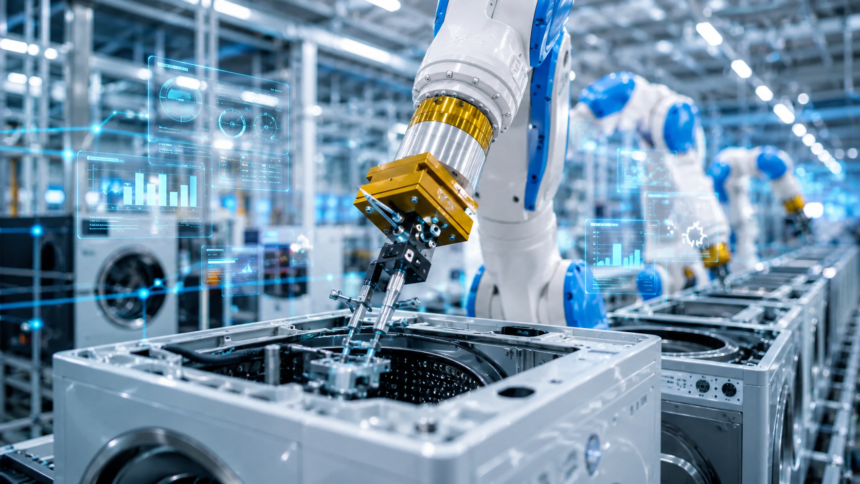
GE Appliances is moving artificial intelligence from the office suite to the factory floor, deploying more than 800 AI agents across manufacturing, logistics and supply chain operations in a rollout that could reshape how appliance plants detect problems, manage production shifts and respond to disruption. The company, a Haier subsidiary, is using Google Cloud’s Gemini Enterprise platform to put agentic AI tools closer to the workers who manage production lines, quality issues and logistics constraints.
The rollout is notable because it is not framed as a distant automation experiment. According to Engineering.com, GE Appliances teams are already using AI systems in shop-floor and logistics settings to surface anomalies, identify trends and speed up decision-making during shift huddles and operational reviews.
For the appliance industry, the story is larger than one manufacturer’s software stack. It points to a broader shift in factory operations: AI moving from a back-office productivity tool into a real-time operating layer for production, logistics, quality and service support.
Why this matters
Appliance manufacturing depends on thousands of small decisions made across plants, supplier networks, warehouses and service channels. A delayed part, a machine drifting out of spec, a recurring defect or a missed logistics signal can ripple into production delays, warranty costs and retail availability problems.
GE Appliances’ AI rollout is designed around that reality. Rather than relying only on centralized analytics teams, the company is putting AI agents into workflows used by people closer to the work — line workers, logistics teams, production managers and other operations staff.
That matters because the appliance business is increasingly judged not just on product design, but on execution. Retailers want reliable inventory. Servicers want better parts visibility and fewer repeat failures. Consumers want appliances that arrive on time and do not create warranty friction after installation.
More Read

GE Appliances’ AI rollout shows how appliance manufacturing is shifting from after-the-fact reporting toward faster, shop-floor problem detection.
Appliance News analysis
What changed
GE Appliances announced in April that it was using Gemini Enterprise to deploy more than 800 AI agents across manufacturing, logistics and supply chain operations. The company said the effort is intended to improve decision-making, product quality and operational efficiency.
Engineering.com’s later report added a closer look at how the technology is being used inside the company. The article described AI-enabled shift huddles where teams can move faster from “what happened?” to “what do we do next?” because agents can summarize production signals, flag anomalies and help teams diagnose problems during the meeting itself.
That is a meaningful operational change. In many factories, the first response to a production issue is still manual investigation: pull reports, check logs, compare shift data and come back with a root-cause theory. GE Appliances is trying to compress that cycle by letting workers query production data and spot early warning patterns while the issue is still fresh.
The company is also using AI in logistics and quality. Google Cloud’s announcement said GE Appliances built a Quality Insights AI tool that moves some review processes from manual analysis to AI-assisted analysis, uncovering improvement opportunities across customer logistics and internal operations.
From assistants to agents
The distinction between an AI assistant and an AI agent is important. Assistants help workers search, summarize or think through a task. Agents are built to perform defined pieces of work inside a workflow, using inputs and producing outputs that teams can act on.
In appliance operations, that could mean detecting recurring machine anomalies, summarizing shift performance, highlighting logistics bottlenecks or identifying quality trends before they become larger problems. The goal is not to replace factory workers, but to reduce the time between signal and response.
Engineering.com quoted Marcia Brey, vice president of logistics at GE Appliances, describing AI as “a tool, not a magic bean” and saying it helps the company solve problems “faster and better.” That framing is important for an industry where automation claims often outrun what plant teams can safely trust.
The industry impact
For appliance manufacturers, GE Appliances’ rollout is a signal that AI adoption is moving beyond pilots and dashboards. The competitive edge may come from how quickly companies can connect plant data, quality data and logistics data to the people making daily operating decisions.
That could affect the entire appliance channel. If AI helps manufacturers identify production drift earlier, retailers may see fewer availability shocks and quality-related disruptions. If logistics teams can detect bottlenecks faster, dealers may get more predictable delivery timelines. If quality signals are analyzed earlier, servicers may eventually benefit from better documentation, improved parts planning and fewer repeat repair patterns.
But the rollout also raises practical questions. AI systems must be governed, monitored and bounded. In manufacturing, a wrong recommendation can affect safety, quality, uptime and cost. GE Appliances’ approach, as described by Engineering.com, keeps human oversight in the loop and treats AI reliability as something that must be monitored over time.
- Manufacturers should watch whether AI agents become standard tools for production, logistics and quality teams.
- Retailers should pay attention to whether factory AI improves inventory reliability and delivery confidence.
- Servicers may benefit if better manufacturing and quality signals translate into stronger parts planning and technical documentation.
- Consumers may never see the AI tools directly, but they could feel the effects through fewer delays, fewer defects and smoother warranty experiences.
The risk is not just automation
The most important risk may not be whether AI replaces a worker. It may be whether AI exposes weak processes that were already hidden inside daily operations.
Engineering.com reported that one outcome of GE Appliances’ rollout is a clearer view of how work is actually structured. In some cases, what first appears to be a problem for AI to solve turns out to be a process problem that needs better definition, better ownership or better execution.
That is a useful lesson for appliance manufacturers. AI agents can accelerate workflows, but they can also reveal where workflows are inconsistent. A plant that lacks clean data, clear escalation paths or disciplined process design may find that AI makes those gaps more visible rather than making them disappear.
What comes next
The next phase will be measured less by the number of agents deployed and more by operational results. The appliance industry will be watching whether tools like these reduce downtime, improve first-pass quality, stabilize logistics and support faster root-cause analysis.
GE Appliances’ rollout also gives other manufacturers a practical model to study. Instead of treating AI as a separate digital transformation project, the company is embedding it in existing operating rhythms: shift huddles, production reviews, logistics decisions and quality investigations.
That may be where industrial AI becomes most useful. Not as a dramatic replacement for human judgment, but as a faster way to surface the signals workers need to make better decisions.
For appliance makers, the message is clear: AI is moving closer to the line. The companies that benefit most will likely be the ones that pair automation with strong governance, clean data, trained workers and a realistic understanding of what factory teams actually need to solve problems in real time.