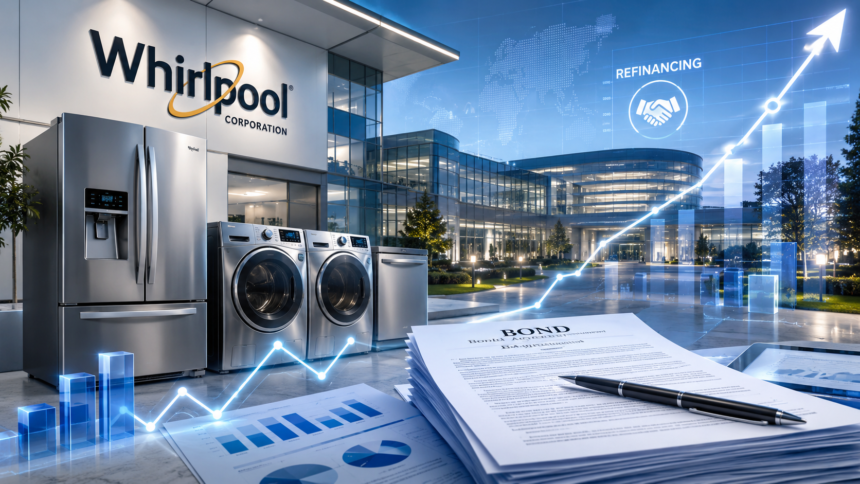
Whirlpool says investors holding most of two near-term bond issues agreed to sell those notes back to the appliance manufacturer, giving the company an early win in a broader effort to refinance debt and reshape its borrowing obligations.
As of the early participation deadline on June 12, holders had tendered about €912 million of the €1.1 billion in notes outstanding. That represents roughly 83% of the combined debt covered by the offer, according to Whirlpool’s early tender results announcement.
The transaction is financial, but its effects could extend beyond bond markets. Debt costs influence how much flexibility a manufacturer has to invest in factories, new appliances, supply chains, service operations and other parts of the business.
What Whirlpool is buying back
Whirlpool is offering to buy back two groups of notes issued through its wholly owned Luxembourg finance subsidiary. One group carries a 1.25% interest rate and is due in 2026. The other carries a 1.10% rate and is due in 2027.
A bond is essentially a loan made by investors to a company. The company receives cash when the bond is issued, pays interest during the life of the bond and repays the principal when the bond matures.
A tender offer gives investors the opportunity to sell those bonds back before maturity under terms set by the company. Whirlpool offered an additional early-participation payment to investors who submitted their notes by the June 12 deadline.
More Read

Investors tendered €365.3 million of the €500 million in 2026 notes, equal to 73.06% of that issue. They also tendered €546.7 million of the €600 million in 2027 notes, or 91.12%.
The tender results show that a large majority of investors were willing to exit the older notes before their scheduled maturity dates. That gives Whirlpool a clearer path to reduce near-term maturities, though the replacement financing carries different costs and terms.
New debt pushes repayment farther out
Whirlpool said it expected to complete a separate $2 billion secured-note offering on or about June 16. The financing consists of $1 billion in 7.5% senior secured second-lien notes due in 2031 and $1 billion in 7.875% senior secured second-lien notes due in 2034.
The company said it expects to use part of the proceeds to purchase the notes submitted through the tender offer, pay accrued interest and cover related fees and expenses.
In simple terms, Whirlpool is using newly borrowed money to retire much of the older debt. That pushes repayment dates farther into the future, but the new notes carry substantially higher stated interest rates and are secured by company assets.
The interest rates should not be viewed as a direct one-to-one comparison. The old and new notes differ in currency, maturity, security and market conditions. Even so, the transaction illustrates the higher financing costs many companies can face when replacing debt issued during a lower-rate period.
Why the appliance channel should care
Debt refinancing does not change how a refrigerator cools or how a washing machine cleans clothes. It can, however, affect the financial resources available to support those products and the businesses behind them.
For manufacturers, higher interest expenses can compete with spending on product development, factory upgrades, automation and supply-chain improvements. For retailers and distributors, a supplier’s financial flexibility can influence inventory planning, promotional support and long-term investment in major brands.
Servicers and warranty companies also have a stake in the manufacturer’s financial position. Investments in replacement-parts availability, technical documentation, training, warranty administration and product-quality improvements all require sustained funding.
The tender offer does not by itself indicate that Whirlpool plans to reduce any of those activities. It is better understood as one part of the company’s broader balance-sheet management: addressing debt that is approaching maturity while arranging longer-term financing.
What investors approved
Alongside the repurchase offer, Whirlpool asked holders of the 2027 notes to approve an amendment to the agreement governing that debt. The company said it received the required level of consent.
Whirlpool, its finance subsidiary and the trustee are expected to enter into a supplemental agreement reflecting the amendment. The change will become operative only after Whirlpool purchases all properly tendered 2027 notes accepted through the offer.
Once effective, the amendment will apply to all remaining holders of the 2027 notes, including investors who did not participate in the tender.
Remaining timeline
- June 15: Whirlpool scheduled the price determination for the notes submitted by the early deadline.
- June 16: The company expected to complete its $2 billion secured-note financing.
- June 18: Whirlpool expected to pay investors whose notes were accepted in the early settlement.
- June 30: The full tender offer is scheduled to expire unless Whirlpool extends it.
- July 6: The company currently anticipates completing the final settlement for later tenders.
Investors who submitted notes before the early deadline and did not withdraw them can no longer reverse that decision. Whirlpool said it will continue accepting additional tenders through the final expiration, but later participants will not receive the early tender premium.
The company retains the right to extend, amend or terminate the tender offer if its conditions are not met. That means the announced dates and final amounts remain subject to change.
For the appliance industry, the transaction is a reminder that corporate financing decisions can eventually reach the operating side of the business. Whirlpool is replacing near-term obligations with longer-dated borrowing, gaining more time before principal repayment while accepting the costs and restrictions that can accompany secured debt.