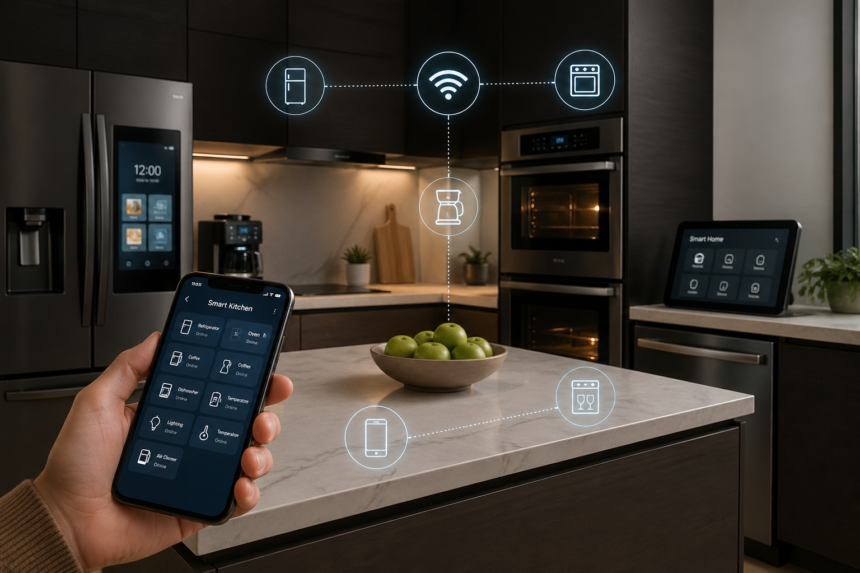
Wilmington, Del., April 24, 2026 — The global smart kitchen appliances market is projected to grow from $21.7 billion in 2025 to approximately $79 billion by 2035, reflecting a compound annual growth rate (CAGR) of 13.8%, according to new research from MarketGenics Global Research.
The report highlights accelerating demand driven by connected home ecosystems, artificial intelligence (AI)-enabled automation, and rising consumer preference for energy-efficient appliances.
“Integration of IoT platforms, voice assistants, and intelligent food management systems is transforming traditional appliances into fully connected, data-driven kitchen environments.”
North America leads the market, accounting for roughly 35% to 40% of global share in 2025, supported by strong smart home adoption and advanced IoT infrastructure.
Smart Refrigerators Lead Market Share
Among product categories, smart refrigerators hold the largest share at approximately 24% of the market. Their growth is attributed to features such as real-time inventory tracking, AI-driven food management, and seamless mobile integration.
Other categories gaining traction include smart ovens and cooktops, which are benefiting from increased adoption of app-controlled and voice-enabled cooking technologies.
- Smart refrigerators — ecosystem anchor with AI food management
- Smart ovens and cooktops — automation and remote control
- Smart dishwashers — efficiency-driven adoption
- Smart small appliances — modular smart kitchen growth
- Integrated kitchen systems — emerging full-ecosystem solutions
AI and IoT Reshape Kitchen Ecosystems
The market is undergoing a shift toward fully connected kitchen ecosystems, combining hardware, software, and cloud-based services. AI-enabled appliances now offer personalized cooking recommendations, predictive maintenance, and automated temperature control.
More Read
Voice assistants and smartphone integration are further enhancing usability, allowing consumers to monitor and control appliances remotely.
Key manufacturers — including Samsung Electronics, LG Electronics, Whirlpool, Haier, and BSH Home Appliances — collectively account for more than 30% of global market share, leveraging vertically integrated ecosystems to maintain competitive advantage.
Cost and Complexity Remain Barriers
Despite strong growth, the report identifies high upfront costs and installation complexity as primary barriers to adoption. AI-enabled sensors, connectivity modules, and integrated software systems contribute to higher price points, particularly in emerging markets.
Additionally, ecosystem integration challenges may limit adoption among consumers seeking simpler appliance solutions.
Innovation and Strategic Developments
Recent product launches underscore the industry’s focus on AI-driven innovation. In January 2026, BSH introduced Bosch Cook AI, a system designed to deliver personalized cooking guidance within connected kitchen environments. In March 2026, Midea launched its AI Eco Master and Smart Master product lines, emphasizing energy efficiency and IoT integration.
These developments reflect broader industry trends toward generative AI-powered cooking systems and connected food ecosystems.
Outlook: $57 Billion Growth Opportunity
The report estimates an incremental market opportunity of approximately $57 billion through 2035, driven by expanding applications across residential, commercial, and institutional sectors.
Growth is expected to be fueled by increasing urbanization, evolving consumer lifestyles, and demand for convenience, efficiency, and intelligent automation in kitchen environments.