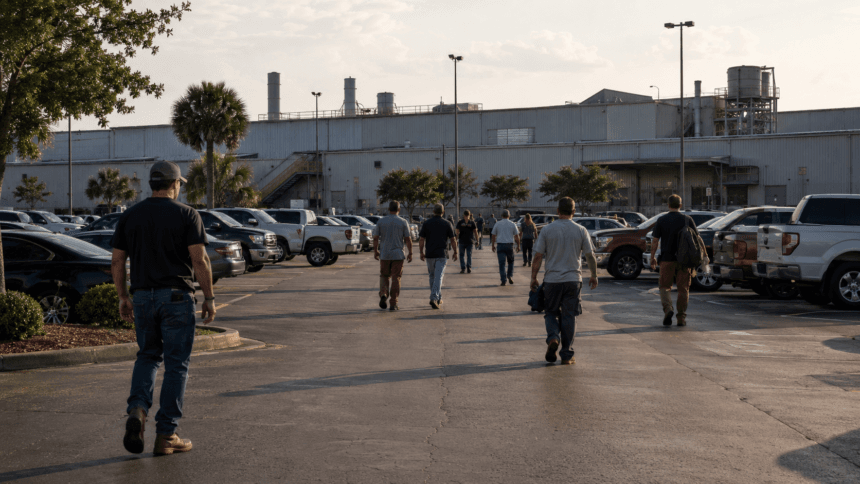
Electrolux Group’s Anderson, South Carolina, refrigerator plant is moving from conversion plan to workforce reality. More than 1,200 jobs are officially set to end as the company phases out refrigerator production, shifts that work to Ciudad Juárez, Mexico, and prepares the Anderson facility for a new laundry-appliance role under its long-term partnership with Midea Group.
The update gives firmer shape to a transition Appliance News previously covered after Electrolux and Midea announced their North American appliance joint ventures in April. At the time, the companies said Anderson would be repurposed from food preservation to fabric care. Since then, South Carolina WARN data and local reporting have confirmed the scale and timing of the job losses.
The Anderson case now sits alongside Whirlpool’s shrinking Amana, Iowa, refrigerator plant as a second major example of U.S. refrigerator manufacturing under pressure. The two stories are not identical, but together they show how hard it has become to defend mass-market refrigerator production in the United States while demand is weak, costs are high and North American supply chains keep shifting.
WARN notice makes the job losses official
The South Carolina Department of Employment and Workforce’s May WARN report lists Electrolux Consumer Products Inc. in Anderson with a May 15 notice date, a July 18 layoff date and 1,139 affected workers at 101 Masters Boulevard. The filing classifies the action as a permanent layoff. South Carolina DEW WARN report
South Carolina Public Radio reported May 28 that Electrolux will lay off 1,255 workers at the Anderson plant starting in July, citing a WARN statement filed with the state. The difference between the state report and later reporting appears to reflect the broader transition total versus the specific number listed in the May WARN report.
For Anderson County, the practical number is large either way. More than 1,100 workers are directly tied to the official WARN filing, and local officials and media have described the broader impact as more than 1,200 jobs. South Carolina Public Radio quoted Anderson County Manager Rusty Burns saying the plant is expected to be down for six months while it retools and that employees will be eligible to be rehired.
More Read

That rehiring possibility is important, but it does not erase the immediate disruption. Workers still face separation, uncertainty over timing, uncertainty over future job matching and the possibility that the retooled operation will not bring everyone back in the same role, shift or pay structure.
Refrigerator work moves to Ciudad Juárez
Electrolux and Midea’s April 23 announcement laid out the manufacturing shift. The companies said they will jointly operate the food-preservation factory in Juárez, Mexico, beginning in the third quarter of 2026. Midea will purchase 65% of the legal entities holding the operational assets associated with food preservation in Juárez, while Electrolux will retain 35%. Electrolux Group
Reuters later summarized the shift more bluntly in its June 29 report on Whirlpool’s Iowa refrigerator plant: Electrolux announced in April that it would stop producing refrigerators at its 1,255-employee South Carolina plant and shift the work to Ciudad Juárez, Mexico.
That move does not mean Electrolux is leaving North American manufacturing. It means the company is moving refrigerator production within North America while changing the South Carolina plant’s product mission. In appliance supply-chain terms, Anderson is being taken out of food preservation and repositioned for fabric care.
The distinction matters for retailers and service networks. The Frigidaire and Electrolux refrigerator supply chain will increasingly depend on the Juárez food-preservation operation and the new Midea-Electrolux commercial structure, while Anderson’s future will be tied to washers, dryers and related laundry platforms.
Anderson’s new role is fabric care
Under the manufacturing joint venture, Electrolux and Midea will jointly operate the Anderson factory after it is repurposed from a food-preservation plant into a fabric-care plant. Electrolux will hold 55% of the Anderson manufacturing joint venture, while Midea will hold 45%.
The current food-preservation production is expected to be phased out by July 2026. Fabric-care production is expected to begin in the first half of 2027, according to Electrolux’s official announcement.
That timeline is firmer than the initial local uncertainty around the shutdown. It gives suppliers, retailers and workforce agencies a clearer planning window: refrigerator work winds down in July, retooling follows, and laundry production is expected to start in the first half of next year.
But the conversion also creates a gap. For workers, the gap is employment. For suppliers, it is production scheduling and qualification. For retailers and distributors, it is the question of whether refrigerator availability, model mix or service-parts flows change as work moves out of Anderson and into the Juárez food-preservation venture.
- July 18, 2026: South Carolina’s WARN report lists the effective layoff date for 1,139 Electrolux Anderson workers.
- July 2026: Electrolux expects Anderson food-preservation production to be phased out.
- Third quarter 2026: The Juárez food-preservation manufacturing venture is expected to begin operations.
- First half 2027: Fabric-care production is expected to begin at the retooled Anderson plant.
Why refrigerator manufacturing is retreating
The Anderson decision fits a wider pattern. Reuters’ June 29 Whirlpool report named Electrolux as a parallel example of U.S. refrigerator work moving away from domestic plants, while Whirlpool’s Amana plant in Iowa has fallen from five assembly lines to one.
Refrigerators are difficult appliances to manufacture competitively in the United States. They are large, labor-intensive, material-heavy and exposed to price-sensitive consumer demand. Many models include multiple doors, through-the-door ice and water systems, sealed-system components, electronic controls and extensive insulation and cabinet work.
Laundry appliances can be challenging as well, but the production economics are different. A factory retooled for fabric care may support more automation, different supplier flows and a product category where Electrolux and Midea believe they can build a stronger North American position.
The move also reflects Electrolux’s broader North American reset. Reuters reported in April that Electrolux’s North American business, which accounts for about a third of the group’s sales, has struggled for years with high costs, underperforming factories and tough competition. Electrolux also announced a roughly $976 million rights issue tied to the Midea partnership and restructuring measures.
What workers and Anderson face next
For workers, the central issue is whether “eligible to be rehired” becomes a practical path back to stable employment. A retooled laundry plant may need different job classifications, training, scheduling and headcount than a refrigerator plant. Some employees may return. Others may have to find work elsewhere or bridge several months without a clear landing point.
Local reporting has said Electrolux is working with state and local agencies to support employees, including placement where feasible. That support will matter because a factory transition of this size affects not only hourly production workers, but also supervisors, maintenance employees, logistics workers, contractors and nearby businesses that depend on plant payroll.
For Anderson County, the plant is not simply closing. It is changing. That gives the community a better long-term prospect than a full abandonment, but it also complicates the short-term response. Economic-development officials must treat the next six to 12 months as both a layoff event and a reindustrialization project.
For competing employers, the transition may open a temporary labor opportunity. Experienced appliance workers will enter the market at the same time manufacturers, logistics firms and industrial suppliers continue looking for skilled production talent across the Southeast.
Retail and service implications
Retailers should watch how the production shift affects refrigerator availability, promotional timing and model transitions under Electrolux and Frigidaire brands. A move from South Carolina production to a Juárez-centered food-preservation venture could be operationally smooth, but the transition still adds execution risk.
Service companies should watch parts continuity and technical documentation as refrigerator platforms move through the new venture structure. Even when branded products remain familiar to consumers, changes in production location, supplier base or platform strategy can affect diagnostics, parts sourcing and warranty administration.
The Anderson retooling could also matter for laundry servicers. A new U.S. fabric-care operation may eventually support updated washer and dryer platforms, but technicians will need to see whether the products share existing Electrolux architecture, Midea-influenced designs or a new joint-venture platform.
For distributors and parts suppliers, the next year will be a transition period. Refrigerator production will move under a different manufacturing footprint, while Anderson moves toward laundry production. That requires close monitoring of model introductions, phaseouts, service bulletins and vendor communication.
The update the original story set up
The original Electrolux-Midea announcement was about strategy: a 15-year partnership, new joint ventures and a South Carolina plant conversion. The follow-up is about consequences. The job losses now have a WARN date. The refrigerator work has a clearer destination. The retooling schedule has a firmer window.
Electrolux may still turn Anderson into a stronger long-term laundry site. The company and Midea may also strengthen North American refrigeration through the Juárez venture. But for more than 1,200 Anderson workers, the transition is no longer abstract. It is a July layoff, a months-long shutdown and an uncertain path back into a plant that will no longer make the refrigerators many of them built.
The broader appliance lesson is the same one now visible in Iowa and South Carolina: U.S. manufacturing strategy is splitting by product category. Laundry may still support new domestic investment. Refrigerators, at least for some legacy plants, are moving the other way.