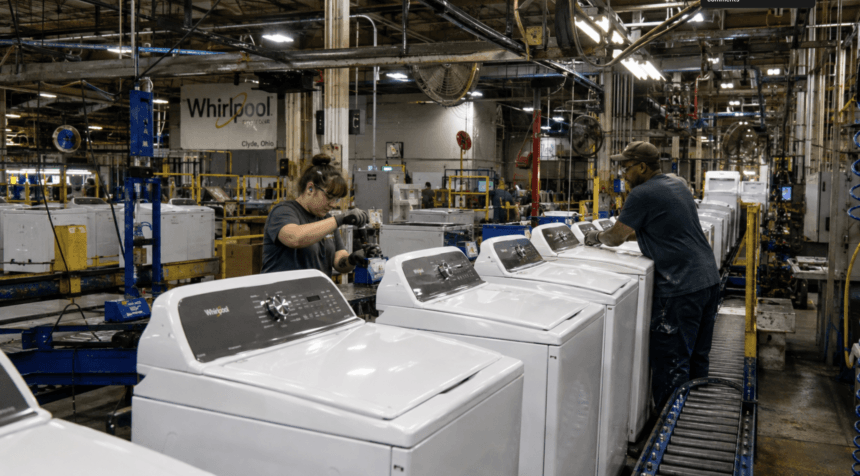
Whirlpool Corp. used a federal labor visit to its Clyde, Ohio, operation to underline a point becoming harder for appliance manufacturers to ignore: the next generation of laundry products will depend as much on trained toolmakers, maintenance workers and production employees as on new factory investment.
The company said Acting U.S. Secretary of Labor Keith Sonderling visited the Clyde facility, which Whirlpool describes as the largest washing machine factory in the world, to review its apprenticeship and training programs. The visit put a national workforce-development frame around one of Whirlpool’s most important U.S. appliance plants.
For appliance manufacturers, retailers and service businesses, the story is less about a one-day plant tour than the operating pressure behind it. Skilled labor, automation maintenance, domestic production capacity and training pipelines are becoming central to whether manufacturers can modernize plants without creating new bottlenecks.
A Plant Visit With a Workforce Message
Whirlpool said the Clyde plant has been operating since 1952, employs about 2,600 people and has maintained a formal apprenticeship program since 1958. During the visit, Sonderling met with apprentices and journeymen in the plant’s tool room, toured an area being modernized and reviewed Whirlpool’s training academy for new production employees.
The same day, Sonderling convened a workforce roundtable with U.S. Senator Jon Husted and northwest Ohio business leaders at Owens Community College in Perrysburg, where Whirlpool was among the participating employers.
The company’s framing was clear: apprenticeship is not being treated as a side program, but as part of the operating model for a mature appliance factory that is being retooled for newer products.
More Read

Why the Clyde Program Matters
Whirlpool describes the Clyde apprenticeship as a four-year, state-certified program that combines classroom instruction with on-the-job training alongside working journeymen. Apprentices work on the dies, tools, molds and automated equipment that keep production running, then move into skilled roles at the plant.
That matters because modern appliance production increasingly depends on equipment uptime and in-house technical knowledge. A plant can add newer lines and more automation, but it still needs people who can maintain, rebuild and troubleshoot the systems behind those lines.
Whirlpool said the apprenticeship program sits alongside an on-site training academy, expanded certification programs and tuition reimbursement for hourly employees who want to move into engineering or plant leadership roles. The next apprenticeship class is scheduled to begin this fall.
Factory Investment Meets Labor Pressure
The visit also came as Whirlpool is putting money into its U.S. laundry footprint. The company said it is investing $300 million in its Clyde and Marion, Ohio, laundry operations, including new and modernized lines and a new generation of front-load washers and dryers expected to launch later this year.
Whirlpool also pointed to construction in Perrysburg for a new parts and sub-assembly plant expected to employ up to 150 people. Taken together, the projects show how workforce training and domestic manufacturing investment are being presented as linked priorities, not separate announcements.
The company said it has about 20,000 U.S. employees, including 14,000 manufacturing workers. Whirlpool also said it builds 80% of what it sells in the United States and sources 96% of its steel domestically.
What the Trade Should Watch
For dealers, distributors and service companies, workforce stories can look distant from day-to-day appliance sales. But training programs at major factories can influence product launches, production consistency, parts flow and the pace at which manufacturers can shift to new platforms.
The practical question is whether companies can pair factory modernization with enough skilled labor to keep production stable. Whirlpool’s Clyde visit suggests the company wants apprenticeships and internal training to be seen as part of its answer.