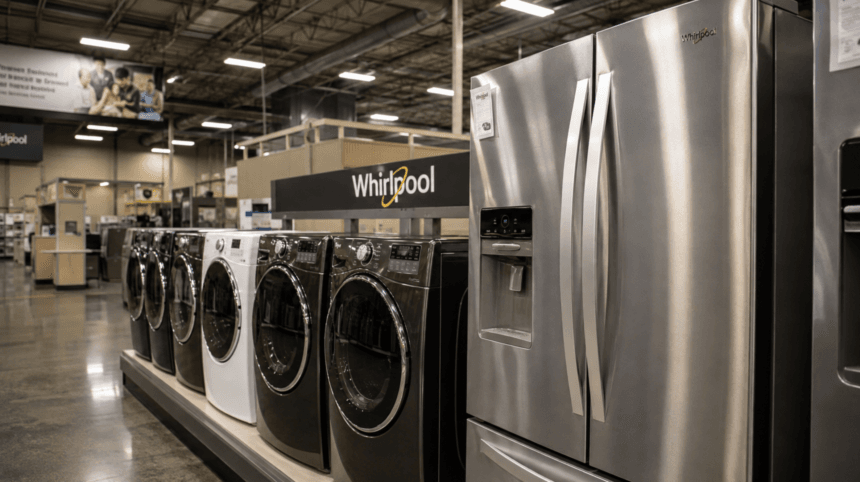
Whirlpool’s strategy of concentrating more of its business in the Americas is running into its hardest test yet: weak U.S. appliance demand, higher costs and a North American profit margin that remains far below last year’s level even after the company’s largest price increases in a decade.
Whirlpool reported second-quarter net sales of $3.52 billion, down 6.8% from a year earlier. GAAP net income available to common shareholders rose to $75 million from $65 million, but the underlying operating picture was weaker: ongoing EBIT fell 69% to $62 million, and ongoing earnings were a loss of 21 cents per diluted share compared with earnings of $1.34 a year earlier.
The results sharpen a strategic question that has been building for several years. Whirlpool has steadily reduced its exposure outside the Americas — contributing its European major-appliance business to Beko Europe, selling its remaining Beko Europe stake this year and reducing its ownership in Whirlpool of India — while betting more heavily on North America, its U.S. manufacturing footprint and brands including Whirlpool, Maytag, KitchenAid, JennAir and Amana.
North American Pricing Helped, but Margins Remain Thin
Major Domestic Appliances North America generated $2.41 billion in second-quarter sales, down 1.5% from $2.45 billion a year earlier. Segment EBIT fell to $64 million from $144 million, cutting the margin to 2.7% from 5.9%.
There was sequential improvement. Whirlpool said North American sales rose 8% from the first quarter and segment EBIT margin improved 240 basis points, primarily because previously announced price increases took effect. New product launches also supported the quarter.
But the year-over-year comparison shows why pricing alone has not solved the problem. Lower industry volume continued to reduce sales, while tariffs, raw-material inflation and fuel costs pressured margins. Favorable price and mix offset only part of those effects.
More Read

That extends a pattern ApplianceNews has been tracking since June, when Whirlpool warned that consumers were delaying appliance replacements. Our July analysis of the company’s tariff strategy found that domestic manufacturing could provide an advantage against finished imports but could not insulate Whirlpool from weak demand, imported-component costs or underused factories. The second-quarter numbers reinforce that distinction: pricing is beginning to help sequentially, but North American EBIT remains less than half its year-ago level.
Whirlpool Has Become a More Americas-Dependent Company
The margin pressure matters more because Whirlpool’s portfolio is now far more concentrated geographically. The company says close to 90% of its 2025 sales were generated in the Americas.
The shift accelerated in Europe. Whirlpool transferred its European major domestic appliance operations into Beko Europe in 2024 and retained a 25% interest. In June 2026, Arçelik agreed to acquire that remaining stake, giving the Turkish appliance company full ownership. Whirlpool said the broader June transaction generated $84 million in net cash proceeds and a $139 million second-quarter gain.
Whirlpool has also reduced its position in India. The company sold an 11% stake in Whirlpool of India in late 2025 and deconsolidated the business, using the proceeds as part of its debt-reduction strategy.
Those moves simplify Whirlpool and can free capital, but they also reduce geographic diversification. A company once spread more broadly across major global appliance markets is now more exposed to the health of North American housing, remodeling and replacement demand. When U.S. consumers postpone a refrigerator, dishwasher or laundry purchase, there are fewer large overseas operations inside Whirlpool to offset the slowdown.
Factory Changes Show the Other Side of the Strategy
Whirlpool’s geographic retrenchment is happening alongside a reset of its North American manufacturing network. ApplianceNews reported in July that Whirlpool plans to close its Supsa refrigeration plant in Apodaca, Mexico, with production expected to cease by the second quarter of 2027. Whirlpool recorded $33 million of restructuring expense tied to that closure in the second quarter.
The company has also reduced employment at its Amana, Iowa, refrigerator operation while investing elsewhere in its U.S. network, including a $60 million Ohio project announced this year. The mix of closures, layoffs and targeted investment reflects a strategy aimed less at preserving every existing plant than at concentrating production where Whirlpool believes it can improve cost and capacity utilization.
For dealers and suppliers, that makes factory utilization as important as tariff protection. A domestic manufacturing footprint can be strategically valuable, but fixed-cost plants need enough volume moving through them. Continued weakness in discretionary replacement and housing-related appliance demand can erode that advantage.
Debt Reduction Now Competes With the Turnaround for Cash
Whirlpool entered the quarter already under balance-sheet pressure. ApplianceNews previously reported on the company’s refinancing and dividend suspension as it shifted cash toward debt reduction. During the second quarter, Whirlpool completed a $2 billion asset-based lending facility and issued $2 billion in secured bonds, clearing major debt maturities until 2028.
The refinancing improves near-term liquidity but carries a cost. Whirlpool lowered its 2026 earnings-per-share outlook to reflect higher interest expense. It now expects GAAP EPS of $2.25 to $2.75 and ongoing EPS of $2.50 to $3, while leaving its operational revenue and margin outlook unchanged.
Whirlpool continues to target about $15 billion in 2026 sales, an ongoing EBIT margin of roughly 4% and more than $300 million of free cash flow. It expects structural cost reductions to contribute more than $150 million, or about one percentage point of margin improvement, and is targeting net debt below $5 billion by year-end.
Those goals connect directly to the earlier Whirlpool stories on ApplianceNews. The company’s tariff thesis, refinancing, dividend suspension, factory changes and warnings about delayed replacement purchases are not separate problems. They are parts of the same turnaround: Whirlpool needs price increases and cost cuts to restore appliance margins while simultaneously reducing debt and keeping enough factory volume to support its concentrated Americas footprint.
The Second Half Will Test the Americas Bet
Whirlpool’s second quarter was better than its first quarter in important ways. North American sales and margins improved sequentially, pricing actions took hold and the company extended its debt maturities. Those are tangible steps in the turnaround.
They have not yet restored the economics Whirlpool enjoyed a year ago. Companywide ongoing EBIT margin was 1.8%, down from 5.3%, and first-half free cash flow was negative $1.11 billion. The quarter’s GAAP profit also benefited from the $139 million gain associated with the Arçelik transactions, making the weaker ongoing result especially important for judging the operating business.
For appliance retailers, servicers and suppliers, the central issue is therefore not whether Whirlpool has abandoned global scale for its own sake. It is whether the more concentrated company that remains can turn its U.S. manufacturing base, established brands and pricing power into durable margins when consumers are cautious and housing demand is weak.
The second half of 2026 should provide a clearer answer. Whirlpool has already made the portfolio smaller, refinanced the balance sheet and raised prices. What it needs now is the part of the strategy it cannot manufacture internally: enough appliance demand to make those decisions pay.