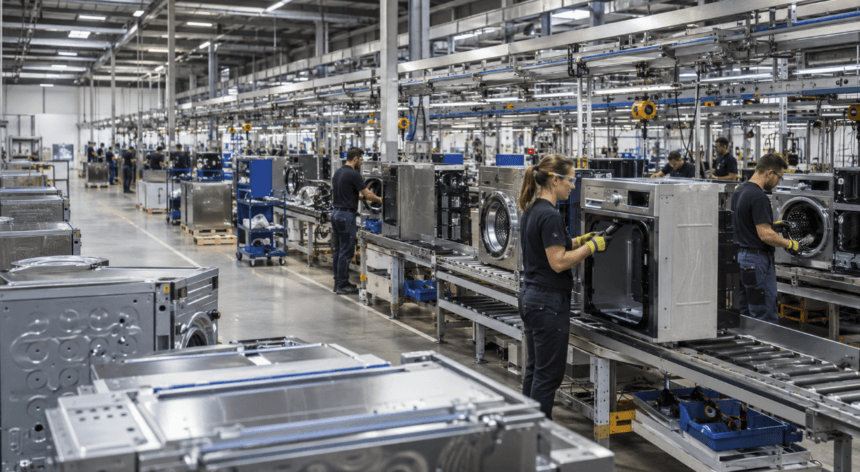
Electrolux’s Anderson, South Carolina, transition has moved from strategy to shutdown work. The company’s refrigeration exit is no longer just a North American joint-venture plan with Midea; it is a late-July layoff window, a smaller crew staying behind for retooling and a race to turn a long-running refrigerator plant into a laundry-appliance operation for 2027.
This is a follow-up to ApplianceNews.org’s July 14 report on the Anderson worker impact and the Electrolux-Midea reset. The earlier story explained the structure of the deal and the stakes for roughly 1,200 Anderson workers. The new development is that the transition timetable has become more concrete: local reporting now points to layoffs expected in late July, about 100 people helping with retooling and laundry production still targeted for the first half of 2027.
The Anderson plant has been a refrigeration site for decades. Under Electrolux Group’s April agreement with Midea Group, that role is being replaced by a Fabric Care manufacturing joint venture, with Electrolux holding 55% and Midea holding 45%. Refrigerator production is being phased out, while washers and dryers are supposed to become the plant’s next act.
What Has Changed Since the First Anderson Story
The broad plan has not changed: Electrolux is moving Anderson away from Food Preservation production and toward Fabric Care. What has changed is the operational stage. The layoff and retooling window is now arriving.
The Anderson Independent Mail, in a report syndicated by AOL, said layoffs at the Anderson County refrigeration plant are expected in late July 2026, with no exact final date set at the time of the report. It also reported that employees are to receive at least 60 days’ notice before their final day of employment, that laid-off employees will be offered severance packages and that about 100 people will help with the retooling process.
That is a narrower and harder phase than the announcement stage. It means the plant must wind down current production, preserve the workforce and supplier knowledge it will need later, install or modify equipment and prepare for a different product category while most of the current workforce is no longer on the floor.
More Read

The Plant Is Not Simply Closing
The Anderson reset is disruptive, but it is not a conventional permanent closure. Electrolux Group says the Anderson factory will be repurposed from Food Preservation into Fabric Care, with the current refrigeration production expected to be phased out by July 2026 and Fabric Care production expected to begin in the first half of 2027.
Electrolux also says the Anderson manufacturing joint venture is expected to hire up to about 1,200 employees gradually across 2027 and 2028 as the site is repurposed. That is the promise behind the temporary shutdown: fewer jobs during the retooling gap, then a ramp back toward comparable employment as laundry production comes online.
Local officials have described the shutdown period as roughly six months. South Carolina Public Radio reported that Anderson County Manager Rusty Burns said all employees would be eligible to be rehired, while also calling the scale of the layoff painful for the community. Fox Carolina reported similar local concern from workers and officials when the layoffs were announced in April.
What Remains Ahead for Retooling
Retooling from refrigeration to laundry is not a sign-change exercise. Refrigerators and freezers depend on cabinet fabrication, insulation, sealed-system handling, refrigeration components, liners, doors and temperature-control platforms. Laundry production brings different cabinets, drums, motors, suspension systems, pumps, water-handling components, dryers, electronics and test procedures.
That shift affects equipment, training, suppliers and quality systems. Tooling has to support washers and dryers rather than refrigerators. Incoming parts streams have to change. Maintenance teams have to learn different production assets. Quality teams have to validate a new set of failure modes. The new plant also has to prove it can hit production targets without carrying over assumptions from the old product category.
Electrolux has said the partnership is expected to require about SEK 1.1 billion in capital expenditure over three years, tied to the Anderson Fabric Care startup and new refrigeration platforms in Juarez, Mexico. That spending underscores that the Anderson change is part of a broader North American production redesign, not a stand-alone local adjustment.
- Workers: The immediate issue is the gap between separation, severance and any future rehire opportunity.
- Suppliers: Refrigeration-linked suppliers face a wind-down, while laundry suppliers need qualification and launch readiness.
- Retailers: The transition could affect future Frigidaire and Electrolux assortment planning in both refrigeration and laundry.
- Servicers: A category shift changes the repair ecosystem, from sealed-system refrigerator work toward laundry diagnostics, pumps, motors and dryer systems.
What It Means for Workers and Suppliers
For workers, the key uncertainty is not whether Electrolux has promised a future hiring path. It is whether workers can bridge the gap. Severance helps, but a months-long shutdown can still force employees to choose between waiting for the plant, taking another manufacturing job or leaving the appliance sector altogether.
The skills question cuts both ways. Some Anderson workers may be valuable precisely because they know the plant, its safety systems, supervisors, maintenance routines and production discipline. But laundry production will require new product-specific training. Rehiring the same number of people does not automatically mean rehiring the same people into the same practical work life.
Suppliers face a different clock. Refrigeration suppliers tied to Anderson must manage the phaseout of current parts. Laundry suppliers need to prepare for a ramp that will not begin until the new operation is ready. The most exposed companies are those with tooling, logistics routes or labor built around the old refrigerator flow and no easy replacement volume.
The U.S. Laundry Production Angle
For U.S. appliance production, the Anderson conversion matters because laundry is one of the industry’s highest-volume replacement categories. Washers and dryers are also strategically important because they sit at the intersection of energy efficiency, water use, cycle performance, electronics, motors and service cost.
Electrolux is not only moving a plant from one product label to another. It is pairing a U.S. production asset with Midea’s manufacturing scale and operational know-how while shifting Food Preservation work to a separate North American structure that includes Juarez. If it works, Anderson becomes part of a more flexible laundry platform. If the launch stumbles, the company risks losing time in a category where retailers expect reliable supply and consumers compare heavily on price, capacity and features.
The unanswered questions remain practical. How many former Anderson refrigerator workers will return? Which laundry models will be built there first? How much supplier work will remain local or regional? How quickly can the plant reach stable output? And what happens if the 2027 startup takes longer than expected?
That is why the Anderson reset has entered the hard part. The partnership announcement created the plan. The layoff and retooling period will determine whether the plan becomes a durable U.S. laundry-manufacturing base or another costly transition in a North American appliance market already under pressure.