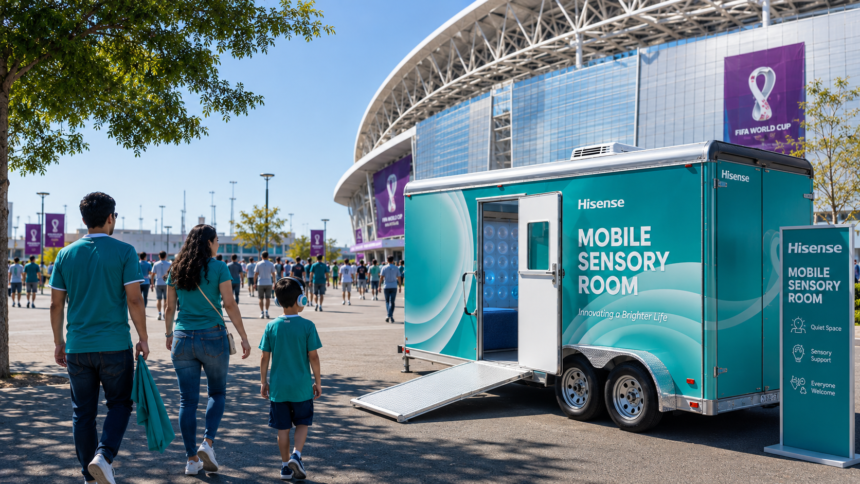
Hisense is moving part of its display strategy beyond the living room and into one of the world’s most demanding public environments: a packed soccer stadium. Every FIFA World Cup 2026 venue is offering a sensory room equipped with Hisense televisions, giving fans who experience sensory overload a quieter place to step away from the noise and movement of match day.
The initiative is part of a broader accessibility program developed by FIFA with sensory-accessibility nonprofit KultureCity. FIFA announced the tournamentwide program May 21, while Hisense used a June 11 release to detail its technology role and a complimentary-ticket initiative for families with sensory needs.
Accessibility moves into the stadium experience
The FIFA World Cup opened June 11 and is staging 104 matches across 16 host cities in Canada, Mexico and the United States over 39 days. FIFA says it is the first sports tournament to receive KultureCity’s Sensory Inclusive recognition, with sensory support available at every match.
For Hisense, the program turns a global sponsorship into a working demonstration of how consumer display technology can be incorporated into an accessibility service. The screens are not being presented primarily as entertainment products inside the sensory rooms. They will instead show calming visual content intended to support relaxation and sensory regulation.
That distinction matters for the appliance and consumer-electronics industry. Much of the television market is built around brighter images, larger screens and more immersive sound. In these spaces, the value proposition is nearly the opposite: technology must support a lower-stimulation environment without adding distraction.
How the rooms are set up
Each of the 16 World Cup stadiums has a dedicated sensory room within the venue or its expanded Stadium Fan Experience area. Eight stadiums have spaces in both locations, and FIFA says fans have access to a sensory space throughout every minute of each match.
More Read
The rooms combine dimmed lighting, reduced noise, comfortable seating and tactile resources with Hisense displays showing calming imagery. They are designed for people who may experience sensory overload, including some individuals with autism, post-traumatic stress disorder, dementia or anxiety.
Hisense and FIFA have not disclosed the television models, display settings or content-production standards being used in the rooms. That means the deployment should be viewed as an accessibility and venue-design program rather than independent validation of a particular television feature or product line.
The rooms are only one part of the tournament’s accessibility plan. FIFA says sensory bags containing noise-canceling headphones, fidget tools and communication devices are available at fan information points. KultureCity also helped develop multilingual “social story” guides intended to help visitors understand the match-day experience before arriving.
The significance is not the screen alone. It is the way display technology is being integrated into a larger accessibility service that also depends on lighting, acoustics, seating, content, staff preparation, wayfinding and equipment availability.
Hisense uses sponsorship as a public technology test
Hisense has been a FIFA commercial partner since 2017 and became an official sponsor of the 2026 tournament under an extension announced in September 2025. The company’s sponsorship has included television branding, fan-experience programs and display technology connected to soccer broadcasts and video-review operations. FIFA
The sensory-room program broadens that strategy. Instead of positioning screens only as a way to create excitement or reproduce stadium energy at home, Hisense is associating its displays with environmental control, accessibility and public-space design.
For manufacturers, the project illustrates how hardware can be evaluated as one component of a complete experience. A premium screen cannot compensate for an inaccessible location, unclear instructions or poorly trained personnel.
Retailers and service businesses can draw a similar lesson. Showrooms, service counters and demonstration areas are often filled with competing audio, flashing displays and bright lighting. Businesses examining accessibility may need to consider the total sensory environment rather than treating accessibility solely as a matter of entrances, aisle widths or website compliance.
What fans and retailers can take from it
For families affected by sensory overload, the practical benefit is the ability to attend a major event without necessarily leaving the stadium when the environment becomes overwhelming. The consistency of having a designated space at every venue may also reduce uncertainty for people traveling between host cities.
Hisense will also provide complimentary match tickets in each host city through KultureCity’s “Make the Nevers Possible” campaign. The companies said the tickets are intended for families with sensory needs who might otherwise be unable to attend.
FIFA’s wider program includes sign-language interpretation for every match, audio-descriptive commentary, mobility assistance and haptic devices at select stadiums. Information about venue-specific services and sensory-room locations is being provided through FIFA’s tournament app. FIFA
- Hardware is only one layer: The rooms combine displays with acoustic, lighting, seating and staffing decisions.
- Accessibility must be available throughout the experience: FIFA says the sensory spaces remain accessible during every match.
- Clear product claims still matter: No specific Hisense models or independently tested sensory-display features have been identified.
- Public deployments can inform retail design: Appliance businesses may find relevant lessons in managing noise, brightness and competing visual stimuli.
The operational test
The operational test is whether fans can locate and use the rooms consistently during crowded, time-sensitive events. Staff readiness, signage, equipment maintenance, room capacity and communication will determine whether the program delivers more than a prominent sponsorship message.
Post-tournament feedback could also help clarify which elements were most useful and whether similar spaces can be replicated at other stadiums, entertainment venues, retail environments or service facilities. FIFA and Hisense have not announced how the program’s use or outcomes will be measured.
For the appliance industry, the project offers a broader definition of innovation. Performance specifications remain important, but technology can also be judged by how effectively it operates within real spaces, alongside trained people and clearly designed services. At the World Cup, Hisense’s screens are part of that larger test.