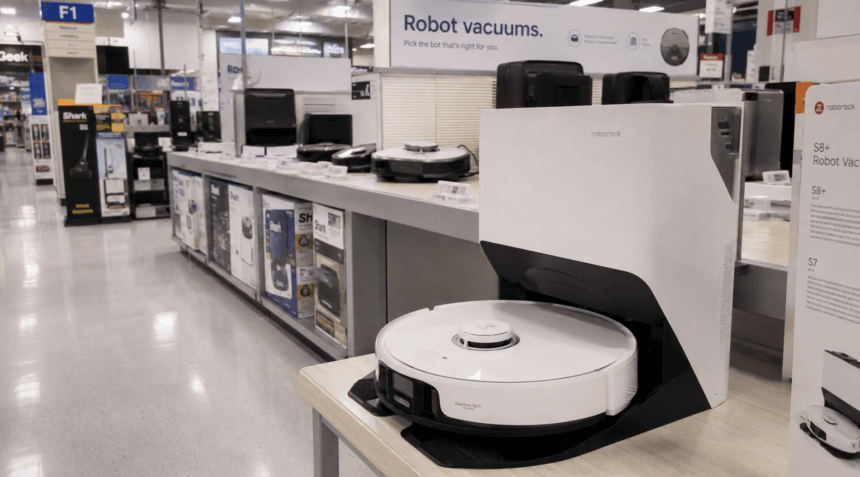
The Federal Communications Commission has added foreign-produced “advanced robotic devices” to its Covered List, a move broad enough to capture many connected robot vacuums and prevent future foreign-made models from receiving the FCC equipment authorization needed to enter the U.S. market unless they qualify for an exception.
The July 28 action does not remove robot vacuums already in American homes or automatically pull current, previously authorized models from store shelves. The immediate pressure is on manufacturers planning new models, and on retailers and distributors whose future assortments depend heavily on robotic floor-care products produced outside the United States.
The Rule Reaches Beyond Humanoid Robots
The FCC’s Covered List now includes foreign-produced advanced robotic devices after a White House-convened interagency body determined that the category presents unacceptable national-security and supply-chain risks. Early coverage focused heavily on humanoid and quadruped robots, but the technical definition is considerably broader.
Covered devices include mobile mechanical systems that can move or navigate on the ground, operate at a distance from a human operator or in response to sensor data, and weigh more than 4.4 pounds when an applicable dock or ground station is included. They also must contain an environmental sensor, qualifying network connectivity and software that controls navigation, perception, data collection or remote command functions.
Those characteristics describe many modern robot vacuums, which commonly map rooms, detect obstacles, communicate over Wi-Fi or Bluetooth and return to charging or self-emptying docks. Independent floor-care publication Vacuum Wars likewise concluded that the definition appears to encompass most modern robotic vacuums.
Existing Models Can Remain on Sale
The distinction between current and future products is important. Equipment already authorized by the FCC is not automatically barred by the July 28 addition. Consumers can continue using products they own, and previously authorized models can continue to be imported, marketed and sold under the policy as announced.
More Read
For shoppers, that means the action is not an immediate ban on every robot vacuum currently available in the United States. For the appliance business, however, it creates a new gate for upcoming models made abroad. A redesigned vacuum, new platform or other product requiring fresh FCC authorization could face a different path than a model that had already cleared the agency before the change.
Foreign Production, Not Chinese Ownership, Is the Formal Test
Although the policy lands especially hard on China’s large robotics manufacturing sector, the FCC framed the new category around foreign production rather than a list of Chinese robot-vacuum brands. Reuters reported that the administration’s broader effort is aimed at reducing security risks and dependence on Chinese technology while encouraging more production in the United States.
The FCC said national-security agencies identified risks including cybersecurity vulnerabilities, sensitive-data exposure and supply-chain disruption. Fox Business reported that the same July 28 action also added foreign-produced connected power inverters to the Covered List.
FCC Chairman Brendan Carr has since said the restrictions are intended both to address security concerns and to spur domestic production. Reuters reported Aug. 6 that Democratic Commissioner Anna Gomez supported the national-security rationale while criticizing the rollout and calling for a more transparent process.
Manufacturers Have a Conditional Approval Route
The policy is not an absolute dead end for every future foreign-made robot. The FCC provides a Conditional Approval route for products or classes of products that receive the required national-security determination. That process will become a key issue for robot-vacuum makers with U.S. launches in development.
Retailers and distributors will need to pay closer attention to the authorization status and production origin of future robotic floor-care lines rather than assuming that a brand’s existing U.S. presence carries over to its next generation. Manufacturers, meanwhile, may have to weigh conditional approval, product changes or manufacturing shifts as they plan U.S. releases.
The practical consumer effect will emerge over future product cycles. Current machines remain usable and existing authorized models remain available, but the rule could narrow or delay the flow of new foreign-made robot vacuums into the United States if manufacturers cannot secure approval for their next products.