Samsung’s reported home-appliance parts increase is not just a pricing story. For servicers, it is a reminder that chip inflation and component inflation can show up long after the appliance leaves the showroom — in the estimate, the warranty claim, the callback decision and the consumer’s repair-versus-replace calculation.
The claim is verified by multiple credible Korean business and wire reports, not by a public U.S. Samsung price bulletin. Yonhap News Agency, Pulse by Maeil Business News Korea, SBS Biz and Korea Economic Daily each reported that Samsung Electronics raised repair-material prices supplied to Samsung Electronics Service in early July, its second increase of 2026 after an earlier January adjustment.
The reports said material costs for Samsung’s Digital Appliances division rose by an average of about 9%, while Mobile eXperience repair materials rose by about 5%. The reported appliance items include motors and compressors used in products such as air conditioners and washing machines. Samsung’s Visual Display division, which includes TVs, was reported to be excluded from the latest increase.
What Has Been Verified — and What Has Not
The verified point is narrower than a broad “all Samsung appliance parts are up 9%” claim. The reporting points to an average increase for repair materials tied to Samsung’s Digital Appliances business and names motors and compressors as examples. It does not provide a full part-number list, a U.S. distributor schedule, a SamsungParts.com price comparison or a public statement that every refrigerator, dishwasher, range or laundry part has changed by the same amount.
That caveat matters for U.S. independent servicers. A Korea service-network adjustment does not automatically prove a matching U.S. parts increase on the same day. But it is still a meaningful signal from Samsung’s global appliance business because the cost drivers — memory chips, electronic components, motors, compressors, materials and supplier pricing — are not confined to one market.
Samsung Electronics Service’s own Korean service-fee guidance shows why parts matter to the final bill. The company describes service charges as the sum of parts cost, repair labor and travel charge, with parts cost defined as the price of the part used for replacement. Yonhap and other reports said materials typically account for 80% to 90% of total after-sales service expenses, meaning even a parts-only increase can become visible at the counter.
More Read
Why This Hits Repair Estimates First
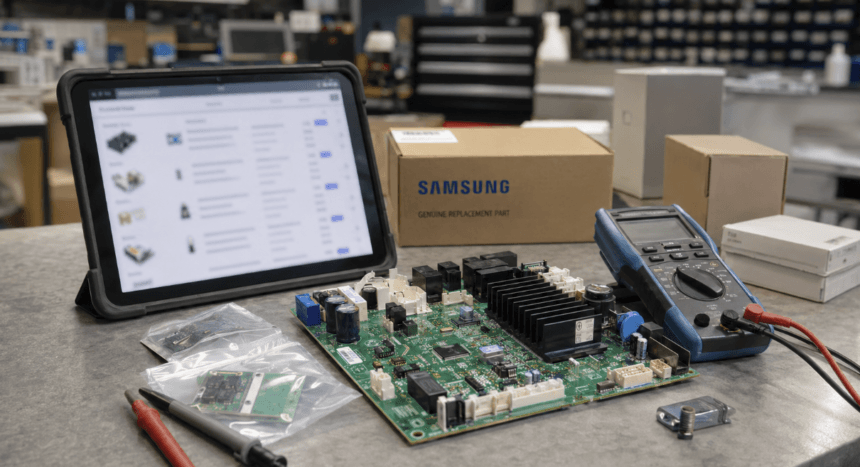
For servicers, parts inflation changes the estimate before it changes the repair. A compressor, motor, inverter board or control assembly can already dominate the economics of a job. If the part cost moves up, the technician has less room to absorb quoting errors, second trips, freight, return restrictions or customer pushback.
The immediate operational risk is stale pricing. A quote built from last month’s part cost can become unprofitable if the replacement part is ordered after a supplier update. Shops that use flat-rate menus, printed estimate sheets, service-plan schedules or dealer-approved labor matrices should check whether parts pricing is being refreshed often enough.
There is also a communication problem. Consumers rarely separate part cost, diagnostic fee, labor and trip charge. When the total estimate rises, the technician is the person explaining why a washer motor, air-conditioner compressor or appliance electronics repair now costs more even though the service visit itself may not have changed.
Warranty Claims and Callbacks Get Tighter
In-warranty repairs create a different pressure point. If the manufacturer pays for the part, rising material costs can affect warranty expense, claim reserves and reimbursement assumptions. If a third-party administrator, retailer protection plan or extended-service contract is paying, the question becomes whether the contract’s allowance has kept up with the new part cost.
For independent servicers, that can turn a covered job into a margin squeeze. A flat reimbursement rate may not reflect a higher OEM part price, added shipping or a second diagnostic visit. Servicers should watch whether Samsung or service-plan partners update parts allowances, authorization thresholds and replacement rules as component costs move.
Callbacks also become more expensive. When a high-cost part is installed and the appliance returns with the same symptom, the shop may face a no-margin second visit, a disputed diagnosis or a part-return process that ties up cash. Higher part prices make documentation more important: error codes, amp draws, temperature readings, photos, serial numbers, board revisions and customer-use notes all become part of protecting the claim.
- Before quoting: Confirm current part cost, availability, freight and return terms.
- Before ordering: Recheck whether the customer, warranty administrator or manufacturer has approved the updated total.
- Before installing: Document diagnostics clearly enough to defend the part decision if the repair is questioned.
- After repair: Track callbacks by part family, not just by brand, so inflation does not hide repeat-failure patterns.
Repair Versus Replace Gets Harder
The consumer impact is clearest on older appliances. If a seven-year-old washer needs a motor repair or a major cooling product needs a compressor-related repair, a parts increase can push the estimate closer to the replacement threshold. That does not mean replacement is always the right answer. It means the math becomes more sensitive to age, condition, warranty status and expected remaining life.
Servicers should be careful not to turn every expensive estimate into a replacement recommendation. A well-maintained premium appliance with available parts and a clear diagnosis may still justify repair. A lower-cost unit with multiple symptoms, deferred maintenance or a history of electronic failures may not.
The harder cases are in the middle: inverter-driven laundry, smart controls, variable-speed compressors and appliances with one expensive failure but otherwise strong condition. Component inflation makes those conversations more transparent but less comfortable. Consumers need to understand whether they are paying for a durable repair, a temporary fix or a high-cost gamble.
Samsung’s Bigger Business Context
The parts-price reports land at an awkward moment for Samsung’s public story. Samsung’s July 7 earnings guidance projected second-quarter consolidated sales of about KRW 171 trillion and operating profit of about KRW 89.4 trillion, a record-level profit picture driven by the semiconductor cycle and AI-related memory demand.
That does not mean the appliance business is swimming in the same margin pool. In Samsung’s first-quarter results, the company said its Visual Display and Digital Appliances businesses posted KRW 14.3 trillion in revenue and KRW 0.2 trillion in operating profit. Samsung said the Digital Appliances business saw only limited earnings improvement amid cost pressures and tariffs, and that it planned cost-efficiency initiatives while driving premium sales.
The repair-parts increase also follows a separate corporate reset in the United States. ApplianceNews.org previously reported on Samsung Electronics America’s confirmed headquarters move from Englewood Cliffs, New Jersey, to Plano, Texas, including employee reports about relocation and layoff timing and unresolved questions about final staffing. That headquarters move is not evidence that parts prices rose because of U.S. layoffs. It does, however, fit a broader pattern of Samsung tightening operating structure while cost pressure moves through appliances, service and support.
What Servicers Should Watch Now
The next question is whether the Korean service-network price change becomes a broader North American parts-pricing reality. Servicers should monitor Samsung-authorized portals, distributor updates, SamsungParts.com listings, service-plan reimbursement schedules and backordered high-cost components.
Retailers and warranty administrators should also pay attention. A consumer who bought an extended plan expects the plan to absorb repair risk. If parts inflation narrows the gap between repair and replacement, administrators may become more aggressive about authorization, cash-out offers or replacement thresholds.
For consumers, the advice is simple: ask for the parts/labor/trip breakdown, ask whether the estimate is current, ask whether the part is in stock and ask how the repair compares with replacement cost. For servicers, the advice is sharper: quote from live pricing, document the diagnosis and do not let chipflation turn a parts problem into a margin problem.