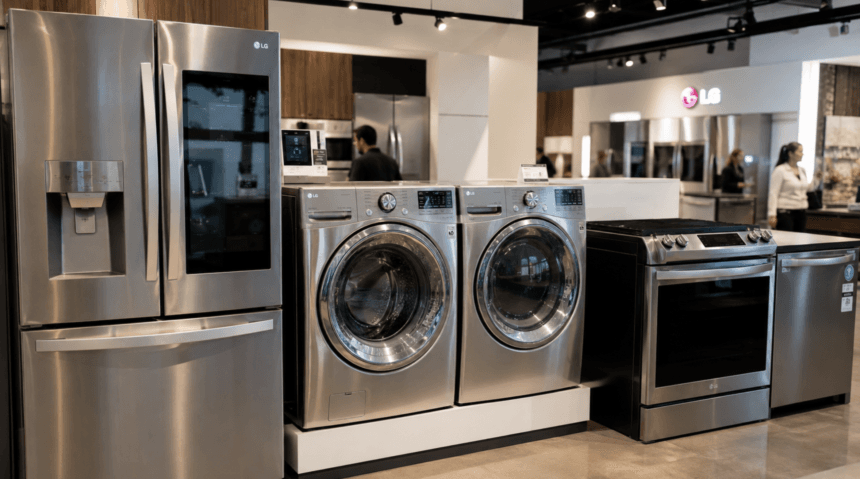
LG Electronics posted its strongest second-quarter financial performance to date, with home appliances helping drive consolidated revenue to KRW 23.83 trillion and operating profit to KRW 1.58 trillion. The company’s home appliance business crossed KRW 7 trillion in quarterly revenue for the first time as LG leaned on premium products, subscriptions, online sales and cost controls.
Second-quarter revenue rose 14.9% from a year earlier, while operating profit increased 147%, according to LG. The comparison is especially sharp because LG reported KRW 20.74 trillion in revenue and KRW 639.4 billion in operating profit in the second quarter of 2025, when tariffs, logistics expenses and weak consumer demand weighed on results.
The latest quarter also included roughly KRW 300 billion in one-time gains, including tariff refunds, according to the company’s earnings discussion. That means the headline profit increase was not solely the result of stronger underlying operations, although LG also credited higher sales, a richer mix of high-value products, cost improvements and operating efficiencies.
Home Appliances Cross a New Quarterly Sales Threshold
LG’s Home Appliance Solution business remained the company’s largest contributor, generating about KRW 7.75 trillion in sales and KRW 685.9 billion in operating profit during the quarter. LG said the appliance business surpassed KRW 7 trillion in quarterly revenue for the first time.
The performance extends a strong start to 2026 for the division. In the first quarter, Home Appliance Solution reported KRW 6.94 trillion in revenue, then an all-time quarterly high, and KRW 570 billion in operating profit. LG attributed that earlier growth to its two-track strategy of competing in both premium and mass-market segments while expanding subscription and online businesses.
For retailers, the results reinforce how LG is trying to grow appliance revenue through more than unit sales alone. Subscription programs and direct online sales give the manufacturer recurring and direct-to-consumer revenue streams alongside the traditional dealer channel, while premium products can support higher average selling prices.
More Read
Profit Growth Came With a One-Time Boost
LG’s KRW 1.58 trillion consolidated operating profit was a major improvement from the same period last year, but the composition of that gain matters. Management said tariff refunds contributed to one-time gains of about KRW 300 billion during the quarter.
Even with that benefit, the company pointed to stronger home appliance sales, premium TV demand, automotive electronics growth and improved cost competitiveness as operating drivers. Consolidated net income was about KRW 781.3 billion.
The tariff effect is particularly relevant to the appliance business. LG entered 2026 managing higher raw-material and U.S. tariff costs, and its first-quarter appliance operating margin was 8.2% despite those pressures. Cost control and supply-chain optimization have remained central to the company’s plan for protecting margins.
Subscriptions and B2B Revenue Keep Expanding
LG’s broader strategy is increasingly built around revenue that does not depend solely on conventional consumer hardware purchases. B2B revenue reached KRW 6.5 trillion in the second quarter and represented 36% of consolidated revenue, according to the company. Subscription revenue reached KRW 660 billion.
For the appliance operation, subscriptions can change the relationship among manufacturers, dealers, servicers and customers because product ownership is bundled more closely with ongoing service. Expansion of that model makes installation, maintenance and customer retention increasingly important alongside the initial appliance sale.
LG is also continuing to pursue growth outside mature consumer markets. Management said demand in India, China and parts of the Global South remains stronger than in developed markets, while the company is expanding businesses including AI data center cooling and robotics.
LG Still Faces Cost and Demand Pressure
The record second-quarter results do not remove the pressures facing appliance manufacturers. LG said consumer spending remains soft in some developed markets, while freight costs, raw-material prices and geopolitical risks could continue to pressure profitability.
The company expects logistics costs to remain elevated before easing and plans to keep emphasizing high-value products, cost reductions, subscriptions and direct online sales. Those priorities put the home appliance division at the center of LG’s effort to sustain earnings after the one-time benefits included in the second quarter.
For the appliance trade, the next test is whether the division can maintain its new revenue scale while protecting margins in a market where demand remains uneven. After home appliance revenue moved above KRW 7 trillion for the first time, LG enters the second half with a larger sales base — and a tougher comparison for determining how much of 2026’s profit improvement can be repeated.