GE Appliances has turned part of its Georgia cooking-products plant into a test of whether factory labor can work more like app-based scheduling without losing the discipline that manufacturing depends on.
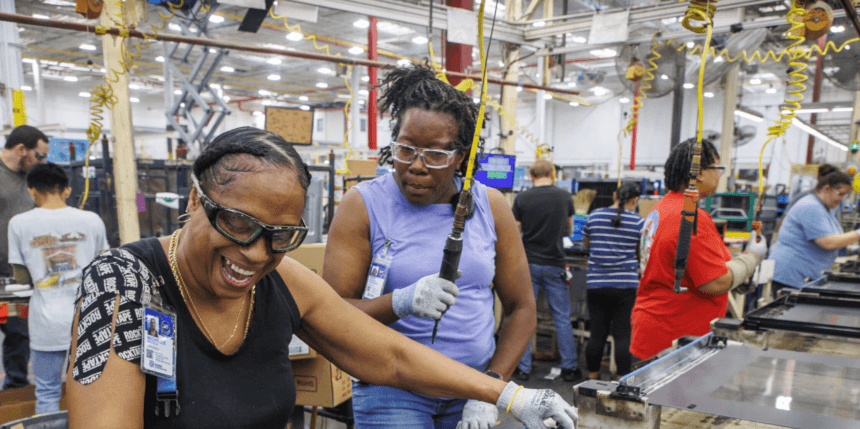
At Roper Corporation in LaFayette, Georgia, GE Appliances has expanded flexible shift scheduling through MyWorkChoice, an app that lets people pick up manufacturing shifts rather than commit only to a traditional fixed schedule. GE Appliances says more than 1,500 people now use the program to fill the equivalent of 200 full-time positions daily at Roper, giving working parents, retirees and other nontraditional workers access to part-time factory jobs.
The model is not remote work for the plant floor. It is a staffing layer built around pre-qualified workers, posted shifts, attendance rules and production needs. For appliance manufacturers facing tight labor pools, overtime fatigue and demand swings, that makes the experiment worth watching. It also raises harder questions about pay, benefits, retention and whether flexibility can support factory stability without creating a second-tier workforce.
How Flexible Factory Shifts Work
The Roper plant makes cooking products, including ranges, wall ovens and cooktops. GE Appliances says the site has 15 production lines and is vertically integrated with stamping, paint, enamel, welding, graphics and production under one roof. That is a complex environment for any flexible-labor model because each line has its own pace, safety requirements and quality expectations.
MyWorkChoice is the verified scheduling partner at Roper. GE Appliances describes the app as a way for people to schedule as little as one shift a week up to full-time, with workers trained and pre-qualified before they sign up for shifts. Current reporting from Georgia Public Broadcasting and NPR described a pool of more than 900 workers who sign up through the app, with about 450 flexible workers picking up shifts in a typical week and averaging 24 hours a week.
The day-to-day mechanics look less casual than the “gig” label may suggest. MyWorkChoice’s own GE/Roper worker guidance lists pay rates by shift, safety rules, line locations, clock-in procedures, reliability ratings and penalties for late arrivals, early departures or excessive dropped shifts. The company says shift access is tied to reliability ratings, and its GE/Roper guidance says dropping too many shifts within 30 days can result in suspension.
More Read

Why Appliance Makers Would Consider It
Appliance production is unforgiving. A plant needs enough people in the right place at the right time, and a missing operator can affect line speed, quality checks, material flow or overtime requirements for the rest of the crew.
GE Appliances first leaned into flexible work at Roper during the pandemic-era production crunch, when appliance demand rose and the plant was short of workers. The model gave the plant an additional pool of trained labor to cover absences, support higher demand and reach people who were not looking for a conventional 40-hour manufacturing job.
That labor strategy now sits inside a broader manufacturing investment. GE Appliances completed a $180 million expansion at Roper in 2025, adding capacity, robotics and more than 600 jobs. The new high-volume lines can produce gas, electric or induction ranges and flex to meet customer demand. Flexible staffing is therefore not a side story; it is one piece of how the company is trying to make a high-investment U.S. appliance plant more responsive.
- Absence coverage: A flexible pool can backfill dropped shifts without forcing every gap into mandatory overtime.
- Demand swings: Plants can add hours around busy production periods without hiring every worker into a fixed schedule.
- Recruiting reach: Part-time access can attract parents, students, retirees and workers with second jobs.
- Retention options: Experienced workers who might otherwise leave can remain connected to the plant on fewer days.
The Retention Promise and the Benefits Gap
MyWorkChoice presents the GE Appliances case as evidence that flexibility can outperform traditional temp-to-hire manufacturing roles. Its case study says flexible job positions at GE Appliances produced a 106% higher rate of new hires than traditional temp-to-hire positions in a comparison involving two manufacturers. It also says more than 70% of flexible workers lasted more than a year, compared with a typical temp-hire tenure of six weeks.
Those figures are useful, but they should be treated as vendor-reported results rather than an independent labor study. They do, however, fit the central problem facing many factories: attracting workers is not enough if attendance policies, mandatory overtime or rigid hours push them back out.
The tradeoff is benefits. Georgia Public Broadcasting and NPR reported that many Roper flexible workers prize schedule control despite lower pay and almost no benefits, and that MyWorkChoice employees can opt into a group healthcare plan but few do. The same reporting said some workers can become full-time GE Appliances employees and gain access to the company’s full benefits package, including paid time off, paid holidays, on-site healthcare and a 401(k) match, but not every worker wants that conversion.
That is the labor-policy tension. Flexibility can open the door for people who cannot or do not want to work a conventional schedule. It can also normalize a work arrangement in which some people help staff a major appliance plant while remaining outside the full employer-benefit structure that traditional employees receive.
Production Stability Is the Real Test
Manufacturing leaders have long favored consistent crews because repetition supports quality, speed, safety and problem solving. Flexible scheduling challenges that assumption. A worker who appears two days this week and four days next week may be valuable, but the plant still has to control training, task assignment, line balance and supervisor workload.
The Roper example suggests the model works best when flexibility is bounded. Workers are pre-qualified before signing up for shifts. Shift access is tied to reliability. Safety gear, line-specific tasks and production rates are spelled out in worker guidance. The plant started with smaller areas and expanded over time rather than turning the whole factory into an open shift marketplace at once.
For appliance manufacturers, that may be the lesson. The app is not the strategy by itself. The strategy is deciding which jobs can tolerate flexible coverage, which jobs require stable crews, how much training is needed before a worker can move across lines and how supervisors will protect quality when the workforce mix changes daily.
What Other Appliance Plants Should Watch
The Roper model will not fit every appliance plant. A unionized facility, a highly specialized refrigeration line, a tight-margin supplier plant or a site with complex certification requirements may draw different boundaries around flexible work. The model also depends on a local labor pool large enough to support optional scheduling.
Manufacturers should watch whether flexible scheduling reduces absenteeism and overtime without hurting first-pass quality, safety, training time or supervisor effectiveness. Retailers and distributors should care because factory labor instability can eventually show up as missed launch dates, constrained availability or uneven product flow.
Workers should watch the conversion path. If flexible shifts are a bridge into full-time appliance manufacturing, they can expand access to stable jobs. If they become a permanent substitute for full-time hiring, the model may shift risk from the factory to the worker.
GE Appliances’ experiment is not a simple tech success story. It is a factory-labor redesign built around the reality that some people want manufacturing work but not manufacturing’s old schedule bargain. Whether it becomes a broader appliance-industry template will depend on whether plants can turn that flexibility into reliable production without eroding the employment package that made factory jobs valuable in the first place.