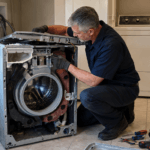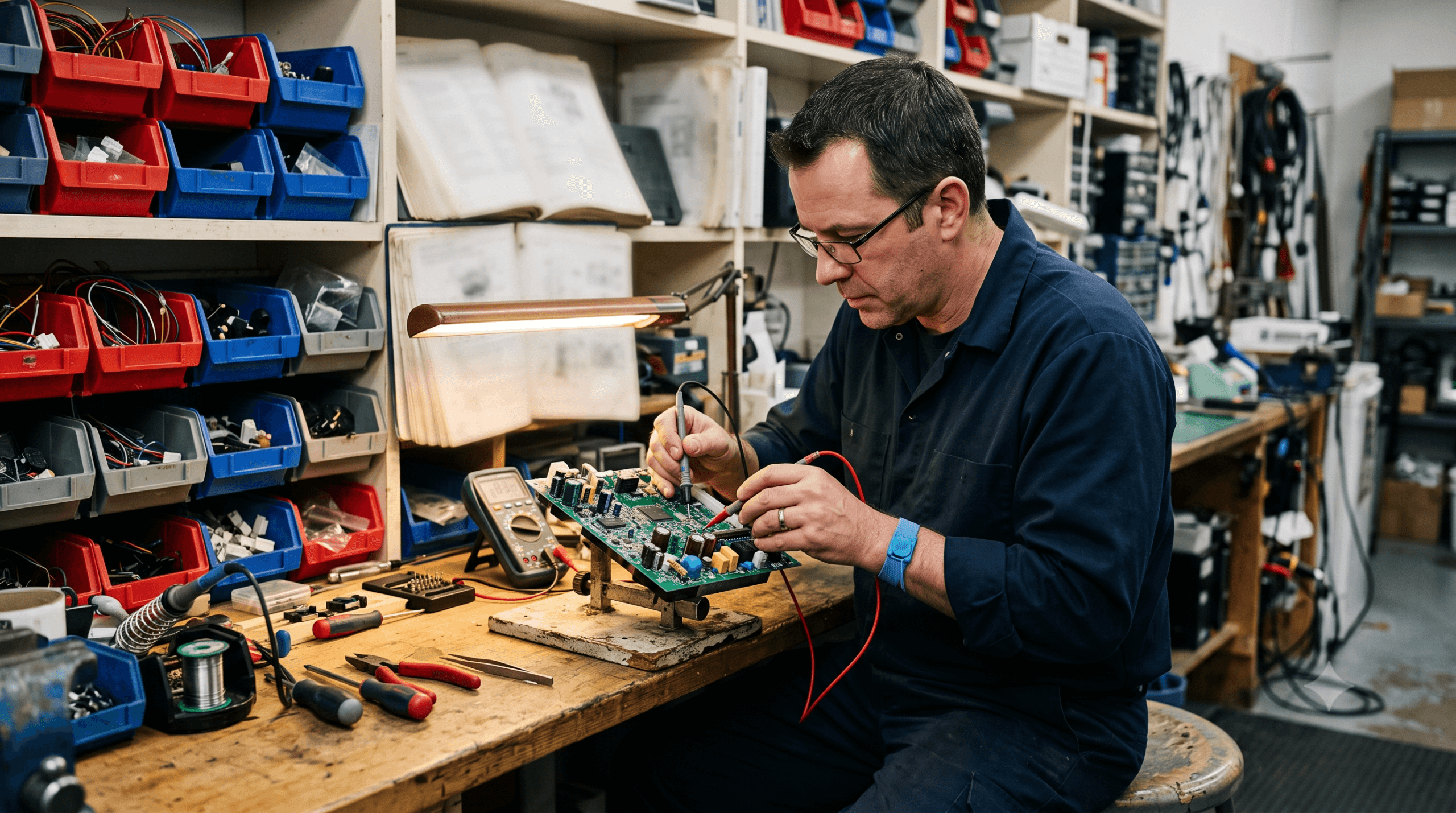
Right to repair is moving from legislative slogans into enforcement details. For appliance manufacturers, retailers, servicers and warranty companies, the next fight is not simply whether repair access exists on paper. It is whether parts, tools, software and documentation are available on terms that an independent shop, in-house technician or skilled owner can actually use.
That is the implementation fight behind the phrase “fair and reasonable.” It sounds simple. In practice, it decides whether a right-to-repair law becomes a meaningful service-market change or a compliance page that few repair businesses can navigate.
Appliance News previously covered the broader right-to-repair landscape for home appliances. This follow-up focuses on what happens after laws pass: enforcement, pricing, diagnostic software, parts pairing, warranty language and the continuing power of authorized repair networks.
Deere made access concrete
The clearest recent example comes outside household appliances, but it matters to the appliance industry. In April, Deere & Co. agreed to pay $99 million to settle a right-to-repair class action alleging the company restricted farmers’ access to repair tools and services for agricultural equipment. Deere denied wrongdoing, but the proposed settlement includes both money and repair-access commitments. Reuters
Reuters reported that Deere agreed to make available to farmers for 10 years the digital tools required for maintenance, diagnosis and repair of large agricultural equipment, including tractors, combines and sugarcane harvesters. The case does not create a home-appliance rule by itself, and it remains tied to agricultural equipment and the settlement terms. But it shows where enforcement is heading: access to software is no longer a theoretical demand.
For appliance companies, the lesson is direct. A modern refrigerator, washer, dryer, dishwasher or range is no longer only a mechanical product. Control boards, firmware, service modes, fault codes, proprietary diagnostics, smart-home modules and parts authorization systems increasingly define whether a repair can be completed. A right to buy a part is incomplete if the technician cannot diagnose, configure or authorize that part.
More Read
Deere’s settlement also shows why money alone is not the whole remedy. A payout compensates past claims. Tool access changes future repair behavior. That distinction is exactly where appliance right-to-repair disputes are likely to move.
Warranty language is an enforcement front
The Federal Trade Commission has already made warranty language part of the right-to-repair fight. In July 2024, FTC staff sent warning letters to eight companies over warranty practices that agency staff said may violate the Magnuson-Moss Warranty Act. The letters focused on language or practices that could lead consumers to believe their warranties would be voided if they used third-party parts or independent repair services. FTC
For appliance brands, that warning should be read broadly. Warranty manuals, customer-service scripts, dealer training, online warranty portals and service-dispatch language can all create risk if they imply that an owner loses warranty coverage merely by using an independent servicer or nonoriginal part. A manufacturer can deny coverage for damage caused by improper repair. It cannot use warranty language to block lawful repair competition.
That distinction is easy to blur on the sales floor. A customer may be told, “Use only authorized service or you’ll void the warranty.” The legally safer answer is more precise: warranty coverage may be denied if an improper repair or unauthorized part causes the failure, but consumers generally cannot be required to use branded parts or authorized service to keep a warranty valid unless the service or part is provided free or the manufacturer has a waiver.
Appliance News has also covered related warranty-policy pressure in Europe, including a Belgian push to extend warranties and connect repairability with product reliability. The U.S. debate is different, but the underlying question is similar: whether warranty systems encourage repair or steer consumers toward locked-in service channels and early replacement.
Colorado puts parts pairing in force
Colorado’s digital electronic equipment right-to-repair law took effect Jan. 1, 2026, expanding the state’s repair-access requirements to certain digital electronic equipment manufactured and sold or used for the first time in Colorado on or after July 1, 2021. The Colorado legislature describes the act as applying to digital electronic equipment while listing exemptions for categories including motor vehicles, some medical devices, certain security equipment, construction and energy equipment, and video game consoles. Colorado General Assembly
Colorado lawmakers said the law bans practices such as parts pairing and software restrictions that lock in customers. That matters for appliances because many household products now depend on embedded electronics. A connected refrigerator, front-load washer, induction range or smart wall oven may not look like a phone, but it can still depend on software-controlled components and electronic modules. Colorado Senate Democrats
Parts pairing is where repair access often becomes real or meaningless. If a replacement control board, pump, display, inverter, sensor or door-lock assembly must be electronically paired to the appliance before it works, the owner or independent technician needs access to the pairing process. If only authorized service can complete the pairing, a nominal parts sale may still leave independent repair locked out.
Manufacturers can argue that pairing protects safety, cybersecurity, calibration and product integrity. Those concerns can be legitimate. The implementation fight is whether a manufacturer can protect those interests without using software authorization as a competitive barrier.
“Fair and reasonable” is the real battle
Many right-to-repair laws use language requiring access to documentation, parts and tools on fair and reasonable terms. The phrase is doing a lot of work. It has to cover price, availability, format, timing, training, software access, security procedures and whether an independent shop can actually complete a repair profitably.
- Parts pricing: Are parts priced at a level that lets independent repair compete, or so high that replacement becomes the practical option?
- Diagnostic software: Are tools equivalent enough to authorized-dealer tools to identify faults, clear codes and complete calibration?
- Documentation: Are service manuals complete, current and searchable, or limited to generic consumer troubleshooting?
- Parts pairing: Can a lawful replacement module be activated without routing the customer back through the manufacturer’s authorized network?
- Network rules: Are safety and certification requirements real safeguards, or barriers that keep independent shops out?
For appliance manufacturers, the safest compliance strategy is to assume regulators and plaintiffs will look at practical access, not only formal availability. Posting a portal is not enough if the portal lacks current manuals, hides error-code trees, excludes calibration functions, delays parts ordering or prices tools beyond realistic use.
For independent servicers, “fair and reasonable” will likely be tested through real examples: a sealed-system repair delayed because software access is missing; a washer control board that cannot be paired; a smart oven error code that requires a dealer-only diagnostic app; or a refrigerator part priced so high that a repair quote becomes uneconomic.
Authorized networks will not disappear
Right to repair does not mean authorized service networks become irrelevant. Appliance manufacturers still need trained warranty servicers, brand-controlled technical support, recall execution, safety campaigns and quality feedback loops. For complex repairs involving refrigerants, gas combustion, high voltage, induction power electronics or connected security features, qualification still matters.
The implementation issue is whether authorized status remains a quality signal or becomes a gatekeeping tool. A manufacturer can reasonably require safe procedures, licensing where applicable and protection against cybersecurity abuse. The legal and reputational risk grows when the network structure appears designed primarily to keep diagnostics, parts or software away from competitors.
Retailers and warranty administrators should watch this closely. If a warranty company sends a customer to an independent servicer who cannot access the required diagnostics, the repair may fail even if the technician is skilled. If a retailer sells a connected appliance without explaining service-access limitations, the customer may blame the dealer when repairs become slow or expensive.
The most durable model may be a tiered one: basic documentation and parts access for owners and independent shops, paid professional diagnostic subscriptions for commercial servicers, and specialized certification for safety-critical or cybersecurity-sensitive functions. The dispute will be over whether those tiers are genuinely functional or intentionally restrictive.
What appliance companies should do now
Manufacturers should audit repair-access systems before a regulator, plaintiff or state attorney general does it for them. That audit should include service manuals, parts portals, diagnostic subscriptions, pairing procedures, warranty scripts, dealer training, authorized-service agreements and consumer-facing statements about third-party repair.
The audit should ask a practical question: Could a competent independent servicer diagnose and complete common repairs within a commercially reasonable time and cost? If the answer is no, the company should identify whether the barrier is safety-related, technical, contractual or simply a legacy control point.
Parts pricing deserves its own review. A manufacturer may comply with a parts-availability requirement while still setting prices that make repair unrealistic. That could become one of the next enforcement fights because high parts prices can function like a repair restriction even when the part is technically for sale.
Diagnostic software is another priority. If an authorized technician can see fault histories, run component tests, pair modules and perform calibrations, regulators may ask why an independent professional cannot obtain a comparable tool under reasonable security and payment conditions.
What servicers and retailers should watch
Independent servicers should document access failures. A vague complaint that a brand is hard to work on may not move enforcement. A record showing that a specific model required a dealer-only diagnostic function, unavailable pairing step, missing service manual or unreasonable parts price is more useful.
Retailers should train sales teams not to make broad warranty threats. A customer who asks about independent repair should not be told that all nonauthorized service voids the warranty. Sales staff should explain that improper repairs can affect coverage, while warranty rights generally cannot be conditioned on paid authorized service or branded parts unless the law allows it.
Warranty companies should also track repeat denials tied to third-party repair. If claims are denied because the customer used an independent servicer, the file should clearly distinguish between lawful warranty limits and unsupported tying language. The FTC’s warning letters show that warranty wording is not a side issue; it is part of right-to-repair enforcement.
For consumers, the practical question is whether repair access reduces the total cost of owning an appliance. A right that exists only after a customer hires a lawyer or files a complaint is not enough. The point of implementation is to make ordinary repair possible before the appliance is scrapped.
The next phase is proof
The right-to-repair movement has won enough legislative and legal ground that the next phase will be measured in proof. Can a shop buy the part? Can it access the diagnostic? Can it pair the module? Can it obtain the manual? Can it do all of that at a price that lets the customer choose repair over replacement?
Deere’s settlement, the FTC’s warranty warnings and Colorado’s parts-pairing restrictions point in the same direction. The fight is no longer only about whether consumers should have a right to repair. It is about whether manufacturers implement that right in a way that changes the repair market.
For the appliance industry, that makes “fair and reasonable” the phrase to watch. It will decide whether right to repair becomes a practical service channel, a compliance burden or the next major source of litigation.