LG’s electric range recall is still testing one of the most uncomfortable questions in appliance safety: When a range can be turned on by a child, an adult brushing past it or a pet bumping the front controls, is a warning label enough?
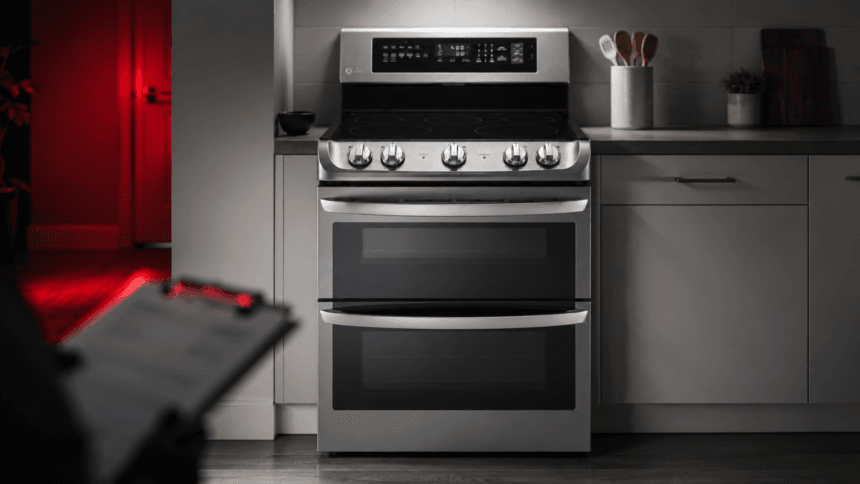
The recall covers about 500,000 LG slide-in and freestanding electric ranges with front-mounted knobs. The U.S. Consumer Product Safety Commission said it had received at least 86 reports of unintentional knob activation tied to the ranges, which have been involved in more than 28 fires. At least five fires caused more than $340,000 in property damage, at least eight minor injuries including burns were reported, and three fires involved pet deaths. CPSC
The remedy is not a replacement range. It is not a new knob system. It is not a technician visit. LG is providing a free warning label, placement instructions and instructions for using the range’s Lock Out or Control Lock function. That remedy has drawn new attention as local reporting has documented post-recall fire claims and consumer frustration over a fix that depends on behavior, memory and a functioning electronic lockout.
The issue matters beyond LG. Appliance News has covered Frigidaire’s gas range recall and proposed class action, and previously reported on Fisher & Paykel’s professional gas range recall. Those cases involved different hazards, but they offer a useful comparison: both Frigidaire and Fisher & Paykel told consumers to stop using the affected ovens until repairs were completed. LG’s remedy leaves owners using the same appliance while relying on a warning and control-lock routine.
What LG recalled
The recalled products are LG slide-in and freestanding electric ranges with front-mounted knobs, sold from 2015 through January 2025 for $1,400 to $2,650. They were sold at Best Buy, Costco, The Home Depot, Lowe’s, LG.com and other appliance retailers nationwide. The ranges were manufactured in Mexico and Korea and imported by LG Electronics USA Inc. of Englewood Cliffs, New Jersey.
The model list includes LDE4411ST, LDE4413ST, LDE4413BD, LSE4611ST, LSE4611BD, LSE4613ST, LSE4613BD, LSEL6337D, LSEL6337F, LSEL6331F, LSEL6333F, LSEL6333D, LSEL6335D, LSEL6335F, LTE4815BM, LTE4815BD, LTE4815ST, LRE4215ST and LTEL7337F, among others in the CPSC notice. Consumers should confirm both model and serial numbers because the recall is tied to specified serial-number ranges, not every product carrying a listed model number.
More Read
The hazard is accidental activation. CPSC says the front-mounted knobs can be activated by accidental contact by humans or pets, posing a fire hazard. The agency’s warning is practical: keep children and pets away from the knobs, check that knobs are off before leaving home or going to bed, and do not leave objects on the range when it is not in use.
- Units recalled: About 500,000 LG electric ranges in the United States.
- Hazard: Front-mounted knobs can be activated by accidental contact by people or pets.
- Incidents: At least 86 unintentional activation reports and more than 28 fires.
- Reported harm: At least eight minor injuries, more than $340,000 in property damage and three fires involving pet deaths.
- LG remedy: A free warning label and instructions for using Lock Out or Control Lock.
Why the warning label is the story
A warning label can be appropriate when the hazard depends mainly on awareness and correct use. The LG recall is more complicated because the reported hazard involves an appliance being activated when consumers may not intend to use it at all.
LG’s label reminds consumers to use the range’s Lock Out or Control Lock function to disable activation of the heating elements when the range is not in use. That approach shifts much of the safety burden to the household. The owner must know about the recall, receive or request the label, place it correctly, remember to use the lock function, make sure everyone in the home understands the risk and keep combustible items off the cooking surface.
That is a different kind of remedy from a physical repair. A new part, new knob system, control redesign or technician-installed fix changes the appliance. A warning label changes the instructions around the appliance.
CBS News reported that LG’s recalled ranges had burned property, people and pets, citing the CPSC totals of more than 28 fires, at least eight minor injuries and at least three fires involving pet deaths. The CBS report also noted that owners are being told to contact LG for the warning label and use the lockout function, while CPSC has warned that accidental range activation has affected multiple brands and has been linked to broader fire and injury reports. CBS News
That larger context matters. The problem is not just one sticker. It is whether front-mounted range controls can be made safe enough through warnings after a product has been installed in hundreds of thousands of kitchens for years.
A Rocky Hill fire shows the real-world risk
WFSB’s I-Team reported in April 2025 that a Rocky Hill, Connecticut, family’s LG Freestanding Double Oven Electric Range, model LDE4413ST, caught fire in March. The station reported that the model was included in the February 2025 recall. WFSB
According to WFSB, the fire marshal’s investigation found the origin of the fire was the stovetop and that the knobs had been turned on. The homeowner said pizza boxes on top of the stove caught fire and that he believed the knobs could have been activated by teenagers in the kitchen or by the family’s dogs. WFSB reported that the family — two adults, four children and pets — was living in a hotel while smoke damage was repaired.
The homeowner told WFSB that the knobs could turn with a brush or graze and criticized the label remedy. WFSB also reported that LG told the station it was sending outside experts to inspect the home and that LG described the program as consumer education about the range’s Control Lock or Lock Out feature, provided in cooperation with CPSC.
That case does not prove every LG range will fail or that every reported fire has the same cause. It does show the practical weakness of a warning-based remedy: the dangerous condition may occur in the ordinary clutter and movement of a real kitchen, not in a controlled showroom where every user follows a safety checklist every time.
WFSB later reported that another Connecticut owner questioned whether the lock feature continued to work after a storm, saying she had been diligent about using the control lock because of concerns that a dog or person could bump the knobs. The station reported that she demonstrated how easily a cabinet door could nudge a knob. WFSB
How Frigidaire and Fisher & Paykel compare
The Frigidaire and Fisher & Paykel recalls involved gas oven delayed ignition, not electric range knobs. The mechanical issues are different. The remedy contrast is still important because all three recalls involve cooking appliances capable of causing fires or burns in the home.
In March 2026, Electrolux Group recalled about 174,800 Frigidaire gas ranges in the United States and about 5,300 in Canada because the oven’s bake burner could experience delayed ignition, posing a burn hazard. CPSC said Electrolux and the agency were aware of 62 reports of delayed ignition, including 30 burn injuries. Consumers were told to stop using the ovens immediately and contact Electrolux for a free in-home repair involving a new bake burner. Cooktop burners could continue to be used. CPSC
In April 2026, Fisher & Paykel recalled about 433 professional gas ranges in the United States and about 70 in Canada after delayed ignition reports. CPSC said the firm had received 18 reports of delayed ignition and one minor burn injury. Consumers were told to stop using the ovens immediately and arrange a free inspection and repair of the oven ignitor. Cooktop burners could still be used. CPSC
The difference is not just severity by incident count. LG’s recall involves far more units and more reported fires, yet the remedy relies primarily on user behavior. Frigidaire and Fisher & Paykel recalls involved fewer units and fewer reported incidents, but the remedy was professional repair and a stop-use instruction for the affected oven function.
Why remedy design matters for retailers and servicers
For retailers, the LG recall creates a customer-trust problem that is harder to resolve at the sales counter. A consumer who hears that a recalled range has been involved in fires and pet deaths may expect a part replacement, technician visit or exchange. A warning label can feel inadequate even when it is the official recall remedy.
For servicers, the issue is equally difficult. If the official remedy does not include a service repair, technicians may have limited authority to modify the range. They may still receive calls from owners asking whether knob guards, new knobs, control-board changes or other workarounds are available. Without manufacturer authorization, those changes can create warranty, liability and parts questions.
For warranty companies and property managers, the recall raises a risk-management question. A label-based remedy depends on tenant or owner compliance. In rental housing, short-term rentals, multigenerational homes and households with children, pets or caregivers, that assumption may be difficult to enforce consistently.
Consumer Reports and other safety advocates have long argued that recall effectiveness depends not only on announcement volume, but also on whether the remedy actually reaches households and changes the hazard. For a product sold from 2015 through January 2025, a large share of affected ranges may be in second-owner homes, rental units or homes where registration information is incomplete.
What consumers should do now
Owners should check the model and serial number inside the oven door or the lower storage drawer and compare it with the CPSC recall list or LG’s recall page. A matching model alone is not enough; serial-number ranges matter.
Consumers with a recalled range should contact LG for the warning label and instructions, learn how the Lock Out or Control Lock function works on their specific model, and make sure every household member understands the procedure. Owners should keep children and pets away from the knobs, verify the range is off before leaving home or going to bed, and never store objects, food packaging, towels or boxes on the cooking surface.
Consumers who experience a fire, burn, smoke event, unintended activation or a problem obtaining the recall remedy should report it to CPSC through SaferProducts.gov. CPSC’s LG recall page also includes a recall complaint link for consumers who believe a company is being nonresponsive or the remedy is not working.
The LG recall is a reminder that appliance safety is not only about whether a product can perform under normal use. It is also about what happens in the moments before anyone realizes the appliance is on. A warning label may remind people of the risk. The unresolved question is whether reminding people is enough when the reported fires begin with accidental activation.