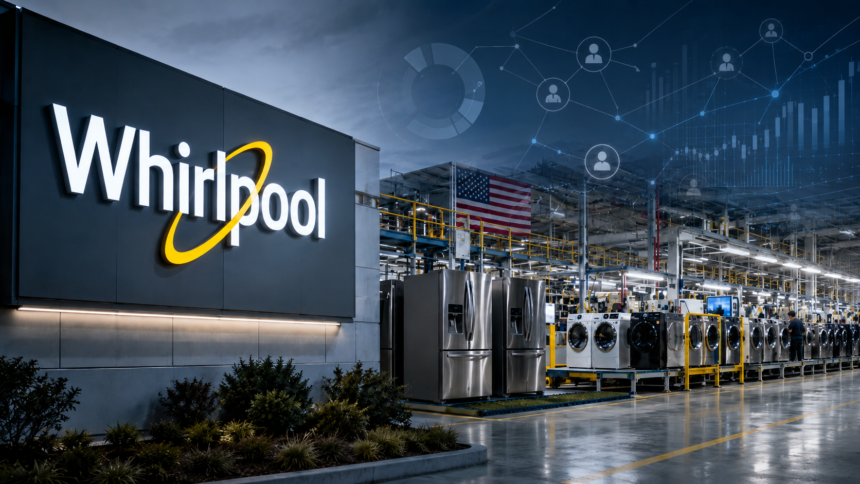
Whirlpool is not a subsidiary of BlackRock, Vanguard or a foreign appliance conglomerate. It is a publicly traded U.S. company whose shares are spread among investment managers, funds and individual shareholders — and whose corporate identity is increasingly tied to a large domestic manufacturing network.
That distinction matters in 2026. Whirlpool is promoting U.S. production as a competitive advantage while investing in additional Ohio capacity, adding automation and navigating an ownership structure that changed after a major stock issuance earlier this year. Whirlpool Corp.
- Corporate status: Whirlpool Corporation is a publicly traded company headquartered in Benton Harbor, Michigan.
- No controlling parent: The company does not have one foreign parent or single investment-firm owner.
- Major holders: Its largest disclosed shareholders include large institutional investment managers, based on proxy filings.
- Product origin: Whirlpool’s corporate identity is American, but the manufacturing origin of any individual appliance is model-specific.
Ownership affects brand and service context
The question “Who owns Whirlpool?” is often treated as a simple search for a parent company. In practice, the answer affects how retailers, servicers and consumers understand everything from brand relationships to manufacturing claims and parts support.
Whirlpool Corporation controls a portfolio that includes Whirlpool, KitchenAid, Maytag, Amana, JennAir and InSinkErator. A customer comparing two apparently separate brands may therefore be looking at products connected to the same corporate owner, engineering organization or manufacturing network. SEC filing
That corporate ownership can matter for service networks, parts platforms and warranty administration. It does not mean every product carrying a Whirlpool-owned brand name comes from the same plant, uses the same parts or has the same repair profile.
Who actually owns Whirlpool?
Whirlpool Corporation is a public company headquartered in Benton Harbor, Michigan, with common stock traded under the WHR ticker. It does not have one controlling corporate parent.
More Read

Whirlpool’s 2026 proxy statement identified BlackRock as the largest disclosed beneficial shareholder in its year-end snapshot, with 11.01% of the common stock. Vanguard was listed at 9.73%, followed by PRIMECAP Management at 6.75% and Fidelity parent FMR LLC at 5.66%. The filing also listed Appaloosa at 6.92%, while noting that the investment firm subsequently reported falling below the 5% disclosure threshold. Whirlpool 2026 proxy statement
Those figures do not mean that BlackRock or Vanguard operates Whirlpool as a parent company would. Large asset managers commonly hold or direct shares through funds and managed accounts on behalf of investors, while Whirlpool’s board and executive team continue to run the business.
The percentages also require a date stamp. Whirlpool’s proxy ownership table was based on holdings as of Dec. 31, 2025, but the company issued nearly 6.9 million additional common shares in February. Whirlpool reported approximately 64.8 million shares outstanding as of May 1, up from about 56.5 million in early February, meaning older ownership percentages should not be presented as a live cap table. Whirlpool investor relations
Descriptions that divide Whirlpool’s ownership into “institutional investors” on one side and mutual funds or exchange-traded funds on the other can also be misleading. Mutual funds and ETFs are often managed by the same institutional firms appearing in shareholder disclosures, so those categories are not cleanly separate.
What Whirlpool makes in the U.S.
Whirlpool says approximately 80% of the major appliances it sells in the United States are produced in American factories. The company also says about 96% of the steel used in its U.S. operations is domestically sourced. Those are companywide production figures, not a promise that every Whirlpool, Maytag or KitchenAid model is built domestically. Whirlpool U.S. manufacturing
The company currently identifies 10 U.S. factories supporting major appliances, small appliances, commercial laundry and food-waste disposers. Its domestic production map includes:
- Laundry: washers in Clyde, Ohio; dryers in Marion, Ohio; and commercial laundry equipment in Fall River, Massachusetts.
- Cooking and dishwashing: ranges in Tulsa, Oklahoma; dishwashers in Findlay, Ohio; and premium cooking products in Cleveland, Tennessee.
- Refrigeration: refrigeration products in Amana, Iowa, and freezers and built-in refrigerators in Ottawa, Ohio.
- Small appliances and disposers: KitchenAid small appliances in Greenville, Ohio, and InSinkErator products in Racine, Wisconsin.
Whirlpool says its U.S. operations support approximately 20,000 employees, including about 14,000 manufacturing workers. Its manufacturing page also carries an important qualification: domestic and imported components are used in the products assembled at those facilities.
Brand ownership does not determine product origin
Whirlpool’s ownership of Maytag, KitchenAid, Amana, JennAir and InSinkErator explains why the brands can share factories, components, distribution systems and service infrastructure. It does not mean every product carrying one of those names comes from the same plant — or even the same country.
Whirlpool’s latest annual filing says the company markets Whirlpool, KitchenAid, Maytag, Amana, InSinkErator, JennAir and several accessory or specialty brands in the United States and Canada. It also licenses some trademarks to third parties that manufacture and sell products under Whirlpool-owned names. SEC filing
That makes the model number more useful than the logo when determining where a specific appliance was produced. Retailers and consumers should verify the country-of-origin label, product documentation and manufacturer information for the exact unit being considered.
Why the network matters
For retailers and distributors, Whirlpool’s domestic network can shorten portions of the supply chain and reduce dependence on finished-appliance imports. A large installed manufacturing base also ties inventory planning, promotional capacity and delivery availability to production decisions in Ohio, Iowa, Oklahoma, Tennessee, Wisconsin and Massachusetts.
For servicers and warranty companies, shared corporate ownership can create overlap in parts, platforms and technical procedures across brands. That can improve scale, but it can also make brand-level reliability claims less informative when products use different factories, designs or component sets.
Domestic production does not eliminate exposure to global supply disruptions or trade costs. Whirlpool acknowledges using imported components, and its annual report identifies tariffs, material prices and supplier availability among the risks that can affect manufacturing costs.
For homeowners, the practical questions remain more specific: Where was this model built? How available are its replacement parts? Who provides warranty service locally? Does the design share components with higher-volume models? A broad “made in America” statistic cannot answer those ownership-cost questions by itself.
Ohio expansion adds to the footprint
Whirlpool plans to expand its domestic footprint with a new facility in Perrysburg, Ohio. The company said it will invest more than $60 million to convert an existing building into a component and subassembly plant supporting washer and dryer production. The project is expected to unfold over two years and create between 100 and 150 jobs, subject to final incentive approvals. Whirlpool Corp.
Once operating, Perrysburg would become Whirlpool’s 11th U.S. factory and sixth in Ohio. It follows a previously announced $300 million investment in the Clyde washer and Marion dryer operations, where Whirlpool expects to add production capacity and between 400 and 600 jobs. Whirlpool Corp.
The clearest answer, then, is not that Whirlpool is “owned by BlackRock” or that every Whirlpool-family appliance is American-made. Whirlpool is a widely held public company with several large institutional shareholders and one of the appliance industry’s most extensive U.S. factory networks.
For the industry, that network is a significant operational asset. For consumers, it is a reason to investigate the specific appliance rather than relying on the corporate name alone.