LG Electronics is preparing to turn part of its Seoul research campus into something more valuable than another robot assembly line: a factory for experience. The reported LG robot data factory would place hundreds of CLOiD home robots inside simulated homes and production environments, where they could repeat ordinary tasks until the company has enough real-world data to make those actions faster, safer and more reliable.
The project reflects a shift in the humanoid robotics race. Building motors, joints and mechanical hands remains difficult, but the larger bottleneck is increasingly teaching a machine how to use them across thousands of unpredictable situations.
For the appliance industry, that makes LG’s plan more than a robotics experiment. It is an attempt to turn decades of experience with laundry equipment, refrigerators, kitchens, motors and connected-home software into a competitive advantage in physical artificial intelligence.
What LG is building in Seoul
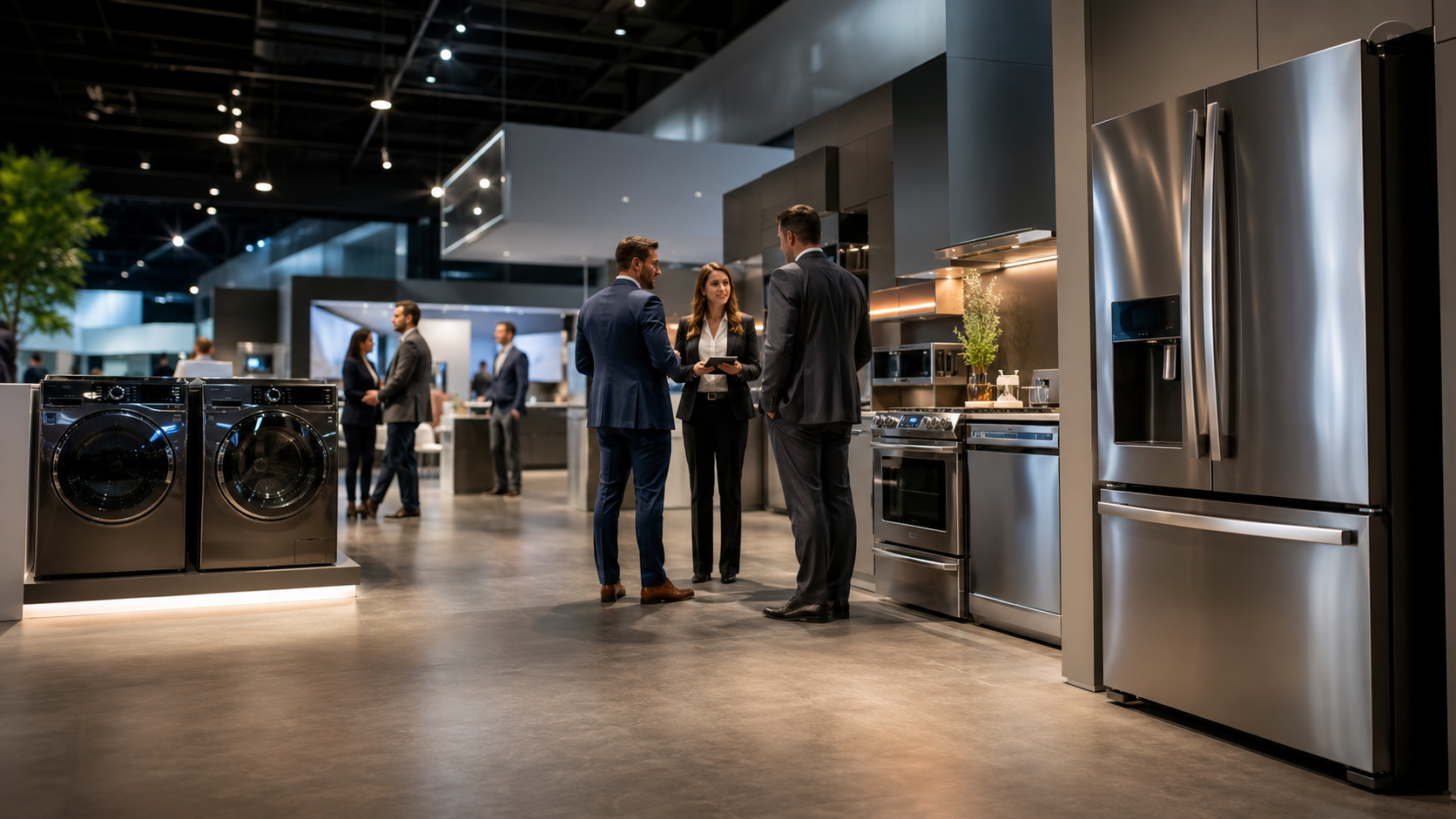
LG is converting its research and development campus in Seoul’s Yangjae district into what Korean media have described as the country’s first large-scale humanoid robot data factory. The Korea Herald reported that the operation would cover about 33,000 square meters, or roughly 355,000 square feet, across four floors. (koreaherald.com)
Industry reports indicate that LG could deploy about 100 CLOiD robots as early as July, with the fleet potentially growing to 300 units by the end of 2026. The robots would train in spaces modeled after homes and working production lines, generating records of how they perceive objects, select movements and respond when an action succeeds or fails. (koreaherald.com)
LG confirmed the broad direction of the project to The Korea Herald, while cautioning that the investment amount and precise opening date had not been finalized. Korean reports have placed the possible investment at more than 400 billion won through 2030, but that figure should be treated as preliminary until the company provides formal guidance. (koreaherald.com)
More Read
The strategic asset is no longer just the robot’s body. It is the continuous stream of task data that teaches that body what to do.
Appliance News analysis
Why this matters for appliances
Large language models can learn from enormous collections of existing text and images. Household robots do not have an equivalent public library showing exactly how much pressure to apply to a refrigerator handle, how to lift a wet towel without dropping it or how to place clothing inside a washer without trapping fabric in the door.
Those capabilities require action data. Cameras, force sensors and joint controls must record what the robot saw, what movement it attempted and what happened next. The same task may need to be repeated under different lighting, with different objects and around people, pets or furniture.
A dedicated training site would allow LG to collect that information in a controlled but realistic setting. It could also give the company a direct way to test how robot behavior changes when appliance layouts, door designs, baskets, shelves and control interfaces are modified.
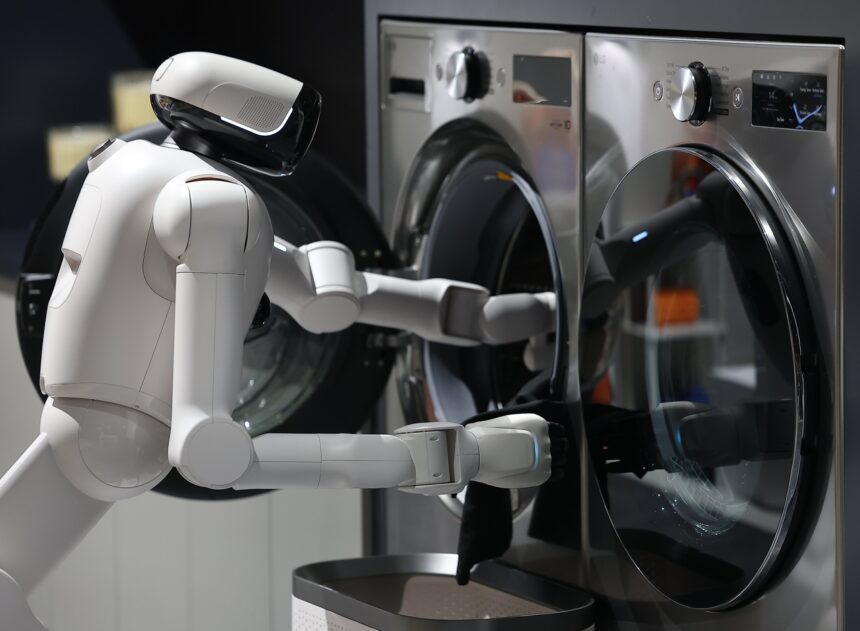
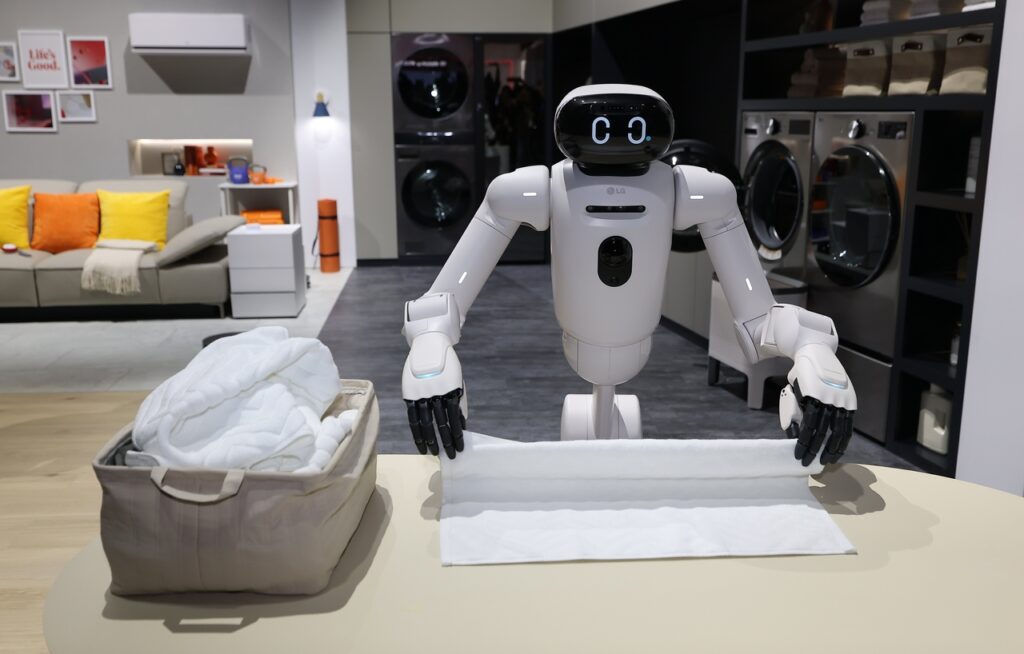
That connection matters because CLOiD is designed around household work rather than general-purpose walking. LG’s CES 2026 demonstrations showed a wheeled robot with two articulated arms performing laundry, kitchen and organizing tasks while communicating with connected appliances through the ThinQ platform. LG says the robot uses cameras, sensors and vision-based AI to interpret its surroundings and translate instructions into physical actions. (lg.com)
LG is betting its appliance experience becomes a robotics advantage
LG enters the humanoid market with assets that many software-focused robotics startups lack. It already manufactures appliances, develops connected-home services and works with motors, compressors, power electronics and mass-production systems.
The company is also moving deeper into robot components. LG introduced the AXIUM actuator brand alongside CLOiD and has outlined plans to establish production capacity for actuators, the assemblies that convert electrical energy into controlled movement at a robot’s joints. CEO Lyu Jae-cheol has identified robots, AI homes, smart factories and data-center cooling as priority growth areas for the company. (lg.com)
The data factory would connect those pieces. LG could develop the mechanical joint, place it inside a CLOiD prototype, test the robot against its own appliances and feed the results back into both hardware and software development.
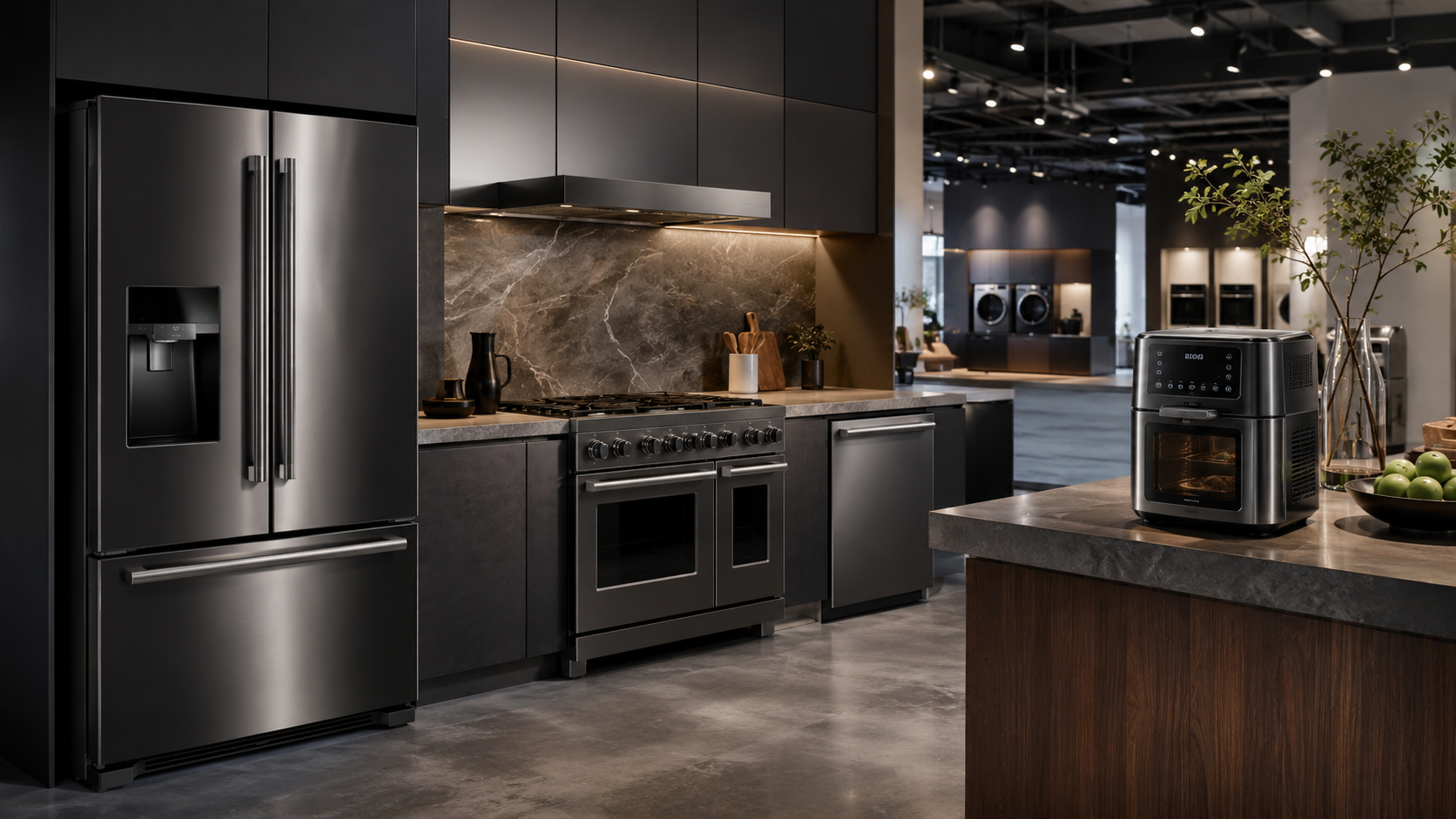
That feedback loop could influence appliance design. Future washers, ovens and refrigerators may need to accommodate both human hands and robotic manipulators. Handles, detergent drawers, racks, doors and removable components could be evaluated not only for ergonomics and accessibility, but also for how reliably a machine can identify and operate them.
The industry impact reaches beyond robot sales
A commercially viable home robot would create new questions across the appliance supply chain. Manufacturers would need to determine which products can communicate directly with a robot and whether physical interfaces should become more standardized.
Servicers could encounter a new category combining appliance diagnostics, navigation systems, cameras, batteries, actuators and cloud-connected AI. Repair documentation and parts distribution would become especially important if robots are expected to operate around high-value appliances and inside occupied homes.
- Manufacturers: Appliance design may expand to include robot-friendly doors, controls, storage systems and machine-readable status information.
- Retailers and distributors: Product demonstrations could shift from selling a standalone robot to explaining an interoperable home ecosystem.
- Servicers and warranty companies: Coverage terms will need to address software failures, sensor calibration, accidental damage and expensive joint assemblies.
- Consumers: Purchase decisions will depend on reliability, privacy, repair access and whether the robot can work with appliances from multiple brands.
The last issue could become a defining competitive question. A robot that works best only with one manufacturer’s appliances may strengthen customer loyalty, but it could also limit usefulness in homes filled with products from several brands.
What LG still must prove
Generating more training data does not automatically solve the hardest problems in domestic robotics. CLOiD must eventually perform tasks at a speed consumers will accept, recover safely when objects move unexpectedly and avoid damaging dishes, clothing, cabinets or appliances.
The system must also generalize beyond the training facility. Homes vary widely in size, layout and condition. A behavior learned with one washer door, refrigerator shelf or laundry basket may not transfer cleanly to another.
Privacy will be equally important. A robot designed to navigate rooms and recognize household objects will rely on cameras and other sensors inside some of the most private spaces consumers occupy. LG will need clear policies covering data collection, local processing, cloud storage, cybersecurity and deletion.
Cost remains another unresolved factor. A home robot with multiple actuators, dexterous hands, cameras, computing hardware and a large battery could be expensive to manufacture and repair. The business case may initially be stronger in commercial environments, premium homes or assisted-living applications than in the mass consumer market.
What comes next
LG has been working toward commercializing a home robot around 2028, giving the company a limited window to turn controlled demonstrations into a dependable product. Its broader robotics strategy now includes robot components, appliance integration, training data and outside computing partnerships. (biz.chosun.com)
That strategy gained another layer in June when Nvidia CEO Jensen Huang said the chipmaker was working with LG Group on humanoid robots, motor and mechanical systems, and future data-center architecture. The companies have not publicly detailed how that cooperation will apply to CLOiD, but the relationship underscores the computing demands behind large-scale physical AI development. (reuters.com)
The significance of LG’s data factory will ultimately depend on whether repeated practice produces a robot that is useful outside the lab. But the project already signals where the appliance business may be headed: appliances will no longer be only connected products that respond to people. They may become part of an environment designed to be understood and operated by machines.