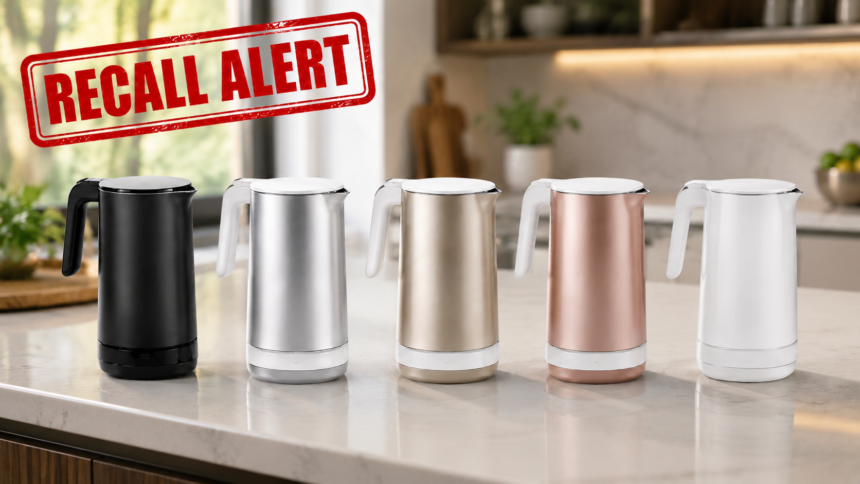
More than 157,000 Zwilling electric kettles sold across North America are being recalled after reports that the handle can loosen or separate, causing hot liquid to spill and creating a serious burn hazard. The recall affects Zwilling Enfinigy 1.5-liter electric kettles and Zwilling Enfinigy Pro 1.5-liter electric kettles sold in multiple finishes from 2019 through early 2026.
The U.S. Consumer Product Safety Commission announced the recall May 14, covering about 113,440 units sold in the United States, plus about 43,963 sold in Canada and 48 sold in Mexico. Combined, the recall affects about 157,451 kettles across the three countries.
The issue is straightforward but dangerous: the kettle’s handle can loosen or separate from the body of the kettle while hot water is inside. CPSC said the defect can cause hot contents to spill, posing a risk of serious injury due to burns.
“The kettle’s handle can loosen and separate from the kettle, causing hot contents to spill, posing a risk of serious injury due to a burn hazard.”
U.S. Consumer Product Safety Commission
Why this matters
Electric kettles are simple countertop appliances, but they handle boiling water in close contact with the user’s hands, arms and torso. A handle failure is not a minor nuisance. It can turn a routine pour into a scalding incident within seconds.
For retailers, the recall is a reminder that small appliances can carry major post-sale obligations. Products sold through national chains, closeout retailers and brand websites can remain in kitchens for years, making clear recall communication essential long after the original purchase.
For servicers and warranty providers, the issue also reinforces a key point: countertop appliances may not always be repaired through the traditional appliance-service channel, but customers still turn to retailers, brands and warranty contacts for guidance when a safety issue emerges.
More Read
What is recalled
The recall covers Zwilling J.A. Henckels Aktiengesellschaft Enfinigy Kettle 1.5-liter and Enfinigy Kettle Pro 1.5-liter models. The stainless-steel electric kettles were sold in several colors, including black, silver, rose, gold and pure white.
- Zwilling Enfinigy Electric Kettle 1.5 L: model numbers 53101-200 and 53101-201.
- Zwilling Enfinigy Electric Kettle Pro 1.5 L: model numbers 53101-500, 53101-501, 53101-502, 53101-503 and 53101-504.
- Where to check: CPSC said the model number and “Zwilling” can be found on the bottom of the kettle and the bottom of the power base.
The recalled kettles were sold at HomeGoods stores nationwide and online at zwilling.com from December 2019 through February 2026 for about $120 to $200, according to CPSC.
The injury reports
Zwilling has received 163 reports of kettle handles separating or loosening, according to CPSC. Five of those reports involved incidents connected with the handle separating, including one reported second-degree burn.
Zwilling’s recall notice said the handle on the affected 1.5-liter Enfinigy and Enfinigy Pro electric kettle models may loosen or break off in isolated cases, allowing hot water to spill uncontrollably and creating a scald risk for users or nearby people.
The company said customers will receive their money back and urged consumers to stop using affected kettles immediately.
What consumers should do
Consumers should stop using the recalled kettles immediately and contact Zwilling for a full refund. CPSC said U.S. consumers should follow Zwilling’s recall instructions, which include unplugging the kettle, cutting the cord, uploading a photo of the product and then safely disposing of it.
Zwilling can be reached toll-free at 866-963-4583 or by email at [email protected]. Consumers can also use Zwilling’s online recall page for instructions.
Retailers and customer-service teams should be prepared for customers who no longer have receipts or original packaging. In this recall, the model number on the kettle and power base is the most important identifier.
The industry impact
The Zwilling recall is a countertop appliance story, but it carries broader lessons for the appliance industry. Consumers increasingly buy small appliances across a fragmented retail map: warehouse clubs, discount chains, off-price stores, direct brand websites and online marketplaces. That makes recall reach more difficult than a traditional appliance distribution chain.
It also raises the stakes for product traceability. A kettle sold in 2019 may still be used daily in 2026, and the person using it may not be the original buyer. Gifts, resale, household moves and secondhand purchases can all make safety notices harder to deliver.
For appliance brands, the recall shows how a mechanical component — in this case, the handle — can become the central safety risk even when the heating function itself is not the issue. For consumers, the safest response is not to inspect for looseness and keep using the kettle. The recall remedy is to stop use and seek a refund.
What retailers and servicers should know
Retailers that sold the product should make recall information easy to find at service desks, online help centers and customer support channels. Even stores that did not sell the item may hear from consumers because Zwilling is a widely recognized kitchen brand.
Servicers should avoid advising consumers to tighten, glue or otherwise repair the handle. The CPSC remedy is a refund, and the agency’s instructions call for the product to be made unusable and disposed of after the recall process is completed.
The recall also matters for warranty administrators and customer-care teams because it involves a direct burn hazard. Clear escalation scripts, model-number guidance and refund instructions can help reduce customer confusion and prevent continued use of affected products.
What comes next
The recall is active, and consumers should act quickly if they own a Zwilling Enfinigy 1.5-liter kettle or Enfinigy Pro 1.5-liter kettle. The most important step is to stop using the kettle before checking the model number and beginning the refund process.
For the appliance industry, the episode is another reminder that recall readiness is part of product trust. When an appliance handles heat, water or pressure, the after-sale safety process needs to be as clear as the original sales pitch.