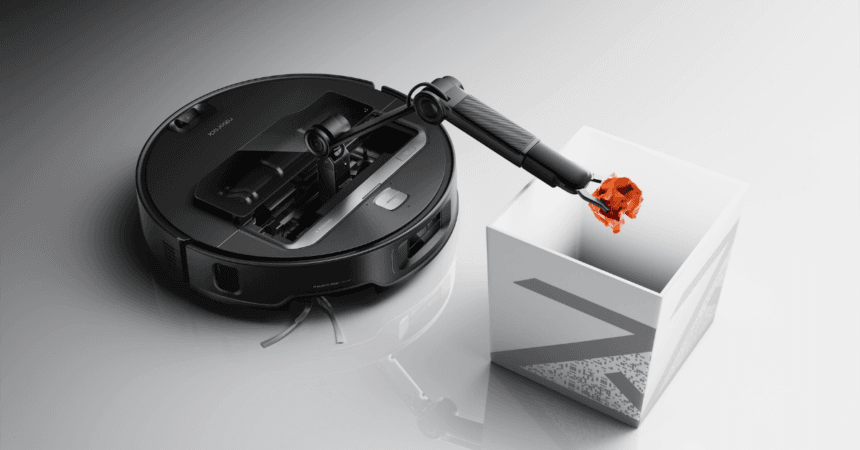
A sock on the floor has long been a small but effective way to defeat a robot vacuum. The better machines can recognize it and steer around it. Roborock’s Saros Z70 tries something more ambitious: it reaches out an arm, picks the sock up and attempts to clean the floor underneath.
That mechanical arm makes the Z70 one of the clearest examples yet of the appliance industry’s effort to turn autonomous cleaners into something closer to household robots. It is also an unusually useful case study in what happens when a futuristic idea has to fit inside a product that still needs to do the ordinary work of vacuuming crumbs and mopping floors.
Roborock’s U.S. store recently listed the Saros Z70 for $999.99, down from a $2,599.99 reference price. Promotions can change, but the current price makes an experiment once aimed at the ultra-premium end of the market considerably more accessible.
Appliance News has not hands-on tested the Z70 and is not rating it. We compared Roborock’s specifications with multiple independent tests to separate what the arm is designed to do from what reviewers have actually seen it accomplish.
A Robot That Tries to Move the Clutter
The Z70’s OmniGrip system is a foldable five-axis mechanical arm stored inside the top of the vacuum. Cameras and object-recognition software help it identify selected lightweight items, grip them and relocate them to places an owner designates in the Roborock app.
Conceptually, that changes the relationship between a cleaning robot and a messy room. Obstacle avoidance treats clutter as territory to surrender. A manipulator treats clutter as something the machine might change about its environment.
More Read

That sounds like a small distinction until a floor is scattered with socks, slippers, tissues or children’s toys. A robot that only avoids those objects can leave islands of uncleaned floor. A robot that reliably moves them could clean a room closer to the way a person would.
The Arm Is Not Yet a Housekeeper
The word “reliably” is doing a great deal of work. Vacuum Wars, which says it bought a Z70 and tested it over several weeks, found the arm succeeded only about half the time in its object-pickup testing. The outlet nevertheless named the machine its mid-2025 Most Innovative Robot Vacuum and found its obstacle avoidance and mopping unusually strong.
TechRadar’s hands-on testing found a similar gap between the idea and autonomous execution. Its reviewer was able to make the gripper pick up supported objects when manually positioning the arm through the app, but found autonomous pickup more limited.
Tom’s Guide likewise treated the arm as the product’s defining innovation while noting that object pickup remained a work in progress. Taken together, the tests point to an important distinction: the Z70 demonstrates that a compact cleaning robot can carry and operate a useful manipulator, but it does not demonstrate that the robot can yet tidy a room with humanlike consistency.
The Arm Has to Live Somewhere
The Z70 is still a vacuum and mop, and the arm competes for the same internal space as everything that makes those functions work. Roborock rates the machine at 22,000 pascals of suction and equips it with StarSight 2.0 navigation, an AdaptiLift chassis, extending edge-cleaning hardware and a multifunction dock. The robot is only 3.14 inches tall despite storing the folded arm inside its body.
Vacuum Wars measured the onboard dustbin at just 180 milliliters, the smallest it had encountered in a robot vacuum, and attributed that packaging compromise to the arm mechanism. Its testing also found below-average carpet deep-cleaning, pet-hair and crevice performance even though overall debris pickup and mopping were strong.
The same outlet gave the Z70 a 22-out-of-24 obstacle-avoidance score and said it produced the second-best result the organization had recorded in its dried-stain mopping test. The paradox is hard to miss: the product’s most futuristic component may not be the part that makes it a good cleaner.
The Price Drop Changes the Story
At launch, the Z70’s roughly $2,600 price put it in a category where buyers were paying a large premium for being early to a new idea. TechRadar and other reviewers evaluated it in that context. At about $1,000 during Roborock’s current promotion, it competes much more directly with conventional flagship robot vacuums that lack an arm.
That does not automatically make it a bargain. Robot-vacuum pricing is unusually fluid, and Roborock itself has continued releasing newer machines with higher advertised suction and different navigation hardware. A large discount can signal an attractive closeout opportunity, rapid product-cycle turnover or both.
The speed of that turnover matters for buyers considering a highly complex appliance. Replacement brushes and filters are ordinary consumables. A multi-jointed arm, cameras, sensors, pumps, motors, dock plumbing and software-supported object recognition create a different long-term service question.
The More a Vacuum Becomes a Robot, the More There Is to Repair
Roborock provides a one-year limited warranty through its U.S. store and sells replacement consumables. What short-term reviews cannot tell buyers is how a folding arm and its joints will tolerate years of dust, pet hair, impacts and thousands of extension cycles.
That uncertainty is not unique to Roborock. It is a larger issue as appliance makers add cameras, lidar, AI processors, moving chassis components and docking systems that wash and dry their own mop pads. Each feature can reduce a household chore while increasing the number of systems that have to keep working together.
There is also a regulatory backdrop. Appliance News has reported on U.S. scrutiny of foreign-made robot vacuums and connected home devices, which could affect future product availability and connectivity rules in a category dominated by Asian manufacturers.
Why the Z70 Matters Even If the Arm Misses the Sock
The first useful version of a technology is rarely the version that makes it ordinary. The Z70’s arm is inconsistent enough that buyers should not purchase it expecting a robot that reliably tidies before it cleans. But the hardware crosses a line that obstacle-avoidance systems do not: the appliance can physically alter the room around it.
If future machines become better at recognizing, grasping and placing ordinary household objects, the significance will extend beyond cleaner floors. A mobile appliance with a dependable arm becomes a platform for tasks that do not fit neatly into the category of vacuuming at all.
For now, independent testing suggests the Z70 is a better robot vacuum than it is a robotic housekeeper. That may be the most interesting thing about it. The cleaning appliance is mature enough to be useful; the arm is still showing us what the next category might become.