The U.K.’s old-fridge problem is a reminder that appliance disposal is not just a consumer inconvenience at the curb. Refrigerators and freezers are bulky, regulated, refrigerant-bearing products that depend on a small network of specialist processors. When that network tightens, local collection can fail quickly.
That is what is now playing out across parts of the U.K. In July, Carmarthenshire County Council told residents it could no longer accept fridges, freezers and other cooling appliances at its recycling centres or through bulky-waste collection until further notice because sites had reached or exceeded safe storage capacity. Earlier this spring, South Gloucestershire Council warned of a national shortage in disposal capacity, saying many processors were closed or full and that it might have to stop accepting fridges and freezers at short notice.
Waste-sector reporting by letsrecycle.com described the same pattern: local authorities are reaching storage limits because external treatment facilities have been disrupted, and refrigeration appliances cannot simply be redirected to ordinary recyclers when capacity is constrained.
Why Fridges Are Not Normal Scrap
A refrigerator may look like a steel cabinet with a compressor attached, but end-of-life handling is more complicated. U.K. Environment Agency guidance treats fridges, freezers, chilled display cabinets, heat pumps, heat-pump tumble dryers and similar equipment as waste temperature exchange equipment when they contain volatile refrigerant gases or insulating-foam blowing agents.
That equipment can contain refrigerants, foam blowing agents, compressor oil, mercury switches, capacitors, circuit boards, plastics and other hazardous or regulated materials. Older units may contain ozone-depleting CFC or HCFC refrigerants and blowing agents. Newer units may contain HFCs or hydrocarbons, which bring their own climate or fire-safety considerations.
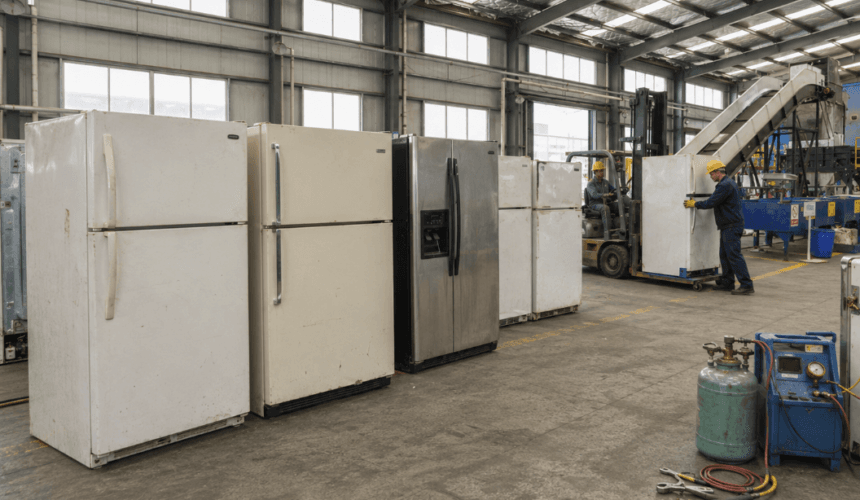
The treatment process is specialized. The Environment Agency describes a first stage that removes refrigerant and oil from the cooling circuit, drains compressors and removes hazardous components, followed by a second stage that shreds or fragments the cabinet, separates foam, metal and plastic fractions, and captures the blowing agent from insulation foam in a contained atmosphere.
More Read

That is why refrigerators become a capacity problem before other appliance categories do. Washers, cookers and dishwashers can still raise hazardous-waste and persistent-organic-pollutant questions, but cooling appliances add sealed-system refrigerants and foam gases to the material mix. A recycler that can process ordinary scrap metal or mixed appliances may not have the permits, containment systems or gas-capture equipment for old refrigerators.
The Bottleneck Is Storage as Much as Collection
For local authorities, the immediate failure point is often not the collection truck. It is the storage compound. Household waste recycling centres can accept only so many cooling appliances before they hit space, safety or permit limits. Once fridges stop moving onward to treatment plants, collection points fill up.
Carmarthenshire said its recycling centres had reached or exceeded safe storage capacity for “COLD” units. South Gloucestershire said space was very tight and that the situation would be checked weekly. Letsrecycle.com reported that some of the pressure traces to disruptions at specialist processing facilities, including a major business failure, fires at treatment sites and a limited number of approved outlets able to handle cooling appliances.
The result is a public-facing problem with a hidden infrastructure cause. Residents may see a council refusing a fridge. The underlying issue is a fragile chain that runs from household pickup or retailer take-back, to safe temporary storage, to permitted transport, to specialist degassing, shredding, foam recovery and final treatment.
- Consumers face fewer legal drop-off options and may delay replacement or store dead appliances longer.
- Local authorities face storage-limit, safety and compliance pressure when onward processing slows.
- Retailers can become the relief valve when haul-away is bundled with delivery of a new appliance.
- Recyclers need specialist permits, equipment and fire-risk controls to handle the stream safely.
- Manufacturers have a long-term stake in design, labeling, recovery programs and lifecycle policy.
Refrigerants Turn Disposal Into Climate Policy
The environmental stakes are larger than landfill diversion. U.K. guidance says CFCs and HCFCs are ozone-depleting substances, while HFCs have high global warming potential. It is illegal to deliberately release F gas into the atmosphere unnecessarily, and recovered waste F gas or whole units must be sent through registered waste carriers and licensed facilities that accept F gas and ozone-depleting substances.
The U.S. has similar disposal concerns, even though the regulatory structure is different. The Environmental Protection Agency says almost all materials in a refrigerator or freezer can be recycled, including the metal cabinet, refrigerant and oil in the compressor, and the blowing agent in polyurethane foam. EPA also says hazardous components such as PCBs, mercury and compressor oil must be removed before disposal, and the final disposer is responsible for recovering refrigerant.
But EPA also identifies a major gap: federal rules do not require foam recovery, so the blowing agent in foam insulation is typically emitted during shredding and landfilling. The agency’s Responsible Appliance Disposal program, which EPA describes in historical materials as running from 2006 through 2025, was designed to encourage better practices for recovering not only refrigerants but also chemicals contained in appliance foam.
What the U.S. Should Learn
The U.K. crunch offers a practical warning for U.S. policymakers: disposal capacity is part of appliance policy. Efficiency standards, refrigerant transitions and electrification incentives all push consumers toward replacing old equipment. If collection and treatment networks are not scaled at the same time, end-of-life appliances can pile up in garages, alleys, storage yards and municipal sites.
For recyclers, the lesson is redundancy. A market that relies on a small number of specialized refrigerator processors can be disrupted by one fire, one insolvency, one permit problem or one delayed plant opening. Refrigeration recycling needs backup capacity, fire prevention investment, clear emergency storage rules and stable economics for foam and refrigerant capture, not only scrap-metal recovery.
For retailers, haul-away is becoming part of the value proposition. South Gloucestershire’s advice to residents was blunt: if they are buying a new appliance, many shops will take the old fridge or freezer when delivering the new one, reducing pressure on council sites. In the U.S., retailer haul-away, utility recycling programs and manufacturer takeback partnerships can make the difference between responsible disposal and an appliance sitting curbside for a scavenger to strip.
For manufacturers, disposal should feed back into product design. Better refrigerant labeling, easier identification of foam blowing agents, more accessible hazardous-component information and design choices that support safe disassembly can reduce friction at the end of life. That does not mean every refrigerator can be made simple to recycle. It means disposal should be treated as a design constraint, not an afterthought.
The Cost Question Will Not Go Away
The hardest issue is money. Proper refrigerator recycling costs more than pulling out valuable metal and landfilling the rest. It requires collection logistics, storage compliance, trained handling, refrigerant recovery, foam-gas capture, treatment of hazardous components and documented material flows.
Someone pays for that chain: local governments, consumers, retailers, manufacturers, utilities, recyclers or taxpayers. When the economics are unclear, the system tends to depend on whichever path is cheapest and available that day. The U.K. disruption shows how quickly that can fail when specialist capacity is tight.
The warning for the appliance industry is direct. A refrigerator’s lifecycle does not end at delivery, warranty expiration or replacement. It ends only when refrigerant, foam, oil, hazardous parts, metals and plastics are handled safely. If the disposal system cannot keep up, the appliance market’s environmental promise breaks at the back end.