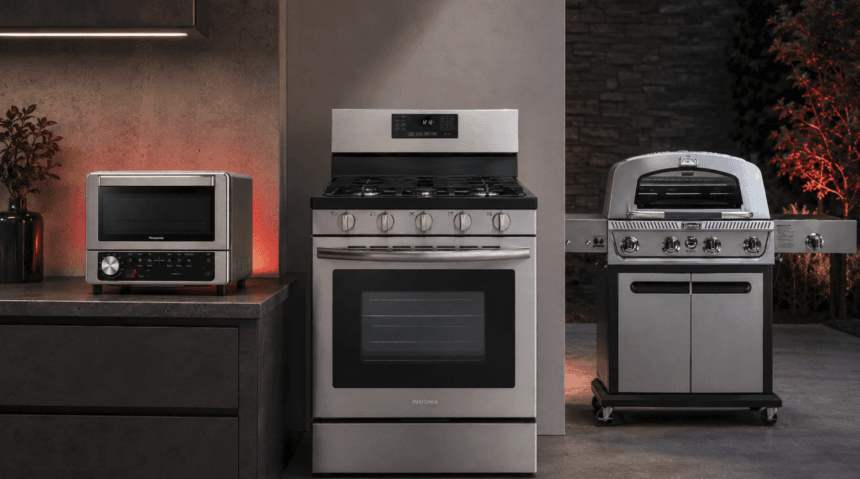
Three appliance-related recalls announced by the U.S. Consumer Product Safety Commission in July cover a countertop toaster oven, front-control gas ranges and a multi-function outdoor gas grill, giving dealers and servicers a timely reminder that recall exposure is not limited to traditional major appliances. The affected products include Panasonic NB-G200 electric toaster ovens, Best Buy Insignia gas ranges and Cuisinart Propel+ Four Burner 3-in-1 gas grills.
The recalls involve different hazards — shock and fire, accidental gas-range activation and shattered tempered glass — but they point to the same operational issue for the appliance channel: inventory checks, customer outreach, service intake questions and return handling can quickly become safety work.
Panasonic toaster ovens recalled over shock and fire hazards
Panasonic recalled about 11,480 NB-G200 electric toaster ovens in the United States, with about 2,184 additional units sold in Canada, because the power cord insulation can be insufficient where a protective fiberglass sleeve does not adequately cover it. CPSC said the defect poses shock and fire hazards.
The recall covers all Panasonic Electric Toaster Ovens, Model No. NB-G200. The stainless steel toaster ovens have the Panasonic brand name on the front, a temperature knob at the bottom, six preset cooking menus, a digital timer of up to 25 minutes and temperature settings from 250 degrees to 500 degrees. The model number is on the name plate label on the back of the unit.
Consumers should stop using the toaster oven immediately and contact Panasonic for a full refund. CPSC said Panasonic has received four reports of tripped circuit breakers or outlets and one report that the product stopped working. No fires or injuries have been reported. The toaster ovens were sold online through Amazon, Costco, Panasonic and other platforms from October 2024 through April 2026 for about $170.
Insignia gas ranges need knob covers after activation risk
Best Buy recalled about 3,820 Insignia Front Control Gas Ranges in the United States, plus about 700 in Canada, because the front-mounted knobs can be activated accidentally by people or pets. CPSC said the condition creates a fire hazard and risk of serious injury.
More Read

The recall covers Insignia gas ranges with model numbers NS-RGFGSS1 and NS-RGFCGS2. The stainless steel ranges have five front knobs and an Insignia label at the bottom of the oven door. The model number is on a label inside the bottom drawer.
CPSC said consumers should stop using the recalled oven immediately and visit Best Buy’s recall website to participate in the recall. Best Buy is offering a free set of compatible knob covers with instructions after consumers confirm their range is included. Until the remedy is in place, consumers are advised to keep children and pets away from the knobs, check that range knobs are off before leaving home or going to bed, and avoid leaving objects on the range when it is not in use.
The ranges were sold at Best Buy stores nationwide and online from November 2020 through March 2026 for $280 to $1,470. Best Buy has received one report of knobs being activated by accidental contact. No injuries have been reported.
Cuisinart Propel+ grill recall centers on pizza oven glass
Conair recalled about 12,660 Cuisinart Propel+ Four Burner 3-in-1 gas grills in the United States, with about 83 additional grills sold in Canada, because the tempered glass window in the pizza oven can shatter during use. CPSC said the defect creates a serious laceration hazard.
The recall covers stainless steel Cuisinart Propel+ Four Burner 3-in-1 gas grills with a griddle, stove top burner and pizza oven. The affected model is CGG-6331, with the model and serial number on a label inside the right-hand metal door.
Consumers should stop using the recalled grill immediately and check Conair’s recall website to determine whether their grill is included. If affected, consumers are instructed to safely remove the tempered glass window from the pizza oven and upload two photographs: one of the removed glass and one of the grill’s serial number. After verification, consumers will receive a $500 refund by check or reimbursement for the original purchase amount with proof of receipt.
Conair has received 37 reports of shattered glass during use, including one reported fire. No injuries have been reported. The grills were sold at Lowe’s, Walmart and online at Cuisinart.com from December 2024 through May 2026 for $500 to $750.
Dealer and servicer implications go beyond the product names
- Sales floors and warehouses should be checked quickly. Even when recalled products were sold primarily through national chains or online platforms, dealers handling open-box, clearance, trade-in or secondary inventory need a process to quarantine affected models.
- Service intake scripts should include model checks. A customer calling about a breaker trip, gas odor concern, knob issue or outdoor cooking appliance problem may not know a recall exists. Asking for model numbers at intake can prevent an unsafe service visit or missed remedy.
- Retailers should document customer guidance. For the Insignia ranges, the interim safety steps are specific: keep children and pets away from knobs, confirm knobs are off before leaving or sleeping, and keep objects off the range when not in use.
- Outdoor cooking products deserve appliance-channel attention. The Cuisinart recall is technically a grill recall, but the product includes a pizza oven, griddle and burner system — features that increasingly overlap with appliance retail and service conversations.
For servicers, the key is not to improvise a fix outside the official remedy. Panasonic’s remedy is a refund. Best Buy’s remedy is compatible knob covers. Conair’s remedy is a refund or reimbursement process tied to removal and documentation of the pizza oven glass. Those distinctions matter for liability, warranty communication and customer trust.
Why three recalls in one week matter
The cluster does not, by itself, prove a broader defect trend across appliances. But it does show how safety risk can emerge across the appliance ecosystem at the same time: a small countertop oven sold online, a private-label gas range sold over several years and an outdoor cooking product with appliance-like features.
For dealers and servicers, the practical takeaway is straightforward: recall monitoring should be routine, not reactive. CPSC also notes that federal law prohibits selling products subject to a commission-ordered recall or a voluntary recall undertaken in consultation with the agency. That makes recall awareness a compliance issue as well as a customer-safety issue.