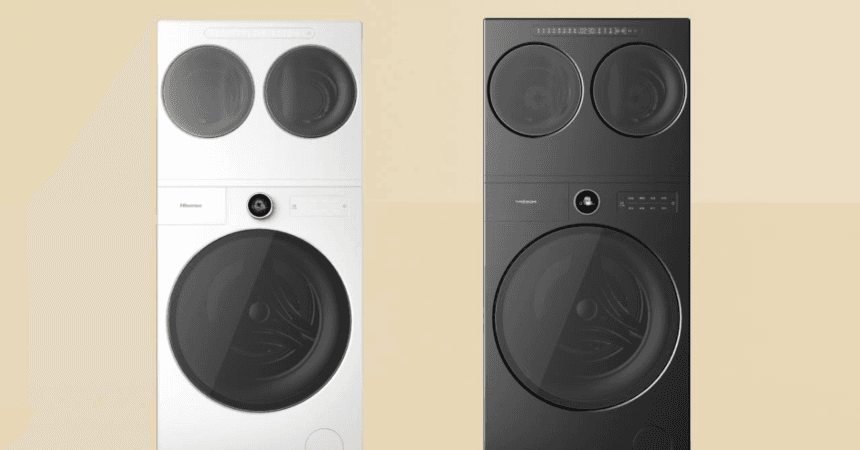
Hisense is pushing a different answer to the all-in-one laundry trend: instead of forcing every load through one drum, its CES 2026 concept pairs a main heat-pump laundry unit with smaller modules designed for separate loads. The idea targets households that want compactness and automation without giving up the ability to run more than one load.
The modular pitch is about parallel laundry
Hisense says its AI Laundry Agent can identify fabric types and soil levels, optimize cycles and provide predictive time-to-ready updates. The main unit uses heat-pump drying, while the smaller modules use fresh-air condensation.
That architecture is interesting because one of the biggest tradeoffs in conventional washer-dryer combos is throughput. A single drum saves floor space, but the household cannot start a second wash while the first load is drying in the same machine. Multiple modules attack that bottleneck from a different direction.
Modularity can help — or complicate service
From a repair perspective, modular design is valuable only if modules are independently diagnosable and replaceable. More pumps, controls, sensors and networked functions can create more failure points, but separation can also prevent one fault from taking the entire laundry system offline.
Hisense has not established a long U.S. service history for this specific platform, so reliability conclusions would be premature. The questions worth watching are parts availability, module interchangeability, warranty treatment and whether independent servicers receive documentation and diagnostic access.
The broader competition is shifting from capacity to workflow
Manufacturers have spent years selling bigger drums and faster cycles. Heat-pump combos changed the conversation by removing the need to transfer a load. Hisense’s modular approach suggests the next competition may be about household workflow: how many loads can run, how automatically they can be sorted and how much floor space the system consumes.
More Read

Hisense detailed the concept in its CES 2026 appliance announcement. Buyers should treat the company’s AI and performance descriptions as manufacturer claims until production specifications and independent testing are available.