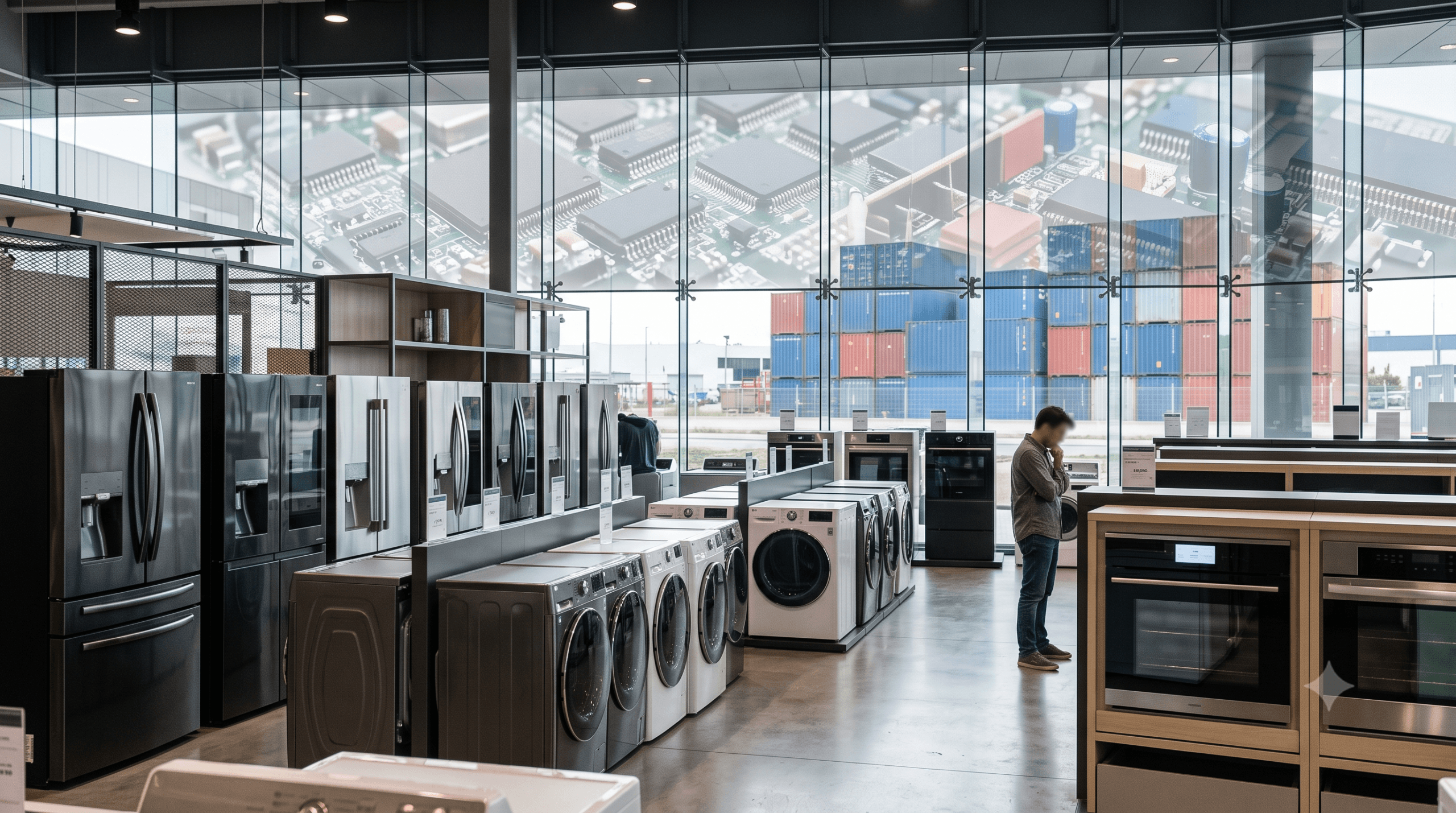
The next appliance price increase may not come from one source. By mid-2026, retailers and manufacturers are dealing with a double squeeze: tariffs on steel-heavy imported appliances on one side and rising semiconductor, memory, copper and logistics costs on the other.
That combination is changing the economics of ranges, washers, dryers, refrigerators and increasingly connected appliances. Tariffs are pushing up landed costs for many steel-containing products. At the same time, the artificial intelligence boom is absorbing memory-chip capacity and raising component costs for the same electronics supply chain that feeds smart appliances, televisions, phones and connected home devices.
The result is confusing for consumers because sticker prices, promotions and delivered prices are not moving in lockstep. A Labor Department inflation table may show mixed or modest movement for broad appliance categories, while dealers are still receiving manufacturer price increases and watching entry-level models climb after tariffs, freight and component costs are passed through.
Tariffs hit the steel inside the box
The tariff pressure starts with the metal content inside appliances. In June 2025, the U.S. Commerce Department added several household-appliance categories to the Section 232 steel-derivative tariff list. Reuters reported that dishwashers, washing machines, refrigerators, freezers, cooking stoves, ranges, ovens, food waste disposals and welded wire racks were among the added product lines, with the duty assessed on the value of the steel content in the imported product. Reuters
The Bureau of Industry and Security notice said the tariff applied to additional steel derivative products entered or withdrawn from warehouse for consumption on or after June 23, 2025. The affected product list included combined refrigerator-freezers, dryers, washing machines, dishwashers, freezers, cooking stoves, ranges and ovens. Federal Register public inspection document
For appliance companies, that is not a small technical change. Major appliances are large metal products with imported components, imported finished goods or both. Even when the final assembly happens in the United States, manufacturers may still buy steel-containing parts, electronics, compressors, motors, wire racks, cabinets and subassemblies through global supply chains.
More Read
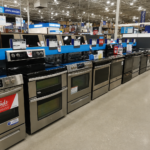
Tariffs do not automatically raise every retail price by the same amount. The impact depends on product classification, country of origin, metal content, vendor contracts, inventory timing, promotional strategy and how much of the added cost a brand or retailer chooses to absorb. But they create a higher cost floor at precisely the time retailers are trying to keep big-ticket purchases affordable.
Price lists are moving even when CPI looks mixed
The public inflation picture is uneven. The Bureau of Labor Statistics’ May 2026 CPI table showed the broad appliances index up 0.2% from a year earlier, while major appliances were down 1.6% year over year. Laundry equipment, however, was up 0.3% from a year earlier and 5.6% over the latest two-month span shown in the table. BLS CPI table
That mixed official reading does not mean appliance pricing pressure is absent. CPI reflects a broad, quality-adjusted consumer basket and can be softened by promotions, product substitutions and discounting. Retailers may still see higher wholesale costs and revised price sheets before those changes fully appear in a monthly consumer index.
OpenBrand’s May durable-goods report said appliance prices declined 0.04% month over month in May after a revised 0.11% increase in April, but the report also showed discount frequency remained high, at 37.8%, and noted that lower discount frequency and magnitude could suggest shelf prices were set higher even as promotions shaped the final monthly reading. OpenBrand
Retail evidence points in the same direction. Yale Appliance, a large New England dealer, said six major manufacturers — ASKO, GE, KitchenAid, LG, Whirlpool and Bosch/Thermador — were raising prices between June 1 and Aug. 1 by 3.5% to 12%, driven largely by a new tariff environment. Yale also said some packages were jumping 8% to 12% between contract and delivery when older pricing was not honored. Yale Appliance
That is why a shopper may see a different reality than the broad CPI number. A promoted laundry pair may still be discounted. A specific range that used to sit below a key retail threshold may reappear at a higher delivered price. Retailers are also quoting more entry-level ranges in the $550 to $700 band as tariffs, freight, labor and model mix reshape what counts as a basic appliance.
AI is competing for the same electronics supply chain
The second squeeze comes from semiconductors. Appliances are not data-center servers, but modern models increasingly rely on electronic controls, displays, connectivity modules, sensors, memory and power-management components. Premium refrigerators, laundry pairs, wall ovens and ranges increasingly compete with other electronics for chips and memory.
Reuters reported in March that Samsung expected strong chip demand to continue in 2026, driven by the artificial intelligence wave. Samsung executive Jun Young-hyun warned that rising memory-chip prices could hit shipments in computers and mobile devices and said risk factors included tariff uncertainty and cost burdens in the “set business,” referring to televisions, phones and home appliances. Reuters
BusinessKorea reported June 1 that Samsung’s mobile-memory purchase amount in the first quarter reached 1.993 trillion won, or about $1.53 billion, and accounted for 9.4% of purchases by the company’s Device eXperience unit, which includes finished products. The report said Samsung disclosed that mobile memory prices in the first quarter were up about 107% compared with the prior year’s average. BusinessKorea
The same report said LG Electronics’ semiconductor purchases for video-equipment components in its display-based business reached 238.3 billion won in the first quarter, up 19.4% from a year earlier, while the average price of those semiconductor components rose 33.1% from the prior year. It also noted copper cost pressure in LG’s HVAC-related business, with average copper prices up 21.1% in the first quarter.
The direct appliance impact varies by product. A basic top-freezer refrigerator is less exposed to memory inflation than a premium smart refrigerator with a large display, cameras, Wi-Fi, adaptive controls and software features. But the direction of travel is clear: as manufacturers add AI-assisted functions, larger displays and connected diagnostics, their exposure to electronics cost cycles grows.
The smart-appliance premium is getting harder to hide
Samsung and LG have spent the past several product cycles making AI and connectivity central to appliance marketing. Samsung has pushed Bespoke AI laundry, refrigerators, cooking and connected displays. LG has leaned into AI-enabled ThinQ features, smart diagnostics, connected laundry and software-driven home platforms.
Those strategies are not just cosmetic. They add electronics, software, cloud-support requirements and service complexity. They can improve diagnostics, energy management and user experience, but they also make the bill of materials more sensitive to semiconductor pricing.
That does not mean AI features are the only reason appliances cost more. Tariffs, steel, copper, freight, labor, warranty costs and weak unit volumes all matter. But semiconductor inflation changes the economics of the premium tier. A manufacturer can no longer assume that adding more memory, more display capability or more connected processing will be absorbed easily inside a high-end margin structure.
For retailers, the challenge is explaining the difference between a useful smart feature and a costly feature that consumers may not value. A shopper already reacting to a higher range or laundry price may be less willing to pay for Wi-Fi, AI wash optimization or an oven display unless the feature clearly reduces energy use, repair friction or daily inconvenience.
Who absorbs the cost?
The biggest pricing question is not whether costs are rising. It is who absorbs them.
- Manufacturers can absorb some costs to protect market share, but that pressures margins and may accelerate plant closures, outsourcing or platform consolidation.
- Retailers can use promotions to soften sticker shock, but heavy discounting narrows dealer margin and complicates inventory planning.
- Suppliers can be pushed for concessions, but component shortages and chip demand limit how much leverage appliance brands have.
- Consumers can delay purchases, trade down or repair older machines, but that can increase service demand and reduce manufacturer volume.
That last point is especially important. Higher prices can become self-reinforcing. If consumers delay replacement, manufacturers lose volume. If volume falls, factories have less output over which to spread fixed costs. If factories become less efficient, companies may need higher prices or deeper restructuring to restore margins.
Whirlpool’s first-quarter results showed how quickly that cycle can appear. The company said U.S. appliance industry demand declined 7.4% during the quarter and 10% in March, while discretionary purchases fell about 15%. It also said spare-parts and repair operations were among its strongest businesses, a sign that some households were choosing repairs over replacement.
What retailers should watch
Retailers should expect more pricing volatility across the second half of 2026, especially where tariff exposure, feature complexity and promotional calendars overlap. The most important signal may not be the average CPI reading. It may be the number of times a dealer receives revised price sheets, changed promo windows or exceptions to previously quoted package pricing.
Entry-level cooking and laundry deserve close attention because they are often the categories where consumers notice price thresholds most sharply. A range that moves from the high $400s to the mid-$500s does not look like a small adjustment to a household replacing a broken appliance. A laundry pair that rises 6% can change financing decisions, delivery timing and attachment rates for hoses, pedestals and extended service plans.
Premium smart appliances require a different conversation. Dealers should be ready to explain which connected features have practical value, such as remote diagnostics, software updates or energy-management tools, and which features may not matter enough to justify the higher price for a particular household.
Parts and service businesses should also watch electronics exposure. As more appliances depend on boards, sensors and connected controls, semiconductor cost pressure can show up not only in finished-goods pricing but also in replacement-parts pricing, availability and warranty reimbursement disputes.
What consumers can still control
For consumers, the practical advice is not simply to buy the cheapest appliance. It is to separate urgent replacement from elective upgrade and to compare the total ownership cost of each model.
A broken refrigerator may require immediate replacement, but a working range or laundry pair can sometimes wait for a promotional window. A lower-priced model may be the right choice if it uses common parts, has local service support and avoids features the household will not use. A more expensive connected model may be justified if diagnostics, efficiency or convenience are meaningful and the brand has strong service coverage.
Consumers should also ask whether a quoted price is protected through delivery. Yale Appliance’s warning that some packages have jumped between contract and delivery highlights a new risk for remodelers and builders: the price on order day may not be the price on delivery day if a manufacturer changes terms or tariffs alter the landed cost.
The broader message is that appliance prices are being squeezed from both ends of the supply chain. Tariffs are raising pressure on steel-heavy finished goods and components. AI-driven chip demand is raising pressure on the electronics that increasingly define premium appliances. Promotions may hide the squeeze for a month or a holiday weekend, but they do not erase it.
For the industry, the pricing problem is no longer just about whether shoppers will accept a higher sticker. It is about whether manufacturers and retailers can explain why the appliance costs more — and whether the added cost is tied to durable value, unavoidable trade policy or features consumers may decide they can live without.