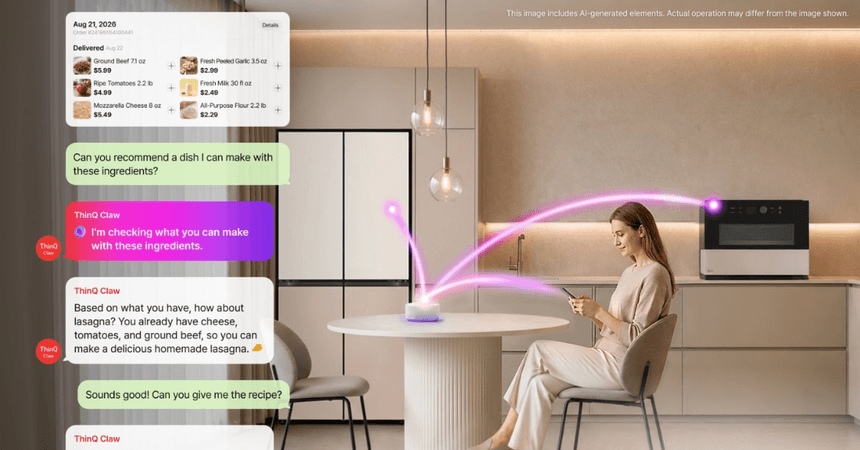
LG’s ThinQ Claw concept points to a more practical future for appliance AI: less about a single smart feature on one machine and more about coordinating food, laundry and home routines across devices.
The Korea Herald reported from IFA 2026 that Samsung and LG are pushing AI home systems beyond individual appliances. LG’s example centered on ThinQ Claw, an AI agent designed to plan meals, prepare the home before trips and coordinate connected products rather than simply respond to one command at a time.
That matters because consumers have often been sold “smart” appliances one product at a time: a refrigerator with a screen, a washer with an app, an oven with remote preheat. The next battle is whether those products can work together in a way that saves time instead of adding notifications.
What It Could Do for an Owner
For a refrigerator owner, a useful AI agent could connect what is in the fridge with meal planning, shopping lists and expiration reminders. For a washer owner, it could help choose cycles, estimate when laundry will finish and coordinate energy use with household routines.
The key word is “could.” Appliance AI is only helpful when it reduces work. If an owner has to correct inventory, approve every suggestion and manage multiple logins, the intelligence becomes another chore.
LG’s Homey Advantage
LG’s broader smart-home strategy is also tied to Homey. The Verge previously reported that LG acquired the company behind Homey and planned to use that technology to make ThinQ work with more third-party devices.
More Read
That cross-brand ambition could age better for appliance owners than a closed system, because most households do not buy every connected device from one manufacturer. A Whirlpool refrigerator, LG washer, Samsung TV and third-party thermostat may all need to coexist in the same home.
The Repair and Privacy Test
Serviceability will be the harder test. When an AI agent coordinates several products, a failure may not be clearly mechanical, electrical or software-based. Owners and technicians will need better diagnostics to know whether the issue is the appliance, the app, the cloud service or a third-party integration.
Privacy will matter too. Meal planning and travel preparation require sensitive household data. LG’s challenge is to make the system useful enough that owners trust it, but transparent enough that they know what data is being used and how to turn features off.