The appliance repair bill is becoming one of the clearest ownership-cost stories of 2026. The pressure is not coming from one source. Parts inflation, electronics-heavy designs, labor costs, warranty friction, uneven parts-availability promises and tougher repair-versus-replace decisions are all hitting the same place: the estimate a consumer sees before approving a repair.
- Repair-Cost Pressure Is Bigger Than One Brand
- Labor Is Not Just the Hour at the Door
- Warranty Friction Turns Cost Into Conflict
- Parts Availability Is the Missing Buying Spec
- Repair Versus Replace Is Now a Costly Gray Zone
- How Servicers Are Affected
- What Consumers Should Ask Before Approving a Repair
- The Buying Lesson Hidden in the Repair Bill
The warning signs are visible across the repair chain. Yonhap News Agency reported in July that Samsung Electronics raised repair-material prices supplied to Samsung Electronics Service for a second time in 2026, including an average 9% increase for Digital Appliances repair materials. The reported appliance examples included motors and compressors used in products such as air conditioners and washing machines.
That Samsung report should be read carefully. It verifies a Korean service-network price increase, not a universal U.S. parts schedule. But it is still a useful signal: when chips, motors, compressors and other components get more expensive, repair economics change even if the appliance was bought years earlier.
Repair-Cost Pressure Is Bigger Than One Brand
Modern appliances have more electronic decision-making than the appliances many consumers remember. Control boards, inverter modules, displays, sensors, smart-home radios, variable-speed motors, compressors, pumps and software-driven diagnostics can improve performance and efficiency. They can also make a single failed component expensive enough to change the repair decision.
Consumer Reports has long warned that the electronic control board and motor can be among the most expensive washing-machine parts to replace. That observation has become more relevant as more refrigerators, washers, dryers, dishwashers, ranges and HVAC-adjacent appliances rely on electronics to meet efficiency, noise, cycle and connectivity expectations.
Samsung Electronics Service’s own fee structure shows why parts matter. Its Korean service-fee guidance describes a paid service visit as a combination of parts cost, repair labor and travel charge. That basic formula is familiar to U.S. servicers, too. If the part cost rises, the estimate rises even when the technician’s time and trip charge stay the same.
More Read
That is why 2026 feels different. Consumers may still think of repair as “labor plus a part.” Servicers are increasingly quoting a bundle of diagnostics, truck cost, skilled labor, manufacturer authorization, freight, return risk, electronic parts and the possibility of a second trip if the first diagnosis is incomplete.
Labor Is Not Just the Hour at the Door
Labor pressure is not only about what a technician earns while standing in front of an appliance. It includes dispatch, insurance, training, warranty paperwork, vehicle costs, diagnostic subscriptions, call-center time, parts ordering, failed-part returns and unpaid travel between jobs.
Federal wage data underline that this is skilled work, not casual handyperson labor. The U.S. Department of Labor’s O*NET wage page, using Bureau of Labor Statistics 2025 data, lists home appliance repairers at a median wage of $24.51 per hour nationally, with the top 10% at $38.78 or more. Retail service departments and independent shops must price jobs above wage cost to cover the full overhead of running a repair operation.
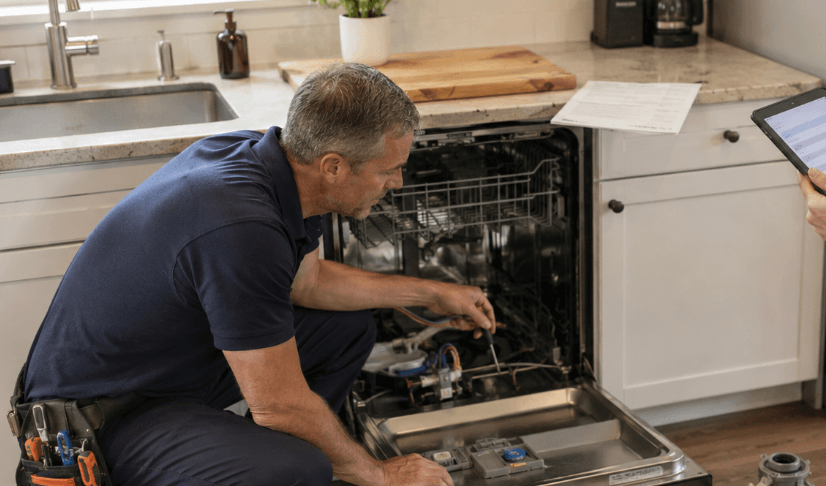
For servicers, the hardest repair is not always the most complex one. It is often the uncertain one: an intermittent cooling problem, a control-board fault that may be caused by another component, a sealed-system diagnosis, a nuisance water leak, a smart-feature failure or a no-error-code complaint that requires more time than the customer expected to pay for.
Those jobs create callback risk. If the servicer installs a costly part and the symptom returns, the shop may absorb a second trip, fight a warranty administrator, wait for manufacturer review or lose customer confidence. Higher parts prices raise the stakes of every borderline diagnosis.
Warranty Friction Turns Cost Into Conflict
Warranty and service-contract coverage can soften a repair bill, but they can also make the process slower and more frustrating. The Federal Trade Commission tells consumers that extended warranties and service contracts do not cover all situations or repairs, and that consumers should check limits, reimbursement amounts, maintenance requirements and the claims process before buying coverage.
That advice applies directly at the appliance repair counter. A consumer may hear “covered appliance” and assume the claim will pay for the full repair. The contract may instead exclude pre-existing conditions, improper installation, lack of maintenance, access work, shipping, labor above a cap, refrigerant, cosmetic parts or the second appliance in a home.
For servicers, warranty friction can mean authorization delays, lower reimbursement, disputed diagnoses or a parts-only approval that leaves the customer arguing about labor. For consumers, it can mean paying a service fee even when the final repair is denied or discovering that a coverage cap does not match the real cost of a compressor, board or motor repair.
The result is a trust problem. The technician may have given a fair estimate, the warranty company may be applying the contract, and the consumer may still feel trapped between a broken appliance and fine print they did not understand at purchase.
Parts Availability Is the Missing Buying Spec
A warranty and a parts-availability promise are not the same thing. A one-year warranty tells consumers what the manufacturer may pay for during the first year. A parts-availability commitment tells them whether the machine has a realistic path to repair after the warranty expires.
That distinction should matter more in 2026 because many high-cost failures happen after the basic warranty ends. A control board, compressor, inverter motor, user-interface panel, pump or specialty refrigerator component may be repairable only if the part still exists, can be ordered at a reasonable price and can be installed without unavailable software or documentation.
Miele is one of the clearest examples. Miele USA says its spare parts remain available for at least 15 years after a series ends production. Miele materials also describe a guarantee to supply functional spare parts for up to 15 years after discontinuation, with exceptions for digital products and process documentation. That kind of language gives consumers a useful ownership signal, even though it does not mean every repair will be inexpensive or that every part is sold directly to the public.
Other brands make different promises. Some publish long spare-parts availability goals. Some publish strong component warranties but no broad post-discontinuation parts guarantee. Some make parts available through factory service or authorized channels without promising a specific number of years for every appliance. Consumers should ask dealers to separate those concepts before buying.
| Brand or group | Published warranty signal | Published parts-availability signal | What consumers should ask |
|---|---|---|---|
| Miele | Miele USA lists a two-year domestic-appliance warranty. | Miele says spare parts remain available for at least 15 years after series production ends; Miele materials note exceptions for digital products and process documentation. | Does the 15-year commitment cover the exact functional part likely to fail, and will an independent servicer or only an authorized provider have access? |
| Bosch / BSH | Bosch U.S. warranty materials list a one-year entire-appliance parts-and-labor limited warranty, with some product-specific extended parts coverage such as registered motor coverage. | Bosch U.K. and Australia materials say large-appliance spare parts are generally available for up to 15 years; the U.S. spare-parts page sells OEM parts but does not present the same blanket U.S. guarantee in the materials reviewed. | Is the 15-year parts language valid for the U.S. model being sold, or only for other markets? |
| Sub-Zero, Wolf and Cove | Sub-Zero, Wolf and Cove describe competitive appliance warranties, and Cove residential materials show five years of parts-and-labor coverage for covered defects. | The company says it attempts to keep replacement parts in stock for 20 years for most products, while noting no formal guideline exists. | Which parts are normally stocked for the specific model, and is factory-certified service available locally? |
| Liebherr | Liebherr U.S. materials describe warranty coverage up to 12 years. | Liebherr says it has extended spare-parts availability from 10 to 15 years after the end of production of the respective model; its U.S. guarantee page says essential spare parts are kept well over 10 years. | Which essential parts are covered, and how quickly can the local service network obtain them? |
| Speed Queen | Speed Queen home-laundry warranty materials show multi-year coverage depending on product, including three years on dryers and seven years on much of some washer coverage in the referenced warranty bond. | No broad post-discontinuation parts-availability guarantee was identified in the public materials reviewed. | Which washer or dryer series carries which warranty, and how does the local dealer handle warranty labor? |
| Maytag | Maytag says many post-2017 major kitchen and laundry appliances carry a 10-year limited parts warranty on key components, in addition to the first-year coverage. | No broad public promise was identified that all functional spare parts remain available for a fixed number of years after model discontinuation. | Which exact components are covered for 10 years, and is labor excluded after the first year? |
| Electrolux | Electrolux warranty materials list first-year parts-and-labor coverage and additional laundry coverage such as lifetime inner wash tub and 10-year motor coverage, excluding labor. | No broad public fixed-year spare-parts availability guarantee was identified in the materials reviewed. | Does the long laundry warranty cover the failed part, and what labor or service-call charges remain? |
| Whirlpool / KitchenAid | Whirlpool materials describe one-year parts-and-labor coverage and, on some models, sealed refrigeration parts coverage in years two through five. KitchenAid says warranty length depends on appliance type and commonly starts with one year, with some product-specific longer component terms. | No broad public fixed-year spare-parts availability guarantee was identified in the materials reviewed. | Is the sealed-system or component warranty parts-only or parts-and-labor, and who can perform the repair? |
| GE Appliances | GE Appliances lists a one-year limited appliance warranty, while separate GE parts pages say purchased parts carry a one-year limited warranty. | GE sells genuine parts and promotes factory service, but no broad public fixed-year parts-availability guarantee was identified in the materials reviewed. | Are parts stocked locally or shipped, and does the one-year parts warranty include any labor if the replacement part fails? |
| LG | LG warranty terms vary by product, with many major appliances starting from one-year coverage and selected component terms depending on model. | LG sells genuine replacement parts and offers direct service, but no broad public fixed-year spare-parts availability guarantee was identified in the materials reviewed. | Which compressor, motor, control-board or sealed-system terms apply to the exact model, and does coverage include labor? |
| Samsung | Samsung says most appliances include a one-year manufacturer’s warranty for parts and labor, with product-specific coverage lengths. | Samsung materials emphasize authorized service and genuine parts during warranty coverage, but no broad public fixed-year post-discontinuation parts guarantee was identified in the materials reviewed. | What are the model-specific parts terms, and how quickly can authorized service obtain electronic boards or compressors? |
| Frigidaire | Frigidaire owner-support materials say most appliances have a one-year manufacturer’s limited warranty; some categories or markets list additional limited parts terms. | No broad public fixed-year spare-parts availability guarantee was identified in the materials reviewed. | Does the appliance have only a one-year warranty, or does that model include a longer component warranty? |
The table is not a ranking. It shows why shoppers should read warranty and parts language before they fall for a simple “10-year” sticker or a premium-brand reputation. A 10-year parts warranty may cover only specific components and may exclude labor. A 15-year parts-availability commitment may improve repair prospects but still leave the consumer paying diagnosis, labor, travel and the part price.
Repair Versus Replace Is Now a Costly Gray Zone
Consumer Reports’ right-to-repair survey shows how heavily cost drives repair decisions. CR found that seven in 10 consumers focused on repair cost when deciding whether to repair a product. Among consumers who did not repair a large appliance, 43% said it was too old to be worth repairing and 42% said replacement was more cost-effective.
That consumer behavior is exactly what servicers are seeing in the field. A $250 repair on a five-year-old dishwasher is an easier conversation than an $850 repair on a seven-year-old refrigerator with a history of ice-maker problems. A covered compressor part may still leave a customer facing labor, refrigerant and trip charges. A washer control board may make sense if the machine is otherwise clean and well maintained, but not if bearings, suspension or a drain pump are also suspect.
Parts availability can move that decision. If a functional part is guaranteed, stocked and reasonably priced, a seven- or eight-year-old appliance may still be repairable. If the part is discontinued, software-locked, backordered or available only as part of a costly assembly, replacement can become the default even when the cabinet, drum or tub still has useful life.
Yale Appliance’s 2026 service data adds another piece of context. The retailer says the average appliance it tracks needs service about 8.3% of the time in the first year, based on 33,190 service calls, and that the rate rises after the first year. That does not mean every appliance is unreliable. It means buyers should think about service access before the first breakdown, not after.
Repair-versus-replace is no longer just a math formula. It is a judgment about appliance age, part availability, local service capacity, product condition, warranty status, future failure risk, installation cost, disposal cost and how urgently the household needs the appliance working.
How Servicers Are Affected
Independent servicers and dealer service departments are caught between consumers who want lower repair bills and manufacturers or distributors whose parts pricing, authorization rules and product complexity they do not control. If the shop quotes too low, it eats the margin. If it quotes accurately, the customer may decline the repair and blame the servicer for the cost.
Parts inflation also changes inventory strategy. Stocking common parts helps speed repairs, but expensive boards, compressors and motors tie up cash. Special-ordering reduces inventory risk, but it can lengthen downtime and create customer frustration if the part is backordered, non-returnable or revised after diagnosis.
For warranty work, the pressure can be worse. A manufacturer or administrator may set a reimbursement schedule that does not reflect local labor cost, travel distance or the time needed for a modern electronic diagnosis. If a shop cannot make those jobs work economically, it may stop taking them, leaving consumers with fewer service options and longer waits.
- Diagnosis matters more: Costly electronic parts make guesswork dangerous for both the customer and the shop.
- Documentation matters more: Photos, error codes, readings and model/serial records help defend warranty claims and reduce disputes.
- Parts policy matters more: Return rules, freight, restocking fees, part revisions and post-discontinuation availability can change job profitability.
- Service access matters more: A brand with strong local parts and technician support may be cheaper to own than a brand with a lower shelf price.
What Consumers Should Ask Before Approving a Repair
The best consumer protection is not automatically saying yes or no to a repair. It is understanding what the estimate includes, what it does not include and what happens if the first repair does not solve the problem.
- What is the breakdown between diagnostic fee, labor, parts, travel, freight and taxes?
- Is the part in stock, special order, backordered or non-returnable?
- Does the manufacturer publish a spare-parts availability commitment for this model or product family?
- Is the failed part covered by a manufacturer, extended warranty or service contract, and does that coverage include labor?
- What evidence supports the diagnosis: error code, electrical reading, leak test, temperature log, visual damage or service bulletin?
- What warranty does the servicer provide on the repair and on the installed part?
- What happens if the same symptom returns after the repair?
- How does the repair cost compare with a comparable replacement, including delivery, installation, haul-away and any new accessories?
- Are there other known issues with the appliance that could make this repair only a temporary fix?
The Buying Lesson Hidden in the Repair Bill
The repair-cost story should change how consumers buy appliances. The sticker price is only the first number. Shoppers should ask who services the brand locally, how long key parts are available, whether the retailer has its own service department, what the warranty really covers and whether premium electronics improve daily use enough to justify the future repair exposure.
At the sales counter, consumers should ask two separate questions: how long is the warranty, and how long does the manufacturer expect to support functional spare parts after this model leaves production? The first question protects the early ownership period. The second determines whether the appliance has a practical repair path later in life.
Manufacturers also have a role. If efficient, connected and software-driven appliances are the future, the industry needs parts access, diagnostic clarity, fair warranty reimbursement and documentation that lets technicians repair rather than replace entire assemblies unnecessarily.
The repair bill is where all of those choices become visible. In 2026, appliance owners are learning that a modern appliance can be efficient, quiet and feature-rich — and still be expensive to fix when the wrong component fails or the right part cannot be obtained.